


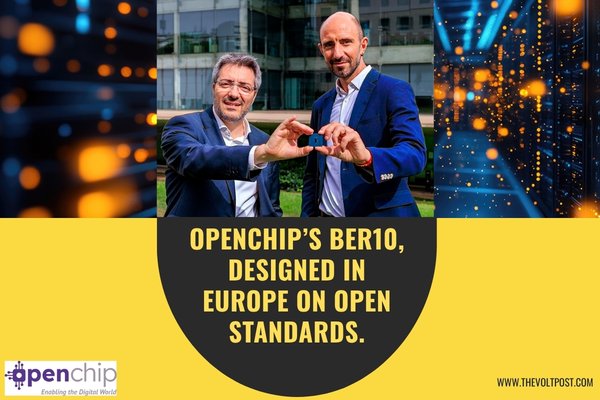
Openchip has rolled out BER10, a fully functional, Linux-capable 64-bit processor built on a leading-edge sub-2nm Gate-All-Around (GAA) manufacturing process. Designed and developed in Europe, BER10 is positioned as industrial-grade silicon for banks, hospitals, public institutions and other critical sectors that need control over the hardware running their most sensitive data.
From Zero to Silicon in 2.5 Years
The company started from scratch in early 2024, no team, no offices, no IP portfolio. It assembled engineering talent, tools and architectures in Europe, taped out its first chip in 2025 and now has finished silicon in hand.
Openchip stresses that BER10 is not an academic prototype or research demonstrator, but production-ready silicon built on the same advanced process used in today’s data centers and critical infrastructure.
Why BER10 Matters for Europe
For decades, Europe’s most advanced computing technology has been designed, controlled and licensed outside the continent. Every hospital, bank, factory and public body that wants to run modern, AI-powered workloads has had to rely on foundations it doesn’t own and can’t fully inspect.
BER10 is built on RISC-V, an open instruction set architecture not owned by any single company or country.
That openness means Europe can design, verify and control its own processors without depending on black-box architectures or foreign licensing terms. As more services move to AI and cloud infrastructure, the question of who can see data and whose hardware it runs on, becomes a matter of privacy, security and autonomy, not just a technical detail.
What’s Under the Hood
BER10 is a compact but powerful processor:
-
Four high-performance CPU cores capable of running a full Linux OS, the same software foundation used in data centers and cloud servers worldwide.
-
Out-of-order, multi-issue execution so cores can run multiple instructions in parallel and avoid idle wait time.
-
A wide vector processing unit tailored for math-heavy workloads such as AI, image processing and scientific computing.
-
Fast, multi-channel memory plus high-speed PCIe and AXI links, similar to the high?bandwidth interconnects inside modern servers and data centers.
A Platform, Not Just a Chip
The company describes BER10 as a first step toward a broader roadmap of RISC-V compute accelerators for supercomputing and AI at data-center scale.
The company is now focused on its first data-center product, built on the core blocks proven in BER10, and is working with strategic partners to bring that product to market as quickly as possible.
Longer?term, Openchip is conducting pathfinding research with the Barcelona Supercomputing Center to shape its technology roadmap, aiming to give Europe the infrastructure it needs to run its own AI on its own terms and compete as a serious player in the global compute market.
 Leadership Comment
“When we started the company, the goal was never just to build a chip, but to prove that Europe can design and deliver world-class silicon on open standards, on its own terms,” said Cesc Guim, CEO of Openchip. “BER10 is that proof, made real. It’s a foundation for the digital sovereignty Europe needs, built on a more open and resilient value chain that ultimately benefits the global technology industry.”
Andrea Gallo, CEO of RISC-V International, called BER10 confirmation that “2026 is the year of highly powerful RISC-V application processor silicon” and that the architecture has moved beyond experimentation into high-performing, industrial-grade, real-world computing. He said seeing a European team deliver Linux-capable silicon of this caliber reflects the momentum across the global RISC-V ecosystem and is exactly the kind of innovation an open standard is meant to enable.