




Japanese Researchers Unlock New Method to Control Electronic Materials Using Counterions.
Designing smarter, more responsive electronic devices just got a major boost. Researchers in Japan have discovered a way to control the molecular shape and electronic behavior of specialized materials simply by swapping out their interacting ions.
The breakthrough tackles a long standing challenge in materials science. While scientists know that electronic materials change behavior when interacting with surrounding ions, controlling those exact effects has been difficult. Now, a research team from Ritsumeikan University has developed a new class of ?-electronic cations where the “counteranion” directly dictates the molecule’s physical shape, its response to physical pressure, and how fast it transfers electrons.
Published in the journal Chemical Science on August 17, 2026, the study was spearheaded by Professor Hiromitsu Maeda, alongside Professors Yohei Haketa and Yoichi Kobayashi from Ritsumeikan University, and Professor Gaku Fukuhara from Kyushu University.
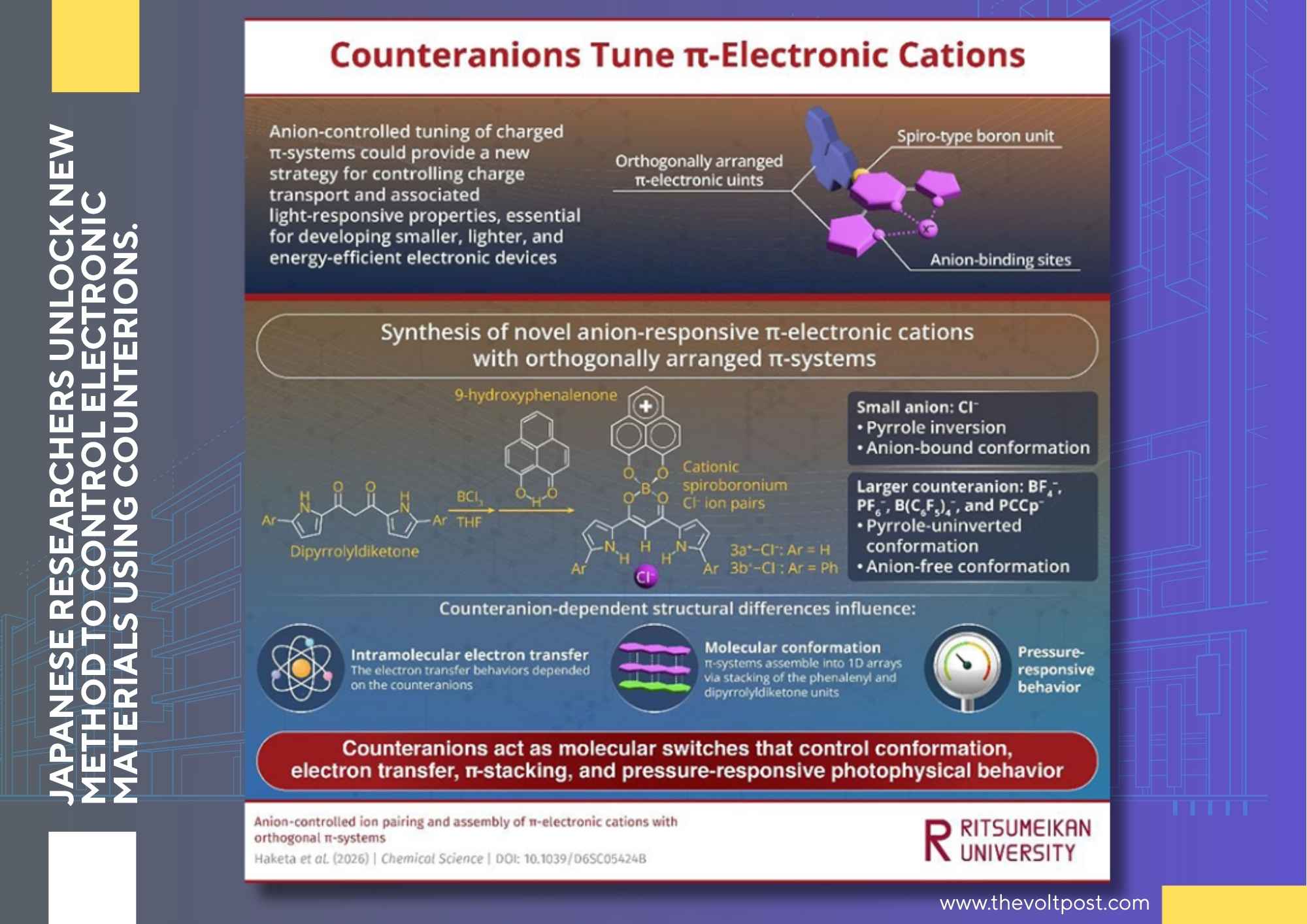
To achieve this level of control, the team engineered unique molecular structures that combine both electron-donating and electron-accepting units. Building on previous research, they successfully incorporated a phenalenyl unit into a boron based framework. From there, they tested what happens when they switch the paired ions. The team started with chloride pairs and then systematically exchanged them for larger ions like BF4-, PF6-, and B(C6F5)4-.
The results were immediate and striking. The choice of counteranion completely altered the physical shape of the anion binding unit. When bound with chloride, two of the molecule’s pyrrole rings were forced to invert. However, introducing larger counteranions allowed the structure to relax into an unbound conformation. The research team confirmed these distinct structural and electronic shifts using nuclear magnetic resonance and UV/visible spectroscopy.
This shape shifting has a direct impact on how the material performs, particularly when exposed to light and pressure. When the molecules were photoexcited, the speed of their electron transfer shifted entirely based on the ion present. The chloride complex reacted incredibly fast, clocking in quicker than the 150 femtosecond limit of the team’s instruments. Meanwhile, larger ions like B(C6F5)4- slowed the electron transfer to a 200 femtosecond time constant.
The molecules also demonstrated a reversible response to hydrostatic pressure up to 280 MPa. As pressure increased, the materials showed gradual red shifts in their light absorption spectra. The larger the ion, the more sensitive the material was to these pressure changes, largely because chloride binding made the overall molecular structure too rigid.
When examined in a solid state, single-crystal X-ray analysis revealed that these molecules neatly organize themselves into one dimensional arrays, stabilized by favorable electrostatic interactions.
Ultimately, this research proves that fine-tuning molecular behavior is entirely possible just by selecting the right counteranion. This level of molecular control provides a fresh blueprint for developing next generation smart materials. The findings are expected to accelerate the creation of highly tunable pressure sensors, molecular switches, and advanced charge transport systems, paving the way for smaller, lighter, and far more energy efficient electronic devices.
Key Comment
“By introducing a phenalenyl unit into our previously studied anion-responsive molecular framework, we were able to create a cationic ?-electronic system with two orthogonally arranged components,” says Prof. Maeda. “We expected that this arrangement would allow counteranions to influence molecular conformation, electronic states, and subsequent photophysical behavior.”
“Counteranions are often viewed simply as charge-balancing partners, but our results show that they can actively control molecular behavior,” says Prof. Maeda. “This ability to regulate electron transfer and pressure-responsive photophysical properties could help establish new design strategies for stimulus-responsive electronic and photophysical materials.”
Reference
Title of original paper: Anion-controlled ion pairing and assembly of ?-electronic cations with orthogonal ?-systems
Journal: Chemical Science
DOI: 10.1039/d6sc05424b
Website: http://en.ritsumei.ac.jp/
Ritsumeikan University Research Report: https://www.ritsumei.ac.jp/research/radiant/eng/
About Professor Hiromitsu Maeda from Ritsumeikan University, Japan
Prof. Hiromitsu Maeda is a Professor in the Department of Applied Chemistry, College of Life Sciences, Ritsumeikan University, Japan and a Fellow of the Ritsumeikan Advanced Research Academy (RARA).
He earned his Ph.D. from Kyoto University in 2004, following a three-month research stay at the University of Texas at Austin in 2001. He joined Ritsumeikan University’s College of Science and Engineering in 2004 and transferred to the College of Pharmaceutical Sciences in 2008, becoming a Professor in 2014.
He moved to the College of Life Sciences in 2016 and has held several additional research appointments in Japan and abroad.
Funding information
This work was supported by JSPS KAKENHI Grant Numbers JP18H01968, JP22H02067, and JP23K23335 for Scientific Research (B); JP24K08389 for Scientific Research (C); JP23K17951 for Challenging Research (Exploratory); and JP20H05863 for Transformative Research Areas (A) “Condensed Conjugation,” the Cooperative Research Program of “Network Joint Research Center for Materials and Devices (MEXT),” and the Ritsumeikan Global Innovation Research Organization (R-GIRO) project (2017–22 and 2022–27).
Theoretical calculations were partially performed using the Research Center for Computational Science, Okazaki, Japan (Projects: 23-IMS-C069, 24-IMS-C067, 25-IMS-C069, and 26-IMS-C067).
Synchrotron-radiation analysis was performed at BL40XU (2023A1240, 2023B1390) and BL02B1 (2023A1645) of SPring-8 with the approval of the Japan Synchrotron Radiation Research Institute (JASRI).