



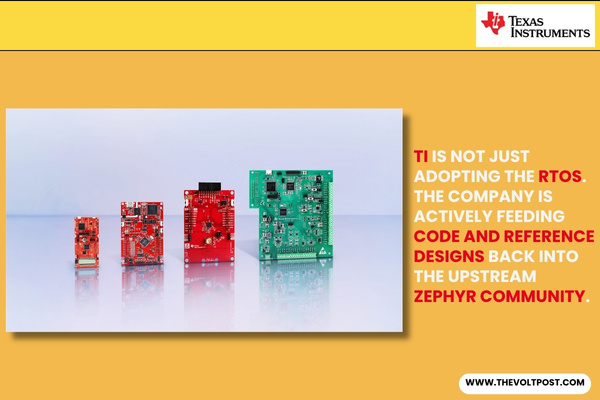
Texas Instruments is officially throwing its weight behind the Zephyr Project. The semiconductor giant announced that its entire embedded portfolio, spanning microcontrollers, microprocessors, and wireless connectivity devices, is now fully supported on the open source real time operating system.
For embedded developers, changing silicon vendors usually brings the massive headache of rewriting code to fit a completely different software ecosystem. TI is using Zephyr to eliminate that friction.
Engineers can now migrate to TI hardware without disrupting their existing open source workflows or toolchains, gaining access to a much broader hardware portfolio under a single development environment.
The shift also directly addresses mounting regulatory pressures. Designed to comply with the European Union Cyber Resilience Act, the unified platform helps developers de-risk their long term roadmaps.
Because Zephyr is backed by the Linux Foundation, TI will push regular updates to its software development kits to patch security vulnerabilities and ensure products remain reliable and compliant for years.
TI is not just adopting the RTOS. The company is actively feeding code and reference designs back into the upstream Zephyr community.
This upstream first approach means the community vets all TI code before any official SDK release, guaranteeing developers a stable codebase that will not shift unexpectedly during a product ramp up.
Beyond platform stability, developers get immediate access to new resources and features through continuous integration and deployment on public GitHub repositories well before they hit the final SDK.
Combined with extensive migration guides and standard 10 year life cycle support for TI silicon, the Zephyr integration offers a flexible and highly secure path for building the next generation of its embedded portfolio and embedded systems.
Leadership Comments
“With TI and Zephyr, developers get everything they need to design and scale with ease across our full MCU, MPU and wireless connectivity portfolios,” said Marian Kost, vice president and general manager of Wireless Connectivity at TI. “They can stay in the open-source workflow that they know on the TI silicon they trust, leveraging the hardware  breadth, software support and supply reliability needed to take a design from prototype to production.”
“A vendor-neutral RTOS only works when companies build on it together, and Texas Instruments making its broad portfolio available on Zephyr is a strong example of that commitment,” said Kate Stewart, Vice President of Dependable Embedded Systems at the Linux Foundation. “Developers can design across TI’s MCUs, MPUs and wireless devices on a common, upstream-first platform, backed by a community that takes security and long-term maintenance seriously.”
For more information, see ti.com/zephyr.