

As geopolitical tensions rise and global supply chains face ongoing disruptions, India’s approach to energy security has never been more critical. While the country has made massive strides in its green transition, its continued reliance on imported fossil fuels leaves Indian industries exposed to sudden price volatility and international market shocks. Today, ensuring energy security is no longer just about keeping the lights on rather it is a strategic imperative for business survival, cost competitiveness, and long-term resilience.
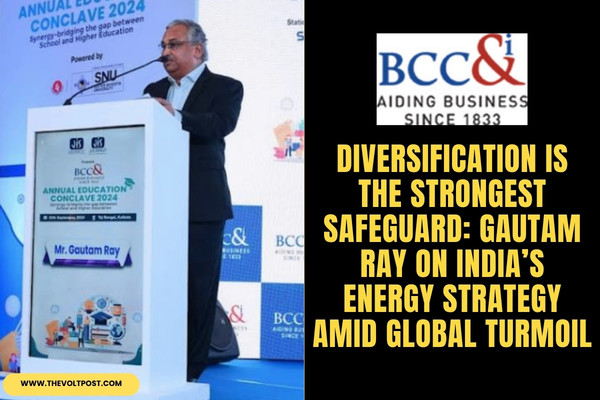
To decode how India can navigate this turbulent global landscape, Mr. Gautam Ray, Former President, BCC&I, and Former President – Corporate, RPSG Group, spoke exclusively to Niloy Banerjee of The Volt Post.
Here is his perspective on mitigating geopolitical risks, fortifying industrial supply chains, and driving India’s journey toward a self-reliant energy future. Read The Edited Volt Excerpts Below.
How do you assess India’s energy security amid growing geopolitical uncertainty and global supply disruptions?
India has made remarkable progress in strengthening its energy security while advancing towards its Net Zero commitments. Renewable energy capacity has now crossed 300 GW, accounting for nearly half of the country’s installed power generation capacity.
However, energy security is an evolving journey rather than a destination. India continues to remain a net importer of crude oil and natural gas, making diversification of import sources a strategic priority.
Alongside diversification, long-term energy security will depend on energy conservation, improved energy efficiency, accelerated adoption of alternative fuels, and greater public awareness about responsible energy consumption.
A balanced mix of domestic renewable resources, resilient infrastructure, and diversified global partnerships will enhance India’s ability to withstand geopolitical disruptions.
What does energy security mean for Indian businesses beyond ensuring uninterrupted power supply?
For Indian businesses, energy security extends well beyond uninterrupted electricity supply. It encompasses affordability, resilience, sustainability, and long-term competitiveness.
Companies are increasingly investing in energy efficiency, renewable energy procurement, distributed generation, energy storage, and digital energy management systems.
These measures reduce operating costs, minimise exposure to fuel price volatility, and strengthen supply-chain resilience.
Energy security today is a strategic business imperative that supports productivity, regulatory compliance, ESG commitments, and global competitiveness.
How can India reduce its exposure to global energy price volatility while maintaining industrial competitiveness?
While global energy prices are influenced by geopolitical and market forces beyond India’s control, the country can reduce its vulnerability through a well-planned energy transition.
Greater reliance on indigenous renewable resources, decentralised energy systems, diversified fuel sources, and digital energy management will reduce import dependence.
The ‘3D Energy Strategy’ – Decentralisation, Decarbonisation, and Digitalisation provides a practical framework for strengthening industrial competitiveness while ensuring affordable and reliable energy.
What role can Indian industry and trade associations like BCC&I play in strengthening the country’s energy resilience and supporting Atmanirbhar Bharat?
BCC&I has consistently played a proactive role in policy advocacy, industry dialogue, and knowledge dissemination on energy security and sustainability.
The Chamber has organised thematic sessions on renewable energy, electric mobility, circular economy, and Net Zero pathways, including participation in COP26 discussions in Glasgow.
Through its annual Environment and Energy Conclave and various sectoral platforms, BCC&I brings together policymakers, industry leaders, academia, and technology providers to accelerate sustainable industrial transformation.
Such collaborative platforms are essential for supporting Atmanirbhar Bharat and India’s clean energy ambitions.
Do you think geopolitical tensions are changing the way Indian companies approach energy sourcing and supply-chain risks?
Yes. Recent geopolitical developments have encouraged Indian companies to diversify both energy sourcing and supply chains.
Businesses are reducing dependence on single-region suppliers, exploring renewable power purchase agreements, investing in captive renewable assets, and strengthening energy storage capabilities.
These strategies improve resilience while supporting India’s long-term energy transition goals.
Where do you see the biggest vulnerabilities in India’s energy supply chain today?
The primary vulnerability remains India’s dependence on imported fossil fuels, particularly crude oil, natural gas, and LPG.
Other challenges include transmission and distribution losses, uneven infrastructure development, storage limitations, and inefficient energy consumption.
Addressing technical and commercial losses, expanding strategic reserves, strengthening grid infrastructure, and promoting responsible energy use will significantly improve supply-chain resilience.
Can greater diversification of energy sources and suppliers help Indian industry manage geopolitical risks more effectively?
Absolutely. Diversification is one of the strongest safeguards against geopolitical risk. Expanding renewable energy, green hydrogen, biofuels, nuclear power, domestic gas production, and multiple international energy partnerships reduces concentration risk and enhances energy resilience for Indian industry.
What lessons should Indian businesses take from recent disruptions in global energy and commodity markets?
Recent disruptions have demonstrated that resilience must be built into business strategy.
Indian companies should prioritise energy efficiency, cleaner production technologies, decentralised renewable energy, and digital monitoring of energy consumption.
Investments in low-carbon technologies will not only reduce costs over time but also improve compliance with emerging global sustainability standards and carbon-related trade regulations.
How can India balance energy affordability and reliability with its transition toward a lower-carbon economy?
Balancing affordability and sustainability requires integrated planning. Large-scale renewable energy deployment must be complemented by grid modernisation, energy storage, flexible generation, demand-side management, and digital technologies.
This integrated approach will help maintain reliable power supply while progressively reducing carbon emissions.
What opportunities do you see for Indian companies in building domestic capabilities across clean energy and emerging energy technologies?
India’s clean energy transition presents significant opportunities in manufacturing, innovation, and technology leadership.
Domestic capabilities in battery storage, green hydrogen, power electronics, smart grids, EV ecosystems, and indigenous materials for energy storage can reduce import dependence while creating global export opportunities.
India’s skilled workforce, strong engineering base, and expanding power grid position the country well to become a global hub for clean energy technologies.
According to you, what policy measures would industry most urgently like to see to strengthen India’s long-term energy security?
Industry would benefit from stable, long-term policy frameworks that encourage investment in renewable energy, energy storage, grid infrastructure, green hydrogen, and energy efficiency.
Faster regulatory approvals, improved financing mechanisms, domestic manufacturing incentives, and stronger public-private partnerships will accelerate India’s energy transition while enhancing long-term energy security.
How can government, industry, and BCC&I work together more effectively on energy infrastructure, investment, and technology adoption?
India’s energy transition requires a collaborative ecosystem. Government can provide enabling policy and infrastructure, industry can drive investment and innovation, and BCC&I can serve as a bridge between stakeholders.
Through policy advocacy, capacity building, industry consultations, and pilot projects, BCC&I is committed to facilitating technology adoption and accelerating sustainable industrial growth.
What role can industry chambers play in bringing businesses, policymakers, technology providers, and investors together around energy security?
Industry chambers play the role of trusted convenors and knowledge partners. They facilitate dialogue, promote best practices, support policy development, enable capacity building, and encourage pilot demonstrations of emerging technologies.
BCC&I will continue to contribute through national forums, sustainability initiatives, and partnerships that advance India’s energy security and Net Zero transition.
Disclaimer: The views, thoughts, and opinions expressed in this interview are solely those of the speaker, Mr. Gautam Ray, and do not necessarily reflect the official stance, policy, or position of The Volt Post. The Volt Post assumes no responsibility or liability for the accuracy, completeness, or validity of any statements made herein.