



At its 2026 Technology Open Day, Shenzhen-based Hesai pulled back the curtain on the Picasso SPAD-SoC chip and the ETX 6D full-colour LiDAR platform, aiming to refocus the conversation in the automotive sensing world, from “how many lines” to “how rich and usable is the data.”

Hesai Technology has just launched what it calls the world’s first “6D full-colour” LiDAR chip and platform, pushing the sensor’s output from raw 3D geometry to vivid, colour-rich point clouds that behave closer to human vision than to a robotic wireframe.
At its 2026 Technology Open Day, Shenzhen-based Hesai pulled back the curtain on the Picasso SPAD-SoC chip and the ETX 6D full-colour LiDAR platform, aiming to refocus the conversation in the automotive sensing world, from “how many lines” to “how rich and usable is the data.”
What “6D full-colour” really means
Hesai’s Picasso SPAD-SoC fuses colour sensing and time-of-flight ranging at the pixel level, on a single chip. Instead of bolting a camera on top of a LiDAR and stitching data later, the sensor itself generates native 3D spatial coordinates (X, Y, Z) plus object colour (RGB) in one coherent stream.
Hesai calls this “6D full-colour” because the system captures not just position and shape, but also reflectivity, velocity, and, crucially, colour information directly from the sensor.
This means a car equipped with Picasso-based LiDAR can distinguish a red traffic light from a green one, read construction signs, and tell the difference between a trash-can-coloured obstacle and a dark-coloured vehicle without relying on camera post-fusion tricks.
Hardware that pushes the envelope
The Picasso chip clocks a photon detection efficiency (PDE) above 40%, a figure Hesai claims sits at international top-tier levels. In practical terms, that enables longer detection ranges, better visibility of small or low-reflectivity targets, and cleaner perception in low-light environments, all under the same laser-power budget.
On the platform side, the new ETX 6D full-colour LiDAR offers flexible line configurations:
- 1,080 line
- 2,160 line
- Up to 4,320 lines, roughly 3–4× higher resolution than many current flagship automotive LiDARs.
Key specs Hesai highlighted include:
- Maximum detection range: 600 m
- Stable detection at 10% reflectivity: 400 m
- Water barrier recognition (120×60 cm): up to 300 m
- Small animal recognition (60×40 cm): up to 280 m
- Small wooden block recognition (15×25 cm): up to 150 m
Tackling noise, missed detections, and false alarms
All that extra resolution and colour data would be useless if it turned into noisy garbage at the edge. To that end, ETX layers in Hesai’s Photon Isolation 2.0 technology, which tightly couples the SPAD-SoC hardware design with intelligent algorithms.
The goal is to slash false alarms and missed detections, preserving the high-resolution fidelity while keeping the compute load manageable for real-world ADAS and autonomous stacks.
Inside the platform, Hesai also stresses that pure line count is no longer the only metric that matters. Resolution, ranging capability, noise ratio, and field of view all play a role in how usable the data is for decision-making at highway speeds or dense urban scenarios.
Why this shift matters for autonomy
For EV and ADAS teams, Hesai’s new rollout can break the boundary between LiDAR and camera-level imaging. The ability to produce native full-colour point clouds simplifies perception pipelines, reduces the need for heavy post-processing of camera data, and can help avoid some of the classic corner-cases where colour-blind LiDAR and camera fusion struggle.
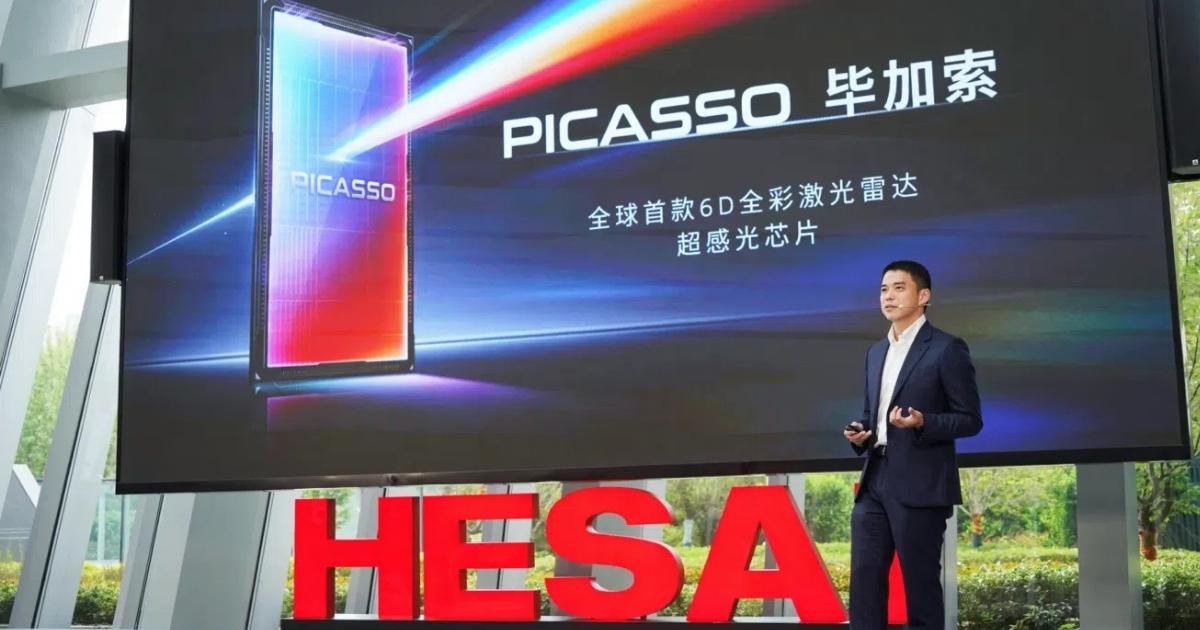
According to Hesai CEO David Li Yifan, this isn’t just a marketing gimmick but a “fundamental innovation” that no other LiDAR player has pulled off yet. The company expects the Picasso-powered ETX sensors to begin mass production in the second half of 2026, with integration into multiple flagship vehicle programs stretching into 2027 and 2028.
A nudge toward “spatial intelligence”
Hesai is also framing this as part of a broader strategic pivot from “spatial perception” to “spatial intelligence.”
Beyond the Picasso chip and ETX platform, the company has introduced its Kosmo spatial intelligence AI hardware platform and robotic power modules, aiming to wrap sensing, compute, and actuation into a more cohesive hardware stack for the “physical AI” era.
To Know More: CLICK HERE