



Synopsys Unveils AgentEngineer and Autopilot Platform to Bring Autonomous AI to Chip Design.
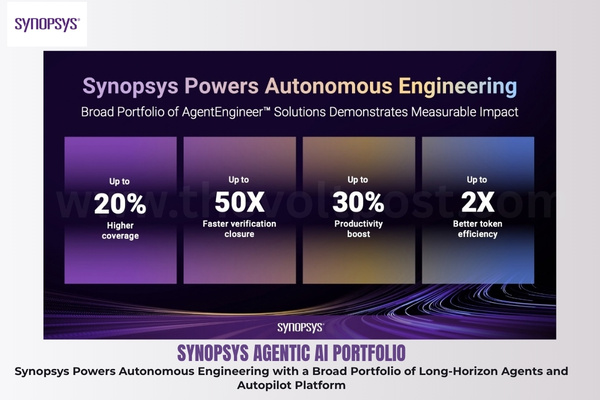
In a major push to automate the increasingly complex world of semiconductor design, Synopsys has rolled out its new AgentEngineer solutions, backed by the purpose-built Synopsys Autopilot™ Platform.
The launch signals a significant industry shift from simple AI-assisted tools to fully autonomous engineering. Designed to handle long-horizon tasks across the entire “silicon-to-system” lifecycle, these new AI agents can actively reason, plan, and execute massive workflows spanning verification, implementation, analog design, manufacturing, and complex simulations.
By tying these capabilities together into a single environment, Synopsys aims to help engineering teams hit design closure faster and improve overall quality, all while reducing latency and optimizing AI token efficiency.
Task-Level Precision Meets Broad Orchestration
Instead of just offering piecemeal automation, Synopsys is giving engineering teams a unified brain. At the ground level, specialized task agents handle the heavy lifting for targeted engineering hurdles.
Whether a team is trying to manage multi-die 3DIC assembly, navigate analog layout synthesis, drive autonomous coverage closure, or crunch signal integrity simulations, these agents are trained directly on Synopsys’ industry-leading EDA and simulation engines.
Together, the long-horizon and task-level agents coordinate seamlessly to knock out cross-domain workflows that historically required tedious, manual handoffs.
The Engine Under the Hood: Synopsys Autopilot
Powering this entire ecosystem is the Synopsys Autopilot Platform. Serving as the foundational command center, it handles everything from AI orchestration and skill management to persistent memory and enterprise-grade governance.
Crucially, Autopilot doesn’t lock users into a walled garden. It’s built for true optionality, allowing companies to plug in third-party models, infrastructure, and partner agents without compromising data integrity.
To ensure it meets the rigorous demands of modern chipmakers, the platform leans on a few core pillars:
- Contextual Intelligence: By combining persistent memory with Synopsys’ proprietary cognitive model, the AI doesn’t just blindly follow prompts—it actually understands underlying design intent to better guide workflows.
- Hyper-Efficiency: Through privileged APIs and deep reasoning, the platform delivers superior engineering outcomes while significantly cutting down on token consumption and processing latency.
- Ironclad IP Security: With flexible architecture, strict access controls, encryption, and runtime guardrails, the platform is built from the ground up to protect highly sensitive customer and partner intellectual property.
By handing the reins to domain-specific AI, Synopsys is offering semiconductor teams a practical way to keep pace with relentless market demands without buckling under the weight of modern system complexity.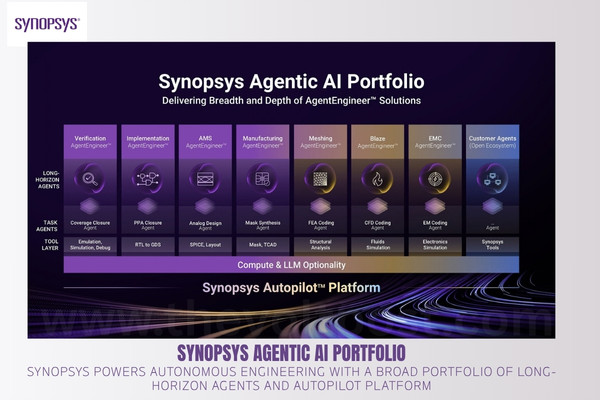
Leadership Comment
“Our customers are re-engineering their engineering workflows across semiconductor and systems products to keep pace with increasing system complexity and tight market windows,” said Ravi Subramanian, Chief Product Management Officer at Synopsys. “Synopsys’ portfolio of AgentEngineer solutions and the Autopilot Platform enable customers to accelerate their shift from AI-assisted design to autonomous engineering, built on trusted EDA and simulation and analysis engines.”
Advancing Autonomous Engineering at Scale Industry Collaborations
Beyond automating individual tasks, the Synopsys Autopilot Platform helps engineering teams accelerate entire workflows from design through verification and systems development. Engagements with leading companies are validating the promise of autonomous engineering and demonstrating meaningful improvements in productivity, design quality, and workflow closure.
“As a fast-growing innovator developing next-generation processor architectures, we are continually looking for new ways to accelerate engineering execution and improve productivity across our design workflows,” said Alon Mahl, VP of Verification, AheadComputing. “The Synopsys AgentEngineer technology extends AI beyond task assistance to help automate complex workflows and accelerate engineering execution. From RTL handoff through implementation, ECO, and signoff, the Synopsys Implementation AgentEngineer helped us reduce manual engineering effort and accelerate design convergence, enabling our engineering teams to focus more time on the differentiated aspects of our processor architecture.”
“We achieved a 10–30% productivity boost in RTL code generation with Synopsys Verification AgentEngineer capabilities,” said Toshio Yoshida, Senior Vice President and Head of the Advanced Computing Development Unit at Fujitsu. “This was driven by highly efficient generation of SystemVerilog assertions, wrapper modules, and parameterized modules, as well as code refactoring.”
“Advancing the productivity and efficiency of our verification teams is critical as design complexity continues to increase across next-generation computing platforms,” said Manoj Selva, Vice President, Product Enablement, Intel. “Our work with Synopsys Verification AgentEngineer technology highlights the promise of agentic AI for debug, enabling engineers to accelerate issue resolution across verification environments. We believe these advancements can help reduce verification bottlenecks, improve engineering efficiency, and accelerate the delivery of our silicon innovations.”
“Our engineers have consistently pushed the boundaries of analog and mixed-signal design and are continuously looking for ways to dramatically enhance design and layout productivity,” said Ching San Wu, Vice President of MediaTek. “Building on the successful deployment of Synopsys SmartFloorplanning Technology, we are continuing our collaboration with Synopsys on the Agentic AI AMS Platform, driving the next frontier of autonomous analog engineering flows. We believe this transformative technology will fundamentally reshape how our teams create, optimize, and implement complex AMS designs.”
“Autonomous engineering requires AI agents that understand design intent, plan and execute complex workflows, and validate their results,” said Tim Costa, Vice President and General Manager of Industrial and Computational Engineering at NVIDIA. “Synopsys is combining its silicon-to-systems expertise with NVIDIA accelerated computing and NVIDIA Agent Toolkit, including NVIDIA Nemotron models and the NVIDIA OpenShell secure runtime, to build long-running agents that help engineers improve design quality and accelerate development.”
“Breakthroughs in AI increasingly depend on breakthroughs in memory: the industry calls for higher bandwidth, greater efficiency, and faster innovation cycles,” said JY Choi, Executive Vice President and Head of Memory Design Technology at Samsung Electronics. “Synopsys agentic AI solutions are helping Samsung’s engineering teams accelerate complex development workflows, allowing us to focus more effort on innovating the advanced memory technologies that power the next generation of AI infrastructure.”
“As AI drives the shift to multi-die architectures with unprecedented power densities, increasingly complex power delivery networks demand new approaches for power integrity signoff,” said Aveek Sarkar, Director of the Ecosystem and Alliance Management Division at TSMC. “Through our enduring partnership with Open Innovation Platform® (OIP) ecosystem partners like Synopsys, we are successfully enabling agentic AI-based solutions to accelerate critical power integrity analysis workflows. As advanced packaging designs rapidly grow in scale and complexity, these AI-based solutions significantly boost engineering productivity and enable groundbreaking designs for next-generation AI systems.”
Availability and Resources
More than 50 engagements are underway with Synopsys AgentEngineer solutions and the Autopilot Platform, with availability planned for the end of 2026.
To Know More About Synopsys AgentEngineer Solutions And The Autopilot Platform: CLICK HERE