As AI GPU clusters demand massive amounts of power, data centers are rapidly shifting toward 800V DC rack architectures to push density and distribution efficiency higher. To speed up that transition, Microchip Technology and Navitas Semiconductor have joined forces to launch a direct 800V-to-6V DC reference design aimed squarely at next-gen AI infrastructure.
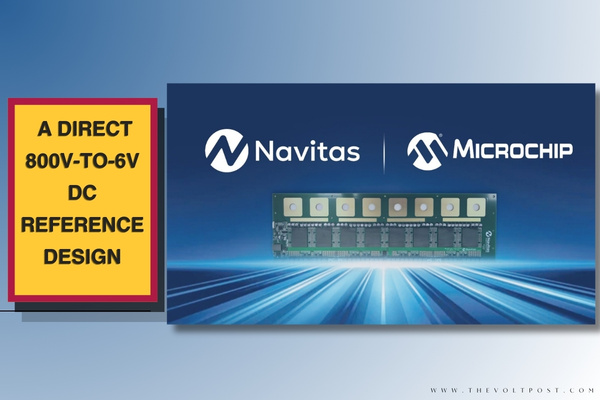
The new 800V DC-to-6V DC reference design bridges Microchip’s digital control and security ICs with Navitas’ GaNFast™ gallium nitride (GaN) power devices.
It gives engineering teams a practical, ready-to-use blueprint for implementing power conversion aligned with the Open Compute Project (OCP) 800V standard.
By bundling the hardware, software, and design docs, the collaboration is designed to cut development time and lower design risk.
Direct Conversion and High-Density GaN
The power delivery board (PDB) punches well above its weight by converting directly from 800V down to 6V. Bypassing the traditional 50V intermediate stage fundamentally boosts end-to-end efficiency.
Under the hood, the primary side uses a stacked half-bridge topology featuring 16 of Navitas’ NV6034 (650V, 17m?) GaNFast FETs.
Housed in dual-side-cooled DFN8×8 packages, the setup keeps thermal resistance low while allowing high continuous power. Therefore, the board hits 96% peak efficiency at full load with a 1 MHz switching frequency, enabling an impressive power density of 2,100 W/in³.
It’s also incredibly thin. At about 20% thinner than a modern smartphone, the ultra-low-profile board can be integrated right next to the GPU. This proximity is critical for maximizing transient performance and minimizing distribution losses.
Precision Control Meets Hardened Security
To manage the high-frequency switching, the design relies on Microchip’s dsPIC33AK Digital Signal Controllers (DSCs).
These 200 MHz, 32-bit controllers deliver deterministic digital power control using a double-precision floating-point unit, ultra-fast 78-picosecond PWMs, and 40 MSPS ADCs.
They also bring serious cryptographic muscle to the table, featuring hardware acceleration and library support for CNSA Suite 2.0 post-quantum algorithms.
Because connected power supplies are increasingly prime targets for cyberattacks, hardware-based security is integrated natively via Microchip’s TA100 CryptoAuthentication™ IC.
The TA100 acts as a hardware root of trust, handling code authentication, secure boot, trusted firmware updates, and TLS key management right out of the box, saving developers the headache of building these defenses from scratch.
Ultimately, by fusing Navitas’ GaN performance with Microchip’s control and security architecture, the reference design gives developers a fast track to deploy the compact, high-efficiency 800V DC systems today’s AI data centers desperately need.
Key Comments
“AI infrastructure optimization is driving one of the most significant power architecture transitions the data center industry has experienced in decades,” said Joe Thomsen, corporate vice president of Microchip’s digital signal controller business unit. “As the ecosystem moves toward higher-voltage rack power systems, developers need proven  control and security to help reduce implementation risk. Our collaboration with Navitas combines digital control, hardware-based security and advanced GaN power conversion to help customers bring 800V rack power systems to market more quickly.”
“As AI infrastructure scales to support increasingly demanding computing platforms, Navitas’ GaNFast technology is a critical enabler of higher power density, greater efficiency and improved system performance,” said Vipin Bothra, vice president of Global Solution Marketing at Navitas Semiconductor. “By combining Navitas’ leadership in power semiconductors with Microchip’s digital control expertise, this collaboration accelerates the delivery of advanced power solutions tailored to the evolving requirements of next-generation AI data centers.”