


Microchip Technology just unveiled its new 3.3 kV HV-D3 mSiC power modules, a game-changer for solid-state transformers (SSTs) in AI hyperscale data centers and other high-voltage power applications.
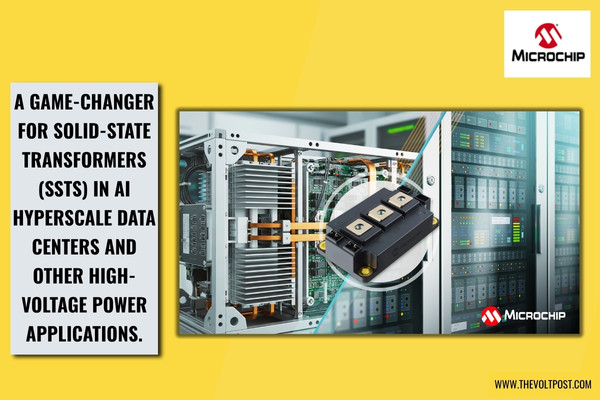
These modules pack 3.3 kV silicon carbide (SiC) mSiC® MOSFETs and Schottky diodes into a standard 62 mm package, making it possible to deliver power efficiently from the medium-voltage grid straight to the server rack.
As AI data centers grow, token generation hits a wall when power runs short, and efficiency becomes the make-or-break factor for ROI. Traditional designs relying on bulky, low-frequency transformers add complexity, increase losses, and limit flexibility.
Solid-state transformers(SSTs) enable cutting conversion stages and boosting system efficiency. With next-gen AI facilities moving toward higher-voltage DC rack distribution, SSTs that deliver regulated DC directly from the medium-voltage grid become even more valuable.
Microchip’s HV-D3 mSiC Power modules were built specifically for this challenge. They leverage Microchip’s mSiC MOSFET technology, which delivers rock-solid RDS(on) stability across temperature ranges.
The packaging supports 6 kV isolation, uses CTI 600-rated materials, and features extended creepage distances designed for safe series connection in high-voltage operation.
A silicon nitride (Si?N?) substrate boosts thermal conductivity and power-cycling capability, letting designers squeeze more power density out of the system without over-engineering the cooling.
The HV-D3 mSiC power modules come in half-bridge and common-source configurations, with or without anti-parallel Schottky diodes, covering the 100-300A range.
Microchip’s mSiC MOSFET technology delivers balanced switching losses for both hard-switched and soft-switched topologies, making these devices ideal for SST designs and other high-frequency, high-voltage systems.
While SSTs in AI data centers are the primary target, the HV-D3 mSiC modules fit a wide range of applications like the megawatt charging for heavy-duty vehicles, auxiliary power supplies for rail and heavy transportation, medium-voltage motor drives, and industrial or defense power systems.
All these markets benefit from the same technology of high isolation, thermal robustness, and efficient power conversion.
 Leadership Comment
“As AI datacenters continue to push limits in supplying power from the grid to the GPU, the need for solid-state transformers becomes increasingly important,” said Clayton Pillion, vice president of Microchip’s high-power solutions business unit. “Our 3.3 kV HV-D3 mSiC power modules enable designers to reduce the number of series connected devices by roughly half versus lower-voltage SiC alternatives when interfacing to 13.8 kV or 34.5 kV grids. The devices also address a key gap in the industrial market for 100–300A products, bridging discrete SiC devices and much larger power modules.”
Microchip has over 20 years of experience in the development, design, manufacturing and support of SiC devices and power solutions, to help customers adopt SiC with ease, speed and confidence.
The company’s mSiC products and solutions are designed to provide lower system cost, faster time to market and lower risk. Microchip offers a broad and flexible portfolio of SiC diodes, MOSFETs and gate drivers.
To Know More About Microchip Broad And Flexible Portfolio of SiC Diodes, Mosfets and Gate Drivers, CLICK HERE
Development Tools
The 3.3 kV power modules are supported by an application note, design guide, device and simulation models for rapid prototyping. Additionally, Microchip provides global technical support, design services and field application engineering support.
Pricing and Availability
The 3.3 kV mSiC power modules are available to purchase in production quantities. You can purchase directly from Microchip or contact a Microchip sales representative or authorized worldwide distributor.