



Panasonic Industry is positioning its Thick Film Current Sensing Resistors as a cost-effective alternative to conventional metal shunt resistors in selected low- and medium-current applications.
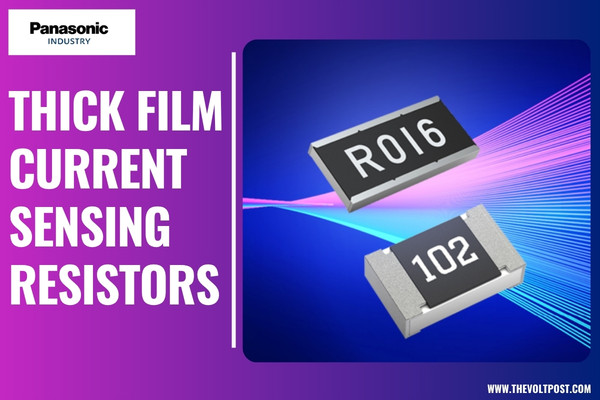
For engineers considering thick film and metal shunt technologies within their overlapping operating ranges, Panasonic highlights several potential benefits:
- Up to 50% potential component cost savings compared with selected comparable metal shunt solutions in suitable applications.*
- Improved heat dissipation, enabled by designs such as wide-terminal structures and double-sided resistive elements that can help reduce operating temperatures and improve thermal performance.
- Improved reliability during thermal cycling, supported by soft termination technology designed to reduce stress on solder joints.
- Accurate current sensing, with resistance values down to 10 m?, stable resistance performance over temperature and TCR values as low as ±75 ppm/°C in selected series.
- Simpler migration from metal shunt solutions, with footprint-compatible designs available in selected case sizes, allowing replacement within the appropriate operating range.
As AI infrastructure, industrial robotics, battery management systems (BMS) and advanced power electronics continue to push power density and efficiency higher, accurate current sensing is becoming increasingly important.
The global current-sense resistor market is expected to grow at a CAGR of approximately 6% in the coming years, driven by rising demand across battery management, motor control and power conversion applications.
Current-sense resistors are widely used to measure electrical current and support monitoring and control across a broad range of systems. These include AI server power supplies, industrial robots, battery management systems, DC/DC converters, motor drives and advanced power supplies. Accurate current measurement helps improve system performance, protect components and increase energy efficiency.
Metal shunt resistors have traditionally been the preferred choice for current sensing, particularly where applications demand very low resistance values and high power-handling capability.
However, many designs do not require the lowest possible resistance or the highest power rating. Where electrical and thermal requirements fall within the appropriate range, thick film current-sense resistors can deliver the necessary sensing performance at a lower component cost.
Panasonic’s Thick Film Current Sensing Resistors are designed for these low- and medium-current applications, combining low resistance, thermal stability and cost efficiency. The company uses advanced resistor materials, optimized trimming technology and different structural approaches including double-sided resistor structures and wide-terminal designs to improve performance.
Selected Panasonic series offer resistance values down to 10 m?, stable resistance performance across temperature changes and TCR values as low as ±75 ppm/°C.
One of the central challenges in current sensing is achieving low resistance without sacrificing temperature stability. Lower resistance can reduce power losses, but maintaining a low temperature coefficient of resistance (TCR) can make the design more challenging.
Panasonic addresses this trade-off through its resistor materials and component structures. The resulting designs are intended to support accurate current measurement while limiting power loss, improving heat dissipation and reducing measurement drift caused by temperature changes.
Panasonic says its Thick Film Current Sense Resistors are already being used in customer applications. The components are particularly suited to AI infrastructure, robotics, battery management systems, motor control, power supplies and industrial automation, where designers are increasingly focused on balancing performance with overall system cost.
As electronics manufacturers work to improve efficiency, control thermal stress and manage bill-of-materials costs, thick film technology offers an alternative for applications that do not require the extreme low-resistance or power-handling capabilities of conventional metal shunts.
For low- and medium-current designs within the appropriate electrical and thermal operating range, Panasonic’s Thick Film Current Sensing Resistors provide designers with a practical option for achieving accurate current measurement while keeping component costs and thermal performance in check.
To Know More About Panasonic’s Thick Film Current Sense Resistor Portfolio: CLICK HERE