


electronica India 2026 Bengaluru edition and productronica India Bengaluru edition 2026 closed its doors after three days of intense commercial and technical engagement, reflecting an industry rapidly shifting its focus from simple capacity expansion to building deeper manufacturing capabilities.
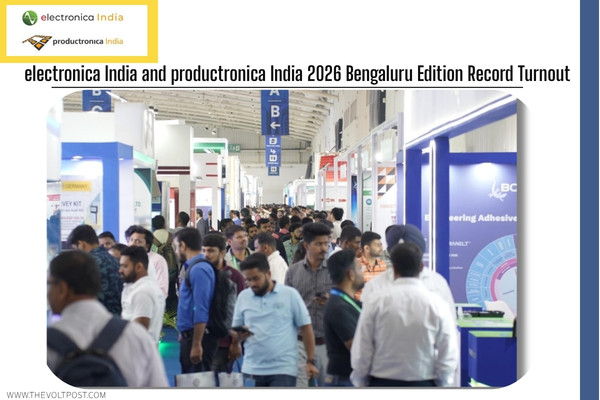
Organized by Messe Muenchen India and held from September 16-18 at the Bangalore International Exhibition Centre, the co-located trade fairs drew impressive numbers – 793 exhibitors, 52,411 business visitors, and 3,225 focused B2B meetings.
Spread across 60,000 square meters, the event became a central hub for the electronics value chain, hosting companies from over 30 countries and welcoming attendees and delegations from more than 50 nations.
The event’s inauguration was led by Shri M. B. Patil, Karnataka’s Minister for Large and Medium Industries and Infrastructure Development, alongside Hiroshi Nawata, Consul-General of Japan in Bengaluru.
Moving Beyond Capacity: A Focus on Capability
Conversations across the exhibition floor underscored a clear industry priority. It is no longer just about increasing output; manufacturers are now zeroing in on stronger capabilities in components, equipment, quality control, testing, design, and sophisticated production processes.
Manufacturers used the platform to evaluate new technologies against practical, real-world requirements, from application suitability and production output to process control and automation. In return, component and equipment providers gained direct insight into the evolving needs of Indian electronics manufacturers.
“The value of a trade fair is ultimately determined by the quality of the business conversations it enables,” noted Bhupinder Singh, President of IMEA, Messe München, and CEO of Messe Muenchen India. “In Bengaluru, we saw manufacturers arriving with specific sourcing, production, and technology requirements. This level of engagement shows that India’s electronics sector is progressing from broad expansion plans toward more defined manufacturing decisions.”
To facilitate these decisions, the Buyer-Seller Forum hosted 3,225 B2B meetings involving 645 unique buyer companies and 1,682 VIP buyers. These structured discussions provided a crucial setting for examining technical requirements and exploring potential cooperation.
Strong International Presence Reflects Market Demand
The trade fairs featured strong international participation, with companies from Germany, China, France, Italy, the UK, Japan, Israel, the US, and South Korea taking part.
Dedicated pavilions from Germany, Japan, Taiwan, and China went beyond acting as simple showcases. Supported by organizations like the Japan External Trade Organization (JETRO) and the Taiwan Electrical and Electronic Manufacturers’ Association (TEEMA), these pavilions allowed international suppliers to hold direct discussions with Indian buyers to better understand local manufacturing needs.
Dr. Reinhard Pfeiffer, CEO of Messe München GmbH, highlighted this dynamic: “Global electronics companies are increasingly in need of a closer understanding of India’s manufacturing requirements and business environment. The Bengaluru edition gave international suppliers direct access to the companies investing in production, sourcing, and technology adoption.”
Conferences Tackle Competitiveness and Future Growth
The accompanying conference program, the India Electronics Conclave, pushed the conversation beyond manufacturing volume to long-term competitiveness. Featuring roughly 150 speakers across 14 conferences and 18 supporting programs, the sessions covered electronics policy, capital goods, AI, exports, free trade agreements, PCBs, flexible electronics, and compliance standards.
Key events included the eFuture Conference, the CEO Forum with ELCINA, and the Industrial Electronics & Capital Goods Summit 2026 organized alongside the India Cellular & Electronics Association (ICEA).
A major highlight was the launch of “eFuture 2035: Engineering India’s Next Electronics Revolution,” an e-paper by MMI and Avanteum Advisors outlining strategic shifts that could define India’s electronics manufacturing over the next decade.
Rajoo Goel, Secretary General of ELCINA, observed, “India’s electronics industry is entering a phase where competitiveness will be measured by consistency, reliability, process maturity, and the ability to meet global customer expectations.”
Shri Pankaj Mahindroo, Chairman of ICEA, echoed this sentiment, emphasizing the need for reliable access to advanced equipment and automation to sustain the sector’s growth.
Engaging Emerging Talent
The 2026 edition also introduced new formats designed to connect emerging technical talent with industry challenges.
The electronica India Tech Challenge, organized with HackCulture and supported by DigiKey, saw teams competing for a ?5 lakh prize pool by developing solutions to defined technology problems. The AI Buildathon by Sarvam AI and the AI Masterclass by GrowthX explored practical applications of artificial intelligence, while a Hand Soldering Skill Test highlighted critical operator-level production skills.
In a significant move for international cooperation, the Taipei Computer Association and IIIT-Bangalore signed a Letter of Intent to advance Taiwan-India collaboration across AI, electronics, smart manufacturing, and cybersecurity.
Expanded Format Proceeds to Delhi-NCR
The successful conclusion of electronica India 2026 Bengaluru edition caps off the first year of the trade fairs’ new, expanded national model. Previously alternating between Noida and Bengaluru, the events moved to annual editions in both markets in 2026, representing a 50 percent growth in format.
The industry’s attention will now turn to the next edition, scheduled for April 28-30, 2027, in Delhi-NCR. This upcoming event will notably feature the launch of Defence Electronics NEXT, a dedicated platform supporting India’s defense electronics ecosystem.