



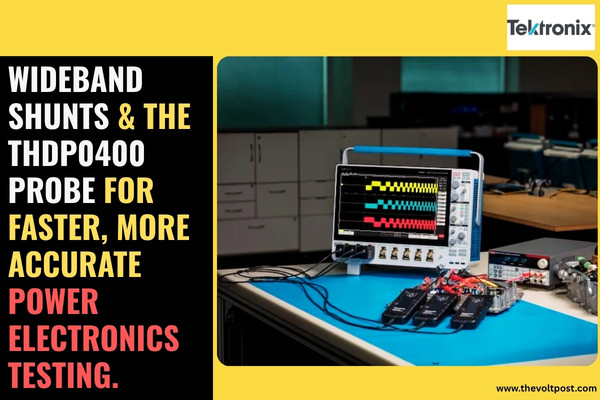
Tektronix has expanded its power testing lineup with two new measurement accessories designed for the demands of modern power electronics. The company has launched wideband shunts for its IsoVu current probes and the THDP0400 high voltage differential probe, giving engineers more options when working on fast switching, high voltage applications.
A broader measurement toolkit
The new wideband shunts are Tektronix’s first shunt based solution in the IsoVu precision current measurement family. They are built for low current, high bandwidth testing, where traditional shunts or clamp style probes may not offer enough sensitivity or transient response.
With bandwidths of up to 250 MHz, the shunts are designed to work directly with Tektronix IsoVu isolated current probes. That makes them useful for capturing fast current transients in areas such as power integrity analysis, power distribution network characterization, embedded systems, semiconductor design, and AI infrastructure.
What the THDP0400 adds
The THDP0400 adds another option to Tektronix’s high voltage differential probe range. It offers 400 MHz bandwidth and a differential input range of ±2000 V, making it well suited for floating high voltage measurements that are common in power electronics validation and wide bandgap semiconductor development.
Tektronix says the probe works through the TekVPI interface, which means it connects directly with the company’s 4 Series B, 5 Series B, and 6 Series B mixed signal oscilloscopes without needing an external power supply. That makes bench setup simpler and more convenient for engineers.
Built for fast switching work
The THDP0400 is especially relevant for SiC and GaN device characterization, power converter validation, and double pulse testing.
In all of these areas, capturing fast switching transients accurately is essential, and probe performance can have a direct impact on the quality of the data.
That is increasingly important as EVs, industrial drives, data centers, and renewable energy systems continue moving toward higher efficiency and denser power designs. Tektronix is clearly aiming this probe at that growing market.
Features such as communication support, temperature compensation, and built in fuse protection
The new shunts may not sound as attention grabbing as the high voltage probe, but they fill an important need.
In low current, high speed applications, engineers often need better visibility into short duration events, switching noise, and transient behavior.
Tektronix has also included features such as communication support, temperature compensation, and built in fuse protection. These may seem like small details, but they help improve reliability and make everyday lab work easier and more consistent.
Next-Generation Power Electronics Testing
Together, these accessories strengthen its position in next  generation power electronics testing.
The company is clearly targeting engineers working on electric vehicles, industrial equipment, AI data centers, and other high performance systems that demand accurate and fast current and voltage measurements.
The release also reflects a broader trend in the industry. As wide bandgap semiconductors and high efficiency converters become more common, test equipment has to keep up with higher bandwidth, higher voltage, and more complex measurement conditions.
The company says both products are available immediately – CLICK HERE to know more.