



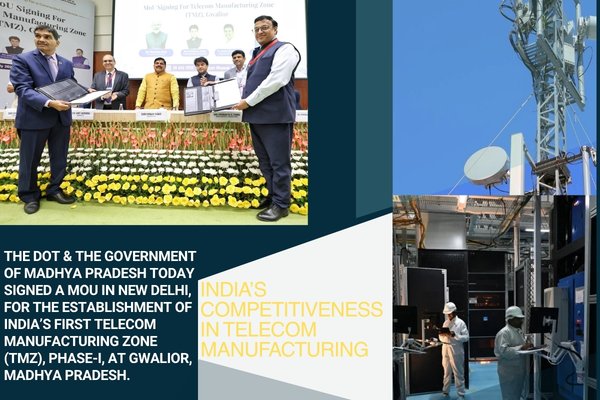
India’s first Gwalior Telecom Manufacturing zone is beginning to gather momentum, with 14 companies committing ?3,500 crore as the Centre and Madhya Pradesh push ahead with plans to create a domestic hub for telecom equipment, testing and design.
Telecom hub takes shape
The Gwalior Telecom Manufacturing is being developed as a joint venture between the Centre and the Madhya Pradesh government. A special purpose vehicle is expected to be formed soon, with the state holding 51 percent and the Centre 49 percent.
The idea is to bring research, design, testing and manufacturing under one roof and give India’s telecom supply chain a stronger local base.
Communications Minister Jyotiraditya Scindia said the project could generate 14,000 jobs and improve India’s competitiveness in telecom manufacturing.
Companies line up
Among the companies that have committed investment are Dixon Technologies, HFCL and VVDN Technologies.
Dixon is looking at an investment of about ?200 crore and expects to create around 1,200 jobs, with a focus on telecom consumer premise equipment, network gear and related components.
HFCL has announced a phase one investment of ?700 crore for an optical connectivity solutions factory, while VVDN has committed ?500 crore for an R&D and design facility focused on 5G, 6G and satellite communications.
Policy Push & Incentives
The Centre has set aside ?493 crore for infrastructure, with a large share of that going toward testing and laboratory facilities.
The Madhya Pradesh government has allotted 170 acres for the project and is offering a package that includes land on a concessional lease, capital support of up to ?200 crore, R&D assistance of up to ?25 crore, a power tariff rebate and subsidized water charges.
The state is also aiming to attract a larger round of investment over the next decade as it positions Gwalior as a long-term telecom manufacturing base.
The Gwalior zone comes at a time when India is trying to localize telecom hardware production and reduce dependence on imports.
The integrated cluster is expected to support mobile phones, network equipment, fibre optics and next-generation 5G and 6G technologies.
For companies such as Dixon, HFCL and VVDN, the zone offers a chance to expand manufacturing closer to domestic demand while also building export potential.
The early ?3,500 crore commitment suggests that industry interest is already building around the project. The government’s wider ambition is much bigger, with targets for stronger investment and job creation over time.
The key test now will be how quickly the infrastructure comes up and how many of the pledged investments turn into actual production capacity.
 Key Comment