


The approvals mark the 15th to 18th state aid decisions under the EU Chips Act framework, bringing total funding from earlier measures to around €14.2bn ($16.3bn).
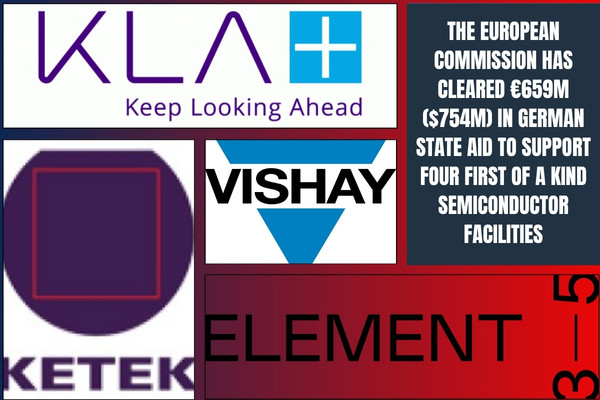
Europe is turning specialty semiconductor manufacturing into a strategic advantage. Now, The European Commission has cleared €659m ($754m) in German state aid to support four first of a kind semiconductor facilities, aiming to sharpen the EU’s competitiveness under the 2023 EU Chips Act. The move underscores how much Europe’s chip ambitions now depend not just on fabs, but on the full ecosystem, including specialty gases and advanced materials used in critical process steps.
Element 3 5 Takes the Largest Share
The largest share, €353m ($404m), goes to German silicon carbide specialist for a new SiC epi wafer manufacturing plant in Baesweiler, North Rhine Westphalia.
SiC epi wafers are standard silicon carbide wafers with an ultra thin crystalline layer grown on top through epitaxy, a process that significantly enhances device performance.
These engineered wafers are in high demand across automotive, communications, energy and industrial power electronics as manufacturers push for higher efficiency and higher voltage capability.
Vishay Siliconix Itzehoe New Site
Vishay Siliconix Itzehoe, the German arm of US component maker Vishay, will receive €214m ($244m) to build a new semiconductor device facility in Itzehoe, Schleswig Holstein.
The site will focus on next generation power MOSFETs, the workhorse switches that control high voltages in automotive power electronics, from EV inverters to advanced driver assistance systems.
KLA Tencor MIE To Manufacture Advanced Optical Overlay
In Weilburg, Hesse, KLA Tencor MIE – the German subsidiary of US equipment maker KLA has been granted €74.4m ($85m) to manufacture advanced optical overlay and film metrology tools.
These systems sit on the line in high volume fabs to monitor layer alignment and film characteristics, underpinning process control for leading edge and specialty nodes.
Once in production, they rely on ultra high purity nitrogen to maintain an inert environment and protect sensitive measurements.
Ketek To Expand Production of SDDs
Rounding out the package, Munich based Ketek will receive €17.9m ($20m) to expand production of silicon drift detectors (SDDs) and graphene radiation entry windows (GREW).
These specialised chips are core to Ketek’s SDD detector systems used in industrial sorting and recycling, and the funding will allow the company to merge two production lines into a single cleanroom, improving efficiency and throughput.
 The approvals mark the 15th to 18th state aid decisions under the EU Chips Act framework, bringing total funding from earlier measures to around €14.2bn ($16.3bn).
First announced in February 2022, the Chips Act aims to mobilise €43bn ($50bn) in combined public and private investment, including €3.3bn ($3.8bn) from the EU budget.