

Sitting in STMicroelectronics’ recent IMG media briefing, one theme came through immediately that the company no longer sees its imaging devices as simple cameras, but as perception engines built for edge AI. At the center of that narrative is Alexandre BALMEFREZOL, Executive Vice President and General Manager of ST’s Imaging sub-group, who described the new vision for imaging as “turning light into trusted data” to enable independent, intelligent, safe and efficient systems.

In that context, ST unveiled two key pieces of its strategy, a high-end direct Time-of-Flight (dToF) 3D LiDAR module and an expanded BrightSense camera portfolio underscoring how quickly the company is repositioning imaging around machine understanding instead of human-centric image quality.
From Nokia Cameras To AI-Ready Sensors
Alexandre Balmefrezol traced ST’s imaging journey back more than 25 years to the acquisition of Scottish start-up VISION, a deal that ultimately powered billions of camera sensors and modules through Nokia’s “golden age” of mobile imaging.
Over time, ST deliberately stepped away from commoditized camera modules and poured investment into differentiated technologies like Time-of-Flight ranging and global-shutter machine-vision sensors, laying the groundwork for today’s FlightSense and BrightSense lines.
It seems ST has moved beyond chasing pixel counts to focus on application-driven sensing, fast autofocus, robust depth perception, biometric security, people detection and now LiDAR-grade spatial awareness at the edge.
 Three Families, Wider Market Approach
During the briefing, ST framed its imaging portfolio around three focused product families:
- FlightSense for advanced depth sensing
- BrightSense for computer vision and edge AI
- SafeSense for in?cabin automotive monitoring
FlightSense has already become the workhorse behind laser autofocus in smartphones, presence detection, and now 3D LiDAR modules in edge systems.
BrightSense targets machine-vision scenarios in IoT, robotics and industrial automation, with global-shutter sensors tuned for reliability and low?noise imaging rather than social?media aesthetics.
SafeSense is tailored to automotive driver and occupant monitoring, bringing the compliance and functional?safety features that Tier-1s and OEMs increasingly treat as mandatory for new platforms.
ST wants to focus on areas where it can deliver clear “system value,” rather than just adding another CMOS sensor to an already crowded camera market.
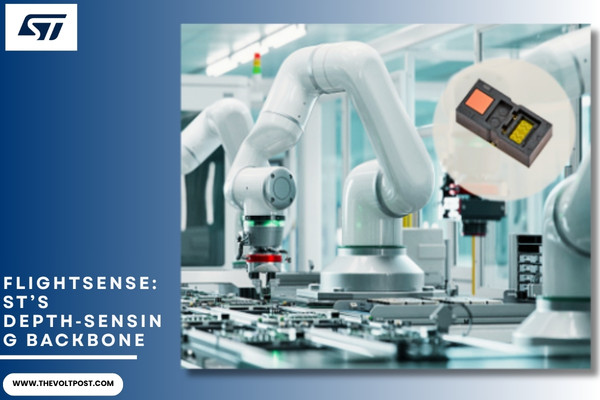
FlightSense: ST’s Depth-Sensing Backbone
FlightSense sits at the core of this strategy. It’s not just a single ToF sensor product, but a platform that has already shipped in the billions of units across smartphones and PCs.
Over more than a decade of iteration, ST has stretched ranging capability from short distances out to several meters, widened fields of view from around 25 degrees to near 90 degrees, and moved from single?point ranging to multizone depth maps with thousands of measurement points.
Underneath those gains are stacked?wafer processes, denser SPAD (Single Photon Avalanche Diode) arrays, and increasingly sophisticated on-chip processing that pushes much of the depth computation into the module itself instead of relying on the host MCU.
 VL53L9 – Compact 3D LiDAR For The Edge
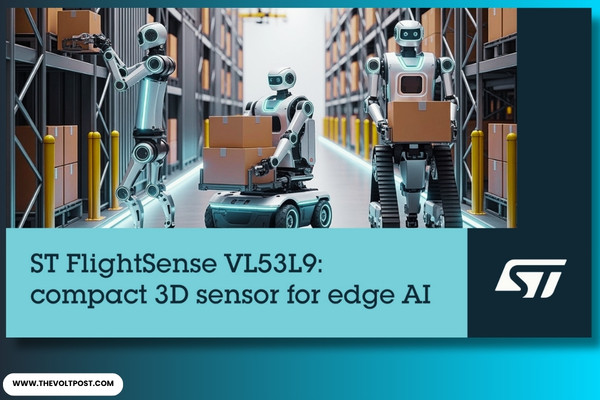
The headline announcement was ST’s VL53L9, a compact 3D dToF LiDAR module that extends FlightSense from simple “rangefinders” into full spatial-awareness engines for edge AI.
The module delivers up to about 2.3K multizone ranging points (2,268 zones in a 54 × 42 grid), combines infrared intensity and depth data, and operates from roughly 5 centimeters out to 9-10 meters depending on lighting conditions.
It’s built to stream depth maps at up to 60 frames per second, and up to 100 fps in specific configurations, while remaining compatible with low-power MCUs thanks to its integrated ASIC, on?chip processing, and support for modern interfaces such as MIPI and I3C.
Why This LiDAR Stands Out
VL53L9’s differentiation lies in its optical and illumination strategy. ST uses dual-scan flood illumination together with a metasurface optical element, rather than the conventional “dot pattern” projection seen in many competing systems.
Flood illumination provides more uniform coverage and a higher density of measurement points across the scene, enabling better detection of small objects and edges, everything from fingers and chair legs to thin obstacles that traditional dot-based solutions can miss.
Combined with dense SPAD arrays and integrated processing, those extra data points transform VL53L9 from a basic distance sensor into a self?contained 3D depth-map LiDAR module aimed squarely at robotics, drones, AR/VR, smart buildings, smart farming and similar edge-AI applications.
Privacy-Friendly Depth Instead Of Surveillance Video
A key theme in the briefing was privacy. VL53L9 is not designed to be a high-resolution RGB camera. Instead, it streams low-resolution infrared and depth image, enough to support people counting, fall detection or gesture recognition, but not enough to identify individual faces or reconstruct personally identifiable video.
ST’s engineers stressed that this is by design, the module delivers anonymized spatial data that can be processed locally on small MCUs, keeping sensitive information at the edge and avoiding full?fidelity video transmission to the cloud.
For use cases like elder-care monitoring, access control and workplace safety, that balance between situational awareness and privacy is increasingly critical.
Edge AI on STM32 – Not in The Data Center
From a system-level vantage point, the most striking aspect is how much intelligence ST can now run on mid-range STM32 MCUs. Demo setups built on the STM32H5 platform showed human-presence detection algorithms consuming only a small portion of available RAM and flash, yet still operating at real-time frame rates.
A more advanced demo added AI-based post-processing atop VL53L9’s depth and IR streams to count people, classify postures (standing, sitting, lying) and detect falls again at around 30 fps, without dedicated AI accelerators and with memory usage kept intentionally low to leave room for customer applications.
This is the “physical AI” many embedded developers are aiming for, advanced perception that stays within tight power and compute budgets instead of demanding a GPU cluster.
BrightSense – Giving Machines Eyes
If FlightSense answers the “how far and where” questions, BrightSense focuses on “what and how fast.” ST’s BrightSense portfolio centers on CMOS global-shutter sensors optimized for machine vision, with resolutions ranging from sub-megapixel up to about 5 megapixels and pixel architectures tuned for sensitivity.
These sensors use backside?illuminated global-shutter pixels manufactured in ST’s European fabs, delivering crisp, low-noise images of fast-moving objects without the rolling-shutter artifacts familiar from consumer cameras.
Variants span monochrome, HDR and near-infrared, targeting barcode scanning, mobile-robot obstacle avoidance, biometric recognition, traffic and security systems, and low-power “always-on” vision nodes in IoT.
SafeSense – Watching Over The Cabin
SafeSense, the third pillar, moves closer to the regulatory frontier with a focus on in-cabin automotive monitoring. These smart CMOS image sensors are built for driver-drowsiness and distraction detection, occupant classification and general interior awareness, capabilities now being written into safety regulations and Euro NCAP-style rating schemes.
Here, ST’s message is about automotive-grade reliability, functional-safety readiness and long-term supply rather than raw resolution.
SafeSense devices support Driver Monitoring Systems (DMS) and Occupant Monitoring Systems (OMS), incorporate cybersecurity features such as authenticated video streams and secure key management, and are manufactured within an EU-anchored supply chain. For automakers and Tier-1 suppliers, an imaging partner that already serves consumer electronics, industrial robotics and automotive offers a useful cross-domain view.
 Pixel-to-system: IDM As A Competitive Strategy
Beyond individual products, Balmefrezol repeatedly pointed to ST’ integrated-device-manufacturer (IDM) model as a key differentiator. Few companies can claim end-to-end control from pixel architecture and CMOS BSI processes through metasurface optics design, packaging, firmware and system integration and ST has spent years building exactly that “pixel-to-system” stack.
This allows the company to co-optimize sensors, optics and algorithms, reduce calibration and integration complexity, and move quickly on new architectures such as stacked wafers, SPAD arrays and metasurface lenses.
It also enables tighter coupling with STM32 microcontrollers, backed by evaluation kits, camera modules and partner-ecosystem support, so customers can bring imaging-rich platforms to market faster.
The Volt Post Question On Optics And What It Confirmed?
During the briefing, The Volt Post put forward a question asking that STMicroelectronics has built a strong portfolio with FlightSense ToF sensors like the VL53L1X, VL53L7CX, and the VD55H1 0.5MP 3D sensor. What specific application or market segment will this new 3D LiDAR module target that current FlightSense products don’t address, and how will it differentiate itself from competing ToF and LiDAR solutions in terms of range, resolution, power consumption, or cost?
Balmefrezol’s response broadly aligned with what VL53L9’s technical documentation already suggests the module leverages a new metasurface optical element combined with a stacked?wafer implementation that places the SPAD array and processing silicon into a compact, closely integrated form factor.
Compared with earlier FlightSense devices, VL53L9 scales the number of zones into the thousands, extends effective range to about 9-10 meters, and adds dual flood illumination plus high-bandwidth interfaces, all while keeping power consumption low enough for embedded edge-AI designs.
The Helm Towards The Data Economy
Taken together, ST’s imaging announcements deliver a dirct helm towards emerging data economy reaffirming that imaging is no longer just about producing visually pleasing pictures, but about generating trusted, structured data streams that machines can process locally.
 FlightSense and VL53L9 translate distance and occupancy into sparse, privacy-preserving depth maps; BrightSense converts photons into machine-friendly frames optimized for detection and classification rather than human viewing; and SafeSense applies the same philosophy inside the vehicle cabin.
Backed by the IDM “pixel-to-system” approach, ST can tune each layer from meta-surface optics and SPAD arrays to STM32 firmware and software ecosystem to the realities of edge AI, instead of forcing developers to integrate together disconnected building blocks and hope everything aligns.
Disclaimer: This article has been developed based on the presentation materials shared by STMicroelectronics following its media briefing. While efforts have been made to accurately reflect the information provided, The Volt Post does not independently verify the facts, figures, or technical claims presented and assumes no responsibility for their accuracy or completeness.