


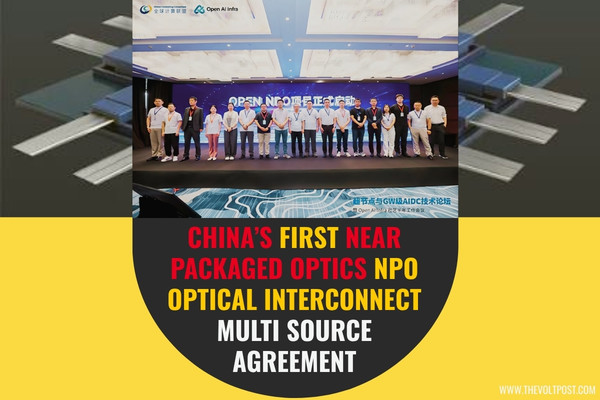
Huawei, Baidu and more than 20 partners have launched the OPEN NPO project, rolling out China’s first near packaged optics NPO optical interconnect multi source agreement for AI data centers. The initiative is designed to create an open, unified technical standard for NPO based high speed optical links, giving China a homegrown framework for next generation AI infrastructure.
Partners Ecosystem
The ecosystem behind OPEN NPO is broad by design. Partners range from carriers and cloud providers to standards bodies and component vendors, including China Mobile Research Institute, JD Cloud, China Electronics Standardization Institute, ZTE Software, H3C, Accelink, Ligent, HGTech, Yamaichi, Hirose, Molex, Luxshare Technology and others.
The project was formally unveiled in Beijing at a forum guided by the Global Computing Consortium and hosted by the Open AI Infra Community, underscoring its positioning as a national level standards play rather than a single vendor push.
At the heart of this move is near packaged optics. Instead of relying on traditional pluggable optics at the edge of a board, NPO brings optical engines and related components closer to the switch or accelerator package.
That shorter electrical reach translates into lower power consumption and latency across the link – a critical advantage as AI clusters scale to GW level facilities.
The Growing Importance
As highlighted in TrendForce’s recent analysis, optical interconnects are now as strategically important as accelerators for energy efficiency and rack level performance, and cloud providers are starting to treat interconnect architecture as a first class design parameter alongside compute, memory and cooling.
Reports estimates that the combined market for co packaged optics and near packaged optics will jump from roughly 100 million dollars in 2025 to more than 39 billion dollars by 2030, a trajectory that puts real weight behind NPO standardization.
With that kind of upside, a robust, interoperable NPO framework is no longer optional, it becomes foundational to how AI data centers are built, financed and upgraded over the coming decade.
An Open Collaboration Framework
OPEN NPO is structured as an open collaboration framework rather than a closed club. The NPO optical interconnect MSA brings together upstream and downstream players to jointly define mechanical, electrical, interface, management and test specifications.
Enabling Interoperable Modules
Instead of a patchwork of proprietary implementations, the goal is to enable interoperable modules, connectors and boards that fit into a shared ecosystem.
The group is explicitly targeting long standing industry pain points such as fragmented interfaces, limited cross vendor compatibility and the absence of unified validation regimes for NPO deployments.
To make that real in the field, participants plan to build shared verification platforms so NPO components can be qualified against multiple deployment scenarios in AI computing centers, rather than validated in isolation for one operator at a time.
This kind of common testbed approach is meant to compress test cycles, improve reliability and de risk large scale rollouts.
Key Rollouts On The Verge
According to Huawei and local media reports, the OPEN NPO group is working toward releasing the first version of its technical specification in the third quarter of 2026.
That initial release will cover NPO modules and matching electrical connectors, with full scenario testing baked into the rollout plan.
By the first half of 2027, the consortium expects to refine collaboration mechanisms and push NPO technology into large scale commercial deployment across AI computing infrastructure. If the schedule holds, NPO based optical links could move from pilot projects to mainstream AI cluster designs within about two years.
Strengthening Domestic Control
The NPO MSA is widely viewed as a critical step in China’s effort to strengthen domestic control over core interconnect technologies used in AI and cloud infrastructure.By defining its own standards in near packaged optics, China is working to reduce reliance on foreign optical and networking specifications and the supply chains they lock in.
The initiative aligns with Beijing’s broader push for self sufficient “AI factories” where compute, interconnect, storage and power systems are sourced from domestically defined ecosystems.
Analysts expect this kind of standardization to shorten testing cycles, lower lifecycle costs and improve utilization across large scale intelligent computing centers.
 Focus on Near Packaged Optics
Globally, co packaged optics and pluggable transceivers are already covered by multiple MSAs that serve as useful reference points for OPEN NPO.
What differentiates China’s approach is its focus on near packaged optics as a pragmatic bridge between current pluggable architectures and fully co packaged solutions, tuned specifically to domestic AI build out priorities.
CPO and NPO Surge
TrendForce notes that while the pluggable market is likely to remain sizable at nearly 26 billion dollars by 2030, CPO and NPO are expected to capture a rapidly growing share of AI data center interconnect spend.
In that context, the OPEN NPO specification becomes a potential lever for Chinese vendors to shape next generation optical architectures and enter global interoperability discussions from a stronger position.