

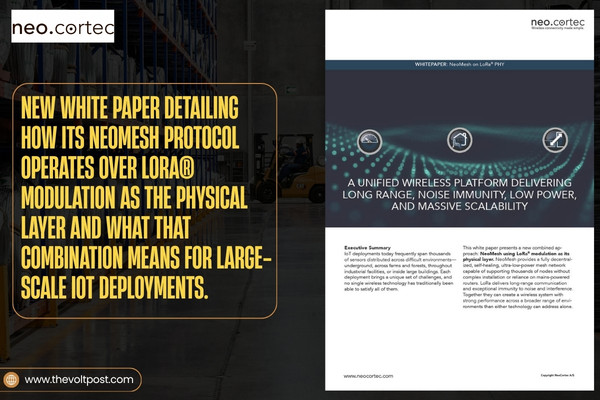
NeoCortec has published a new white paper detailing how its NeoMesh protocol operates over LoRa® modulation as the physical layer and what that combination means for large-scale IoT deployments.
What the white paper covers
The document walks through the technical rationale for pairing NeoMesh’s decentralized, self-healing mesh architecture with LoRa’s long-range, interference-resistant PHY.
It explains how the two technologies complement each other: NeoMesh brings ultra-low-power, scalable mesh networking without mains-powered routers, while LoRa adds range and robustness in noisy environments.
According to NeoCortec, the result is a wireless system that can support thousands of battery-powered nodes across challenging environments, underground, in forests and farms, inside large buildings, or across industrial sites, without the complex infrastructure typical of traditional mesh or star topologies.
Why the combination becomes vital for IoT
IoT projects increasingly involve dense sensor networks spread across difficult terrain or structurally complex facilities. In such settings, single-hop LoRaWAN-style architectures can struggle with coverage gaps, gateway costs, or reliability issues.
NeoMesh on LoRa addresses these pain points by enabling multi-hop communication where every node can route traffic, self-organize, and recover from failures without a central coordinator or backend network server.
The protocol is time-synchronized, so devices sleep most of the time and wake on schedule to transmit, delivering multi-year battery life even at scale.
Practical benefits highlighted
The white paper and related materials point to several deployment advantages:
- Simplified installation: No need for repeaters or mains-powered routers; a single low-cost gateway can connect the mesh to the cloud.
- Scalability: Networks can grow to thousands of nodes (up to 65,000 in theory) with dynamic routing and self-healing.
- Noise immunity: LoRa modulation improves performance in 2.4 GHz bands crowded with Wi?Fi, Bluetooth, and other systems.
- Long battery life: Time-slotted operation enables years of operation on small batteries, with typical deployments targeting 7–10 years.
- Flexible deployment: Works across Sub?GHz and 2.4 GHz bands, with global regulatory compliance.
 Where it’s already being used
NeoCortec and its partners cite real-world use cases that benefit from the NeoMesh + LoRa combination, including building energy optimization, fire detection in commercial properties, underground or forestry monitoring, and industrial sensing where gateway infrastructure is impractical.
The white paper is available on NeoCortec’s website alongside other technical documentation on the NeoMesh protocol stack, integration options, and reference designs.
To find out more about these benefits and to download the new white paper, CLICK HERE