



Toray Industries announced that it has developed the world’s first film (see note 1) for anode current collectors that meets all four key requirements for current collector materials: resistance to oxidation and reduction, metal-layer adhesion, mechanical strength, and thermal stability.
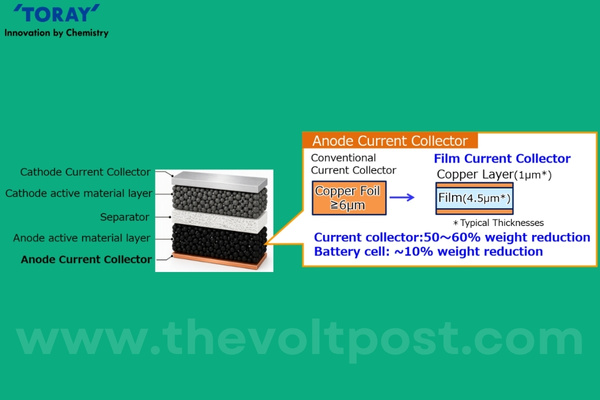
This newly developed film is a resin-film substrate for use in film current collectors(note 2). It enables conventional copper foil current collectors in lithium-ion batteries to be replaced with film current collectors that use a resin-film substrate.
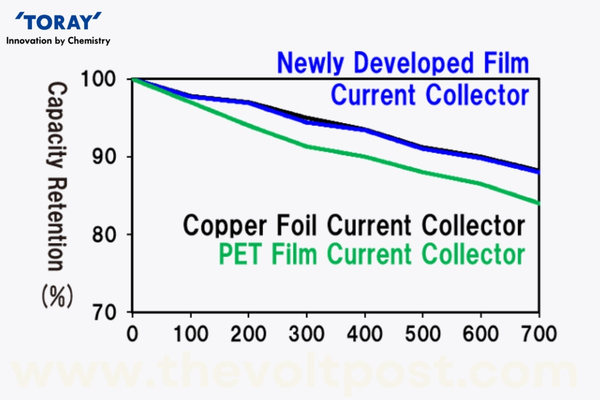
Toray has demonstrated that current collectors using the new film deliver battery performance comparable to that of conventional copper-foil current collectors. It has manufactured the film with mass-production equipment and has begun providing samples to customers. The new film is expected to contribute to weight reduction in lithium-ion batteries.
An anode current collector conventionally uses a conductive copper foil. It draws current from a battery’s anode. Demand for lighter batteries has increased amid the pursuit of higher energy density, driving the development of film current collectors (note 3) featuring ultra-thin copper layers on resin film substrates.
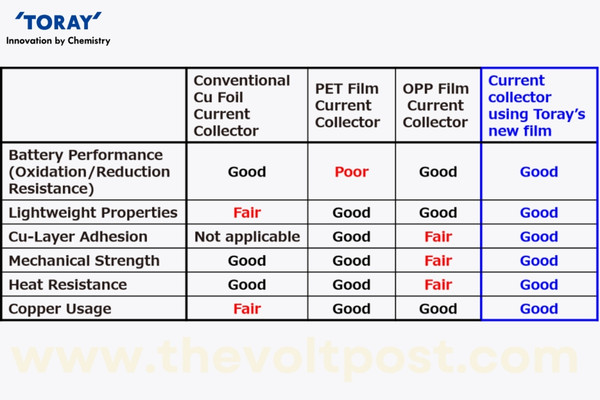 Polyethylene terephthalate (PET) film can serve as a resin substrate on the cathode side but degrades in the strongly reducing environment of the anode. No other resin-film substrate had been available that simultaneously met the required properties of resistance to reduction (note 4), metal-layer adhesion, mechanical strength, and thermal stability.
Toray has developed a new resin-film substrate that meets the four requirements mentioned earlier through advanced structural control using polymer design and film formation technologies based on its proprietary polymer alloy technology (note 5).
Anode film current collectors using the new film offer excellent resistance to reduction and strong adhesion to the copper layer. They also provide mechanical strength comparable to copper foil and low thermal shrinkage. In battery cell evaluations, they demonstrated performance comparable to conventional copper-foil current collectors.
A current collector using the new film is 50% to 60% lighter than a conventional copper-foil current collector. It should reduce battery cell weight by about 10%. Improved gravimetric energy density can lengthen operating times for mobile devices, enhance energy efficiency, and extend drone and electric vehicle ranges.
 Toray estimates that using the weight savings to increase the amount of active materials could boost electric vehicle ranges by up to 10% under certain conditions (note 6). The film should also help stabilize material costs by reducing copper usage amid tight copper supply-demand conditions.
Toray used mass-production equipment to produce a standard grade of the film with a thickness of 4.5 microns. It has begun providing samples to customers. It is exploring ways to make the film even thinner.
The company plans to commercialize the film for small- and medium-sized batteries for mobile devices, drones, and electric vertical take-off and landing (eVTOL) aircraft while considering its applications in large batteries for electric vehicles and energy storage systems.
Toray will keep leveraging its core technologies in polymer chemistry, nanotechnology, and film manufacturing to research, develop, and commercialize advanced materials that make batteries higher-performing, lighter, and more resource-efficient. These efforts will create new value and contribute to social progress.
Notes
- Based on a Toray comparison with collector film products commercially available as of July 2026.
- A current collector is a conductive component that contacts the active material layer in a rechargeable battery electrode. It collects current from the electrode and carries it to the external circuit. Lithium-ion batteries generally use aluminum foil for the cathode and copper foil for the anode.
- A film current collector is a resin film coated with ultrathin aluminum for the cathode or copper for the anode. It is lighter and thinner than conventional metal foil.
- Resistance to reduction is the ability to resist chemical breakdown and degradation caused by reducing substances in the electrolyte at the anode. This property helps current collector films last longer and maintain battery performance in the anode’s strongly reducing environment.
- A polymer alloy combines two or more polymers to achieve properties that a single resin cannot easily provide.
- Toray assumed that the weight saved by using film current collectors allowed more cathode and anode active materials and electrolyte while keeping the negative-to-positive capacity ratio (N/P ratio) constant.
To Know More: CLICK HERE