



Pickering Electronics has released a practical new application guide aimed at engineers working with high-voltage (HV) measurement and insulation testing in electric vehicles (EVs) and charging infrastructure.
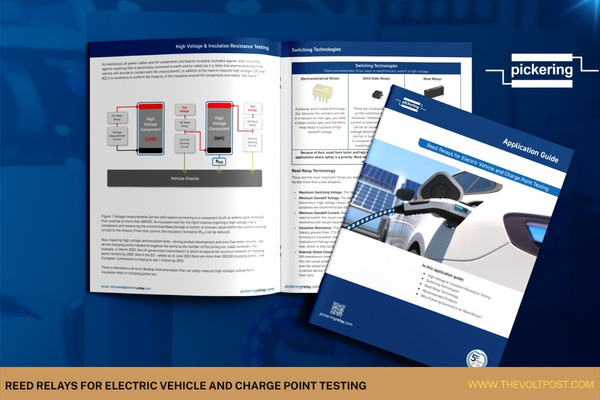 Titled ‘Reed Relays for Electric Vehicle and Charge Point Testing’ the application guide explores why high-isolation reed relays are particularly well-suited for precision instrumentation in these demanding environments.
Modern EVs and hybrid vehicles (HEVs and PHEVs) rely on high-voltage architectures that include battery packs, battery management systems (BMS), inverters, and electric motors.
These systems operate as “floating” circuits, meaning their power terminals are not referenced to chassis ground. As a result, both components and high-current cabling require robust insulation to ensure safe operation.
This creates a clear need for specialized test equipment and methodologies both during vehicle development and throughout their operational life. The same applies to EV charging points, which must also undergo rigorous high-voltage and insulation testing as deployment scales.
The application guide highlights two key requirements:
- Accurate high-voltage measurement (AC and DC) and reliable verification of insulation integrity.
These are critical not only for performance validation but also for ensuring user safety, especially since technicians are often in contact with grounded structures while working on HV systems.
Pickering makes a strong case for reed relays in this context, pointing to several inherent advantages:
- Hermetically sealed construction prevents contamination from dust and moisture
- High switching and stand-off voltage capability
- Ultra-low leakage for precise measurement accuracy
- Galvanic isolation to protect sensitive instrumentation
- Fast operation, compact size, and exceptional mechanical life often reaching millions or billions of cycles
The guide provides practical insights into selecting the right relay technology for specific EV and charging test applications, helping engineers make informed design decisions.
High-End Reed Relay Market
Pickering’s position in the high-end reed relay market is built on decades of focused innovation and manufacturing expertise.
Its relays incorporate instrumentation-grade reed switches designed for stability and longevity, supported by features such as formerless coil construction and patented SoftCenter technology for enhanced mechanical durability.
Mu-metal screening enables dense relay packing with minimal magnetic interference, while 100% testing ensures consistent performance across every unit.
For engineers working on EV systems or charging infrastructure, the guide offers a clear, experience-backed perspective on why reed relays remain a reliable choice for high-voltage switching and measurement.
Download this free EV & chargepoint testing application guide
 Leadership Comments
“Electric vehicles and charging points are demanding high voltage environments for instrumentation and test equipment,” said Robert King, Reed Relays Product Manager at Pickering Electronics. “Because of their compact size, high isolation and low leakage, reed relays are a strong fit for EV and chargepoint testing applications, where safety and measurement accuracy are both critical. Their mechanical contact path can switch AC or DC, while helping to minimise leakage that could otherwise affect insulation measurements.”
“There is, therefore, a need to develop instrumentation that can safely measure high voltages and perform insulation tests in charging points too – and that instrumentation will require switching,” added King. “Reed relays can offer leakage currents below 1 nA and stand-off voltages of several kV in compact packages. The reed switch contacts are hermetically sealed, helping protect them from contamination and oxidation compared with open electromechanical contacts.”
To Know 10 key Advantages Pickering’s Reed Relays Offer Over Competitor Relays: CLICK HERE