



Generational, the UK-based electric vehicle battery diagnostics specialist, has published new analysis of individual used-EV battery cell tests from nearly 10,000 carried out through hundreds of automotive dealers across the UK.
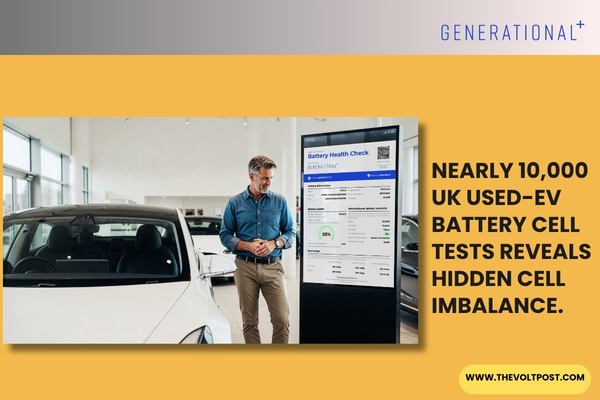
The findings show that most used EV batteries remain well balanced. However, a small but significant minority display cell-level imbalances that may not be apparent from headline State of Health (SoH) figures alone.
Across the dataset, the median used-EV recorded a voltage difference of just 8 millivolts (mV) between its highest and lowest battery cells, indicating that the typical battery is operating within a closely balanced range. Around one in 85 tests, however, showed an imbalance of more than 50 mV, a level that warrants further investigation, while approximately one in 200 recorded an imbalance above 100 mV, suggesting a potential underlying fault requiring further assessment.
SoH does not tell the whole story
Generational CEO Oliver Phillpott said that while reporting battery State of Health remains essential when assessing used EVs, it does not provide a complete picture of battery condition.
“State of Health measures capacity, but it does not necessarily show whether the individual cells within the battery pack are functioning correctly,” he said.
“Cell imbalance can develop without obvious symptoms, while the battery is gradually developing a fault that could later affect range, charging or vehicle value. The only practical way to identify that risk at an early stage is to test for it.”
Modern EV battery packs contain hundreds of individual cells that operate together as a single system. To deliver consistent performance, the cells must remain closely balanced. If one cell begins to diverge materially from the others, the battery management system may restrict charging or discharging to protect the weakest cell.
This can affect driving range, state-of-charge estimates and charging behaviour. In more serious cases, it may result in the need for expensive module or full battery replacement.
Generational’s cell-level diagnostic tool measures the voltage spread between individual cells, giving dealers a more detailed view of battery condition than an overall capacity reading can provide. It was launched as an extension to the company’s existing EV battery assessment platform.
Most batteries remain robust
 Phillpott said the findings should not be interpreted as evidence that widespread battery failure is becoming a problem. Instead, he argued that the data provides a more detailed picture of a market in which most batteries continue to perform well, while a small minority require closer attention.
“The industry has made significant progress in showing that EV batteries are generally much more robust than many people assume,” he said.
“Our cell-level testing adds another layer of transparency, supported by a complete vehicle audit history. This gives dealers and finance companies greater confidence, helps strong vehicles demonstrate their quality and allows dealers to identify the small number of vehicles that may need attention before they become a customer problem.”
Generational’s previous Battery Performance Index, based on more than 8,000 EV battery assessments in the UK, found that average battery State of Health stood at 95.15%. It also found that many older and higher-mileage vehicles continued to perform strongly, although variation between vehicles increased with age.
Importance of cell balance
An EV battery pack is made up of cells connected in groups and wired in series. The pack stops charging when the first cell reaches its upper limit and stops discharging when the first cell reaches its lower limit. As a result, one weak cell can restrict the performance of the entire pack, something that may not be visible in a pack-level average.
Cell voltage can also vary according to the vehicle’s state of charge and recent usage. A borderline imbalance measured at a low state of charge does not necessarily indicate a persistent fault. By contrast, a substantial imbalance that remains after an attempted rebalance is more significant.
When an issue is identified, Generational works with customers on the appropriate next steps. These may include a guided cell rebalance, testing the vehicle at rest and confirming whether the imbalance persists before determining whether further investigation, warranty support or repair is required.
Implications for dealers and consumers
Cell-level issues may be difficult for drivers to detect. In some cases, there may be no warning light, dashboard message or obvious change in vehicle behaviour until the imbalance becomes more advanced.
For dealers and finance companies, unresolved battery issues can lead to costly repairs, lengthy investigations and customer disputes. Some consumers may return vehicles or suspend finance payments while the matter is being resolved.
The battery is often the most valuable component in an EV and can account for more than 40% of the vehicle’s overall cost. As the UK’s electric vehicle fleet continues to age, Generational said that assessing battery condition on an individual-vehicle basis will become increasingly important.
Used battery-electric vehicle transactions reached record levels in the first quarter of 2026, according to SMMT data, while industry research continues to identify battery confidence as one of the key factors influencing consumer consideration of EVs.
Supporting a more transparent used-EV market
Generational’s wider diagnostics platform is designed for automotive retailers, leasing companies, remarketing businesses and workshops that need to assess used EV batteries quickly and consistently.
The company said verified battery data can help retailers price vehicles more confidently, reduce acquisition risk, protect residual values and give consumers clearer information about the most valuable component in an electric vehicle.
Phillpott said greater transparency would be essential as more EVs move into the used-car market.
“Understanding of battery condition has not yet caught up with the number of EVs now entering the used market,” he said. “More detailed, vehicle-specific testing will help build a healthier and more confident used-EV sector.”
Generational’s recently published Battery Performance Index can be downloaded here.