



Texas Instruments (TI) has introduced what it says is the industry’s first multiaxial coreless Hall-effect current sensor designed for traction inverter applications across hybrid electric and electric vehicles.
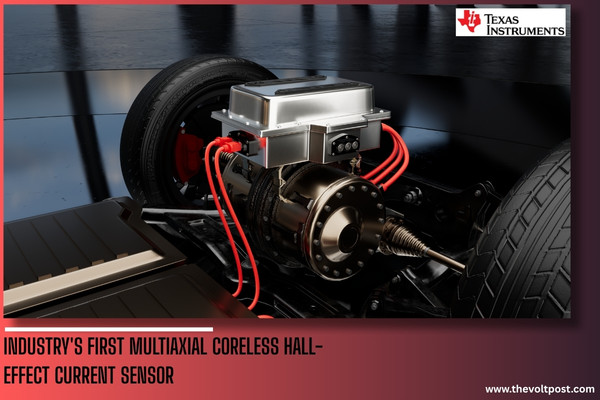
The new TMCS2100-Q1 is aimed at one of the key challenges in EV powertrain design: achieving more accurate current measurement without adding the size and weight associated with conventional magnetic-core solutions.
TI says the sensor combines multiaxial magnetic-field measurement with a proprietary algorithm to improve precision while allowing designers to develop smaller, more power-dense traction inverters.
Unlike existing coreless current-sensing solutions that typically measure magnetic fields along a single axis, the TMCS2100-Q1 measures both horizontal and vertical magnetic fields simultaneously.
According to TI, this approach can deliver up to 20 times greater accuracy than single-axis alternatives, with displacement error below 1% at 0.4 mm movement and as low as 0.25% at 0.1 mm.
The improved accuracy is particularly relevant as automakers move toward 800 V EV architectures, where tighter current measurement can play an increasingly important role in traction inverter performance, efficiency and motor control.
Addressing the accuracy-versus-size trade-off
Traction inverters need to balance several competing requirements. Automakers want them to be smaller and lighter while maintaining the accuracy needed for efficient motor control and power delivery.
Traditional current-sensing approaches have their own limitations. Magnetic-core or C-core solutions can provide high measurement accuracy, but the additional core increases the size and weight of the system. Coreless alternatives, meanwhile, offer a more compact design but can be more susceptible to displacement errors and magnetic crosstalk.
TI’s TMCS2100-Q1 is designed to address this trade-off through multiaxial sensing.
During vehicle operation, vibration can cause movement between the current sensor and the conductor. With conventional single-axis differential coreless sensors, that movement can introduce measurement errors.
By measuring magnetic fields in both horizontal and vertical directions simultaneously, the TMCS2100-Q1 is designed to reduce the impact of vibration-induced displacement and maintain more consistent current measurements.
Improved current accuracy can also help reduce the effects of magnetic crosstalk and torque ripple. In an EV, excessive torque ripple can contribute to jerky acceleration, motor noise and inefficient operation, ultimately affecting driving range and overall vehicle performance.
Smaller, more power-dense traction inverter designs
A key advantage of the new approach is that it removes the need for a magnetic core while maintaining high measurement precision.
TI says this enables designers to develop smaller and more power-dense traction inverters, potentially supporting improvements in vehicle efficiency, range and driving performance.
The sensor also offers greater flexibility in mechanical design. Conventional differential coreless current sensors can require modifications to the busbar, such as notches, slices or holes. These changes can complicate thermal management and limit design options.
The Multiaxial coreless Hall-effect current sensor, TMCS2100-Q1 instead uses a multiaxial sensing architecture that can be positioned relative to the busbar without requiring such modifications. This gives designers more freedom to accommodate different mechanical configurations while making better use of available board space.
Why multiaxial current sensing matters for EVs
Hall-effect current sensors detect the magnetic field generated by current flowing through a conductor, such as the busbar connecting a traction inverter to the vehicle’s motor.
As EV powertrains become more compact and move toward higher-voltage architectures, accurate current measurement is becoming increasingly important. Small changes in sensor position caused by vibration, mechanical tolerances or thermal effects can affect measurement accuracy and, in turn, the inverter’s ability to control the motor.
TI’s multiaxial approach is designed to address these challenges while keeping the sensor footprint small.
The TMCS2100-Q1 is the latest addition to TI’s automotive sensing portfolio and reflects the company’s focus on current-measurement technologies for next-generation HEV and EV powertrains.
To Know More, Read The Technical Article, “Smooth operators: How multiaxial Hall-effect current sensors deliver precise torque control.”
Leadership Comment
“For the first time, engineers have a Hall-effect current sensor that breaks through the limitations of existing solutions,” said Jason Cole, vice president and general manager, Sensing Products at TI. He added that the device was developed using research from TI’s Kilby Labs and is intended to help automakers achieve longer range, smoother ride quality and more efficient motor control.
Availability
Production quantities of the TMCS2100-Q1 Hall-effect current sensor are now available upon request at TI.com.
The following resources are also available: