


Panasonic Energy will present its V-Cell-based Nickel-Metal Hydride (Ni-MH) battery technology in Europe for the first time at InnoTrans 2026 in Berlin, taking place from September 22 to 25. The company will showcase its railway battery portfolio at Hall 15.1, Booth 180.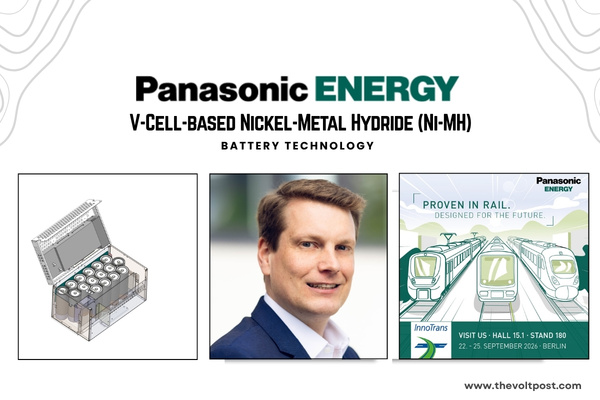
Designed for a broad range of rolling stock, Panasonic Energy’s solutions are intended for applications ranging from high-speed trains to trams and low-floor vehicles.
Visitors will be able to view three battery modules together as part of an integrated portfolio: the V-Type Module, F-Type Module and Ultra-Slim Module.
V-Cell makes European debut
The centrepiece of Panasonic Energy’s exhibition will be the V-Cell, a battery cell developed and manufactured in Japan and deployed there for many years. The technology has been used in demanding railway applications, including Japan’s high-speed rail network.
Its European introduction is intended to give railway manufacturers and operators access to a proven battery platform for high-speed and other advanced rail applications.
The V-Cell’s lightweight, space-saving design allows it to fit the tight installation constraints often found on high-speed trains. Its high energy density is designed to support improved efficiency and performance, while its compact modules operate without routine maintenance or electrolyte refilling.
The battery also includes a built-in Battery Management Unit (BMU), which provides life prediction, communication functions and an LED display.
Three-module portfolio
Panasonic Energy will present the following modules as a flexible portfolio for different vehicle platforms:
- V-Type Module: Based on the V-Cell, this module is designed for demanding railway applications, including high-speed trains where reliability, energy density and long service life are essential.
- F-Type Module: A versatile solution for a wide range of railway vehicles, offering manufacturers and operators a scalable auxiliary power option.
- Ultra-Slim Module: Built around Panasonic’s F-Cell technology, this module is designed for space-constrained vehicles such as trams and low-floor rail vehicles.
Together, the three modules give manufacturers greater flexibility when selecting a battery for a particular vehicle type, while retaining the advantages of a common Ni-MH technology platform.
Field experience in Japan
Panasonic Energy will also highlight its long operational track record in Japan. The company says its decades of experience in demanding railway environments provide an important competitive advantage for European customers looking for dependable and sustainable energy-storage systems.
Its Ni-MH battery systems offer long service life, maintenance-free operation and remote monitoring capabilities. They also avoid environmentally hazardous substances such as lead and cadmium and can be used as an alternative to existing nickel-cadmium battery installations.
Panasonic Energy will welcome railway manufacturers, operators, system integrators, industry analysts and members of the media at its InnoTrans 2026 booth to learn more about the V-Cell’s European launch and the company’s complete railway battery portfolio.
Leadership Comment
“With the introduction of our V-Cell technology to Europe, we are bringing a proven innovation from Japan to the European railway industry,” said Carl-Frederik Riemenschneider, Head of Business Development at Panasonic Industry Europe. “The technology has demonstrated its reliability and performance in some of the world’s most demanding but also successful railway environments. We are excited to make this expertise available to European customers.”
To Know More Abour Panasonic Industry Europe and Its Innovative Ni-MH Battery System: CLICK HERE