


Data Centers in Space and the Role of Modern Semiconductors. The dream of data centers orbiting Earth is brining top tech CEOs to the same board room. It’s all fueled by exploding AI demands, Earth’s energy crunch, and breakthroughs in cheap launches and space hardware.
“Sundar Pichai just called data centers in space “the new normal” within a decade, while Elon Musk has been championing this for years.”
But to make Data Centers in Space operate seamlessly, modern semiconductors comes to play. Semiconductors can make or break how well computing, power, cooling, and connections hold up in orbit’s brutal environment.
Why It’s Gaining Steam
Data centers on the ground are hitting walls, skyrocketing power bills, massive cooling needs, scarce land, and green mandates.
IBM points out some orbital ideas could slash AI training energy costs by up to 95%, cut emissions, and ditch water cooling altogether. That’s why teams are testing if space could deliver cleaner, bigger scale for the right jobs.
Once we think about constant solar power up there, endless room to grow, and no reliance on shaky Earth grids. But we’re not talking about hauling entire server farms into space tomorrow. It’s more about layering in new setups for tasks like remote data crunching or processing right where the info’s born.
What Sets Space Apart
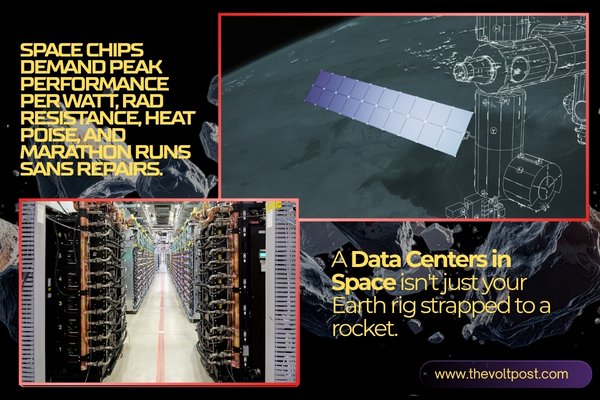
A Data Centers in Space isn’t just your Earth rig strapped to a rocket. It has to shrug off radiation, wild temperature swings, launch vibrations, zero fixes once it’s up, and insane power juggling. For cooling, forget air as there’s no atmosphere to whisk heat away.
So plans lean toward modular satellites or clusters, not mega-warehouses.
IBM sketches scenarios like one bird collecting data while another chews through it, or orbit rigs aiding disaster watch and space ops. Bottom line: early wins will be niche, not your everyday cloud swap.
Semiconductors Calling the Shots in Orbit
These chips will make or break orbital computing. They need top efficiency on power, heat handling, radiation-proofing, and tight packing, a new form of innovation to drive the semiconductor ecosystem.
AI speedsters, next-gen CPUs, tough storage, and power controllers must pack punch without guzzling juice.
Power semiconductors becomes crucial since every watt counts. Infineon’s take on data centers shows how beefy power chips boost density, toughness, and efficiency down here.
It’s do-or-die, with solar panels, batteries, and heat pipes tuned razor-sharp to each chip’s appetite.
Chips Tough Enough for the Void
Radiation’s are another tussle as off-the-shelf silicon flips bits from cosmic rays, locks up, or wears out fast. Enter rad-hard memory, bulletproof controllers, and self-healing designs, powered by cutting-edge nodes, backups, and space-smart packaging.
Memory’s huge too. Orbit needs stuff that holds data forever, grabs it quick, and laughs off abuse without babysitting.
MRAM, next-level flash, and custom embedded types fit perfectly as they flaunt staying power with grit that older tech can’t touch.
Tackling Heat, Packs, and Links
Heat management’s a beast in space. That flips the script on chips, forcing them to thrive in super-slim heat budgets.
Packaging needs major advancements too. Chiplets, mixed-tech stacks, and mini all-in-ones shrink footprints and amp efficiency per watt, gold for payload limits. Platforms fusing brains, storage, power, sensors, and nets into rugged, space-ready bricks.
Big Moves Driving It Forward
Things are heating up fast. IBM flags Europe’s ASCEND study, mapping from a 50kW testbed to full-scale orbit over years, tying into climate wins and data control.
Axiom Space is rigging its station for data operations with laser satellite chats and sealed rooms for Earth-like gear.
Lumen Orbit’s turning heads with sun-powered arrays and dense compute to trim costs and pollution. Heavy hitters like SpaceX and Blue Origin are paving the way with reusable rockets and orbit playgrounds.
Game-Changer for Chip Makers
This opens a wild new playground for semis. Space chips demand peak performance per watt, rad resistance, heat poise, and marathon runs sans repairs. Foundries, memory pros, power gurus, and packagers who nail orbit tweaks stand to cash in.
It amps up the push for homegrown chains too. Nations eyeing space for defense, crises, or secret AI want bulletproof fabs, safe tests, and endless support. That’s where U.S./Euro fabs, niche memory, and trusted nets turn strategic.
Slow Build, Not A Cloud Killer
Rocket bills, fix bottlenecks, lag times, rules, and space junk looms large. Right now, sweet spots are jobs where orbit’s free power and isolation beat the hassle. It’s a slow build, not a cloud killer.