
By Flex Power Modules
Generative AI has transformed the data center into an AI factory, where performance is directly tied to compute density and therefore how much power density you can pack into a rack. State-of-the-art GPUs already are pushing beyond 1 kW per device.
The result is rack power densities that routinely reach megawatt scale, stressing traditional distribution, conversion, and cooling schemes far past their comfort zones. Forced air cooling alone can’t keep up; operators are accelerating liquid and hybrid cooling because thermal overhead from inefficient power conversion magnifies the cooling bill.
In other words, every fractional percentage of efficiency gained upstream pays back twice – once in watts saved, again in watts not needing to be removed.
The industry response is a decisive architectural shift toward high-voltage DC (HVDC) distribution and multi-stage DC/DC power conversion.
Moving from 48 V racks towards ±400 or 800 V DC slashes copper mass and I²R losses.
Converting HVDC to 48 V allows users to rely on existing 48 V bus architectures for power distribution boards and motherboards to down convert to 12 V and then, using voltage regulators to the sub?voltage rails AI processors need.
Why three-step DC/DC conversion wins for AI workloads
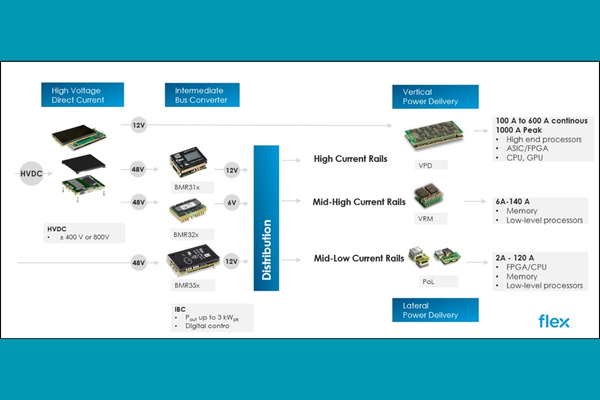
A three-step conversion from HVDC, to an intermediate bus converter (IBC), to vertical power or near-die regulation has become the de facto blueprint for hyperscale and AI deployments (Figure 1):
- HVDC Distribution (±400 V or 800 V DC)
Minimizes current in the busbars, sharply reducing copper weight and conduction losses. It also prepares facilities for >100 kW racks and MW?class clusters now visible on roadmaps. - Intermediate Bus Conversion (48 V ? 12V or 13.2 V or 6–7 V)
The IBC sets the stage for efficient point?of?load regulation. Selecting 4:1 (?12 V) vs 8:1 (?6 V) is a strategic trade-off: at the same kilowatts, 4:1 halves the current in the local bus compared with 8:1, allowing more placement freedom and lower distribution loss ahead of the multiphase VRM. 8:1 shines when boards need very low bus voltages close to the load but expects tighter proximity to the VRM to avoid I²R penalties. - Vertical Power Delivery (VPD) / VRM
Hundreds to >1000 A rails are delivered inches or even millimeters away from the die, often from under the package to minimize parasitics and IR drop. This is where regulation happens at sub-1 V with dynamic load steps driven by GPU/AI transients.
The efficiency compounding across these stages is crucial. With AI racks already exceeding 250 kW an end-to-end improvement of even <1–2 percentage points can eliminate kilowatts of heat and tens of thousands of dollars per rack per year when cooling is included.
Introducing next-gen high density, high efficiency IBCs
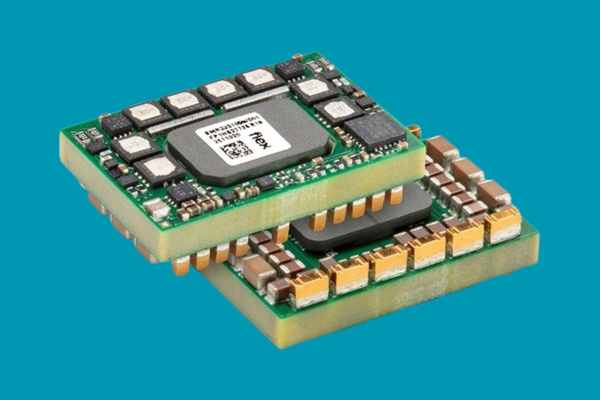
Flex Power Modules delivers a portfolio explicitly tuned for AI data centers: high power density, high efficiency, digital control (PMBus), and consistent footprints so customers can scale without requiring a re-layout of their boards.
- Fixed Ratio 4:1 Intermediate Bus Converter
BMR316 — 1 kW non-isolated, 4:1 unregulated IBC
- Input 38–60 V ? output 9.5–15 V
- Unregulated 4:1 ratio
- 1 kW continuous, 2.8 kW peak (successor to BMR313)
- Up to 97.7% efficiency at 50% load (54 V in)
- Ultra?small LGA: 23.4 ×8 × 7.65 mm; optimized for cold-wall mounting or liquid cooling
- PMBus telemetry; integrates with Flex Power Designer software; https://flexpowermodules.com/flex-power-designer
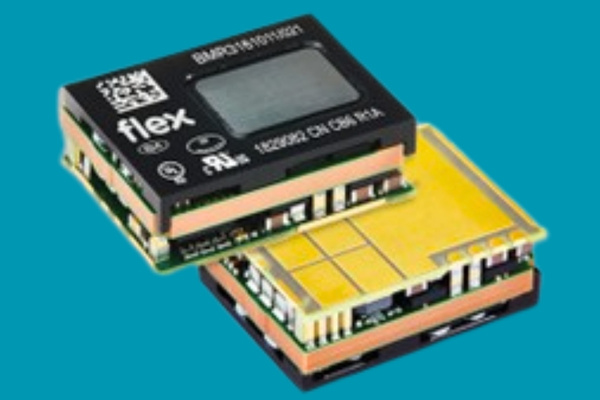
This product targets space–limited AI accelerator cards needing a 12–13.5 V intermediate bus without sacrificing efficiency at peak transients.
2. Regulated 48/54V to 12V quarter brick
BMR352 — 2 kW non-isolated, regulated 12V IBC (quarter brick)
- Input 40–60 V, output 8–13.2 V
- Up to 2 kW continuous, 3 kW peak power
- ~98% peak efficiency, PMBus, active current share for paralleling
- Standard quarter brick footprint for easy thermal/mechanical integration
Use cases: regulated 12 V rails for baseboards and sleds needing tight voltage tolerance across wide load dynamics.
3. Fixed Ratio 8:1 Intermediate Bus Converter
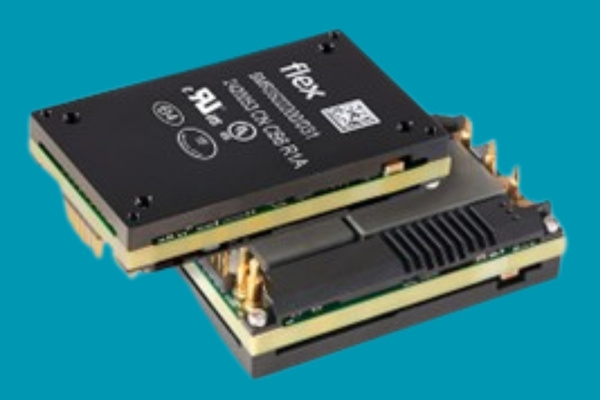
BMR323 — Non-isolated, digital, fixed?ratio 8:1
- Input 40–60 V, output 5.0–7.5 V
- Unregulated 8:1 ratio
- Target: 600 W continuous,1.2 kW peak power
- Up to 97.8% efficiency at 50% load (54 V in)
- Ideal for 6–7 V intermediate rails feeding memory and auxiliary loads that benefit from 8:1 topology.
Designed for the cooling transition
As liquid cooling expands, power modules must cooperate with cold plates, CDUs, and manifold routing. The shift from air to direct-to-chip and immersion variants will continue, but air will still shoulder ~20% of heat removal in hybrid cooling solutions.
Thus, module efficiency remains pivotal, by reducing even 10–20 W of dissipation per converter accumulates to kilowatts per rack, easing pump and chiller loads.
Flex Power Modules’ regulated QB and compact LGA modules operating near 98% in the sweet spot are engineered to be thermal good citizens in this new environment.
Power is now the decisive constraint in AI infrastructure. The winners will be architectures that deliver more compute per rack unit, not by brute force, but by smarter, denser, cooler power.