


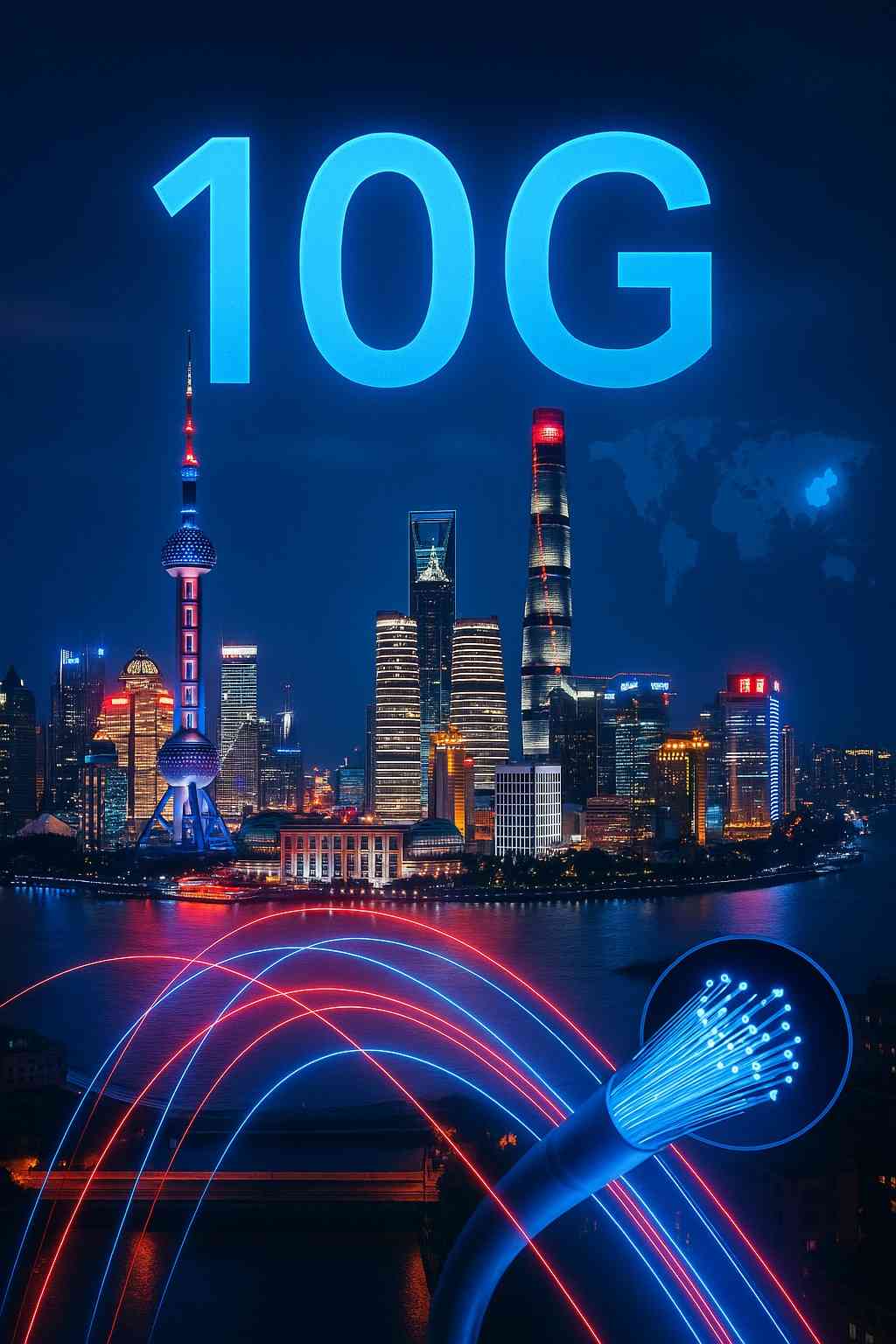
China has reportedly rolled out the world’s first commercial 10-Gigabit (10G) broadband network, powered by 50G Passive Optical Network (PON) technology.
Developed through a landmark collaboration between China Unicom and Huawei, the network achieved real-world speeds of 9,834 Mbps (download), 1,008 Mbps (upload), and latency as low as 3 milliseconds.
While most countries are still in the early R&D stages of 6G or theoretical 7G, has China shattered the global benchmarks, signaling a paradigm shift in digital infrastructure that could redefine how entire industries operate?
How 10G Broadband Will Transform Global Industries
1. Education: The Rise of Immersive Smart Classrooms
With ultra-low latency and massive bandwidth, real-time holographic classrooms, interactive AR lessons, and AI-assisted tutoring will become mainstream.
- Remote learning becomes hyper-immersive with zero buffering for 4K/8K streaming.
- Global classroom exchanges can happen with real-time multilingual translation and gesture-tracking.
- Students in rural or under-connected areas will gain equal access to world-class education tools.
2. Telemedicine: Precision Healthcare Goes Global
10G networks unlock the true potential of telehealth, remote diagnostics, and robotic surgery.
- Remote robotic surgeries can now happen with latency under 3 ms — safer, faster, and more scalable.
- Real-time transmission of high-resolution imaging, such as 3D MRIs, for accurate cross-border consultations.
- Rural clinics can be directly connected to Tier-1 hospitals via cloud-based diagnostic platforms.
3. Enterprise & Remote Work: Office 2.0 Becomes Reality
Work-from-anywhere evolves with seamless access to cloud desktops, virtual collaboration spaces, and instant large data syncs.
- Real-time rendering for architects, engineers, and designers across continents.
- AI model training and deployment become faster with edge-integrated, high-speed cloud access.
- Virtual offices in the metaverse become usable with stable, high-bandwidth environments.
4. Gaming & Entertainment: Zero-Lag, Multi-Reality Worlds
Game studios and streaming platforms can leverage 10G to push boundaries in content delivery and user interaction.
- Cloud gaming with zero latency, even on 4K/8K monitors, becomes widespread.
- Multi-user VR/AR environments, such as virtual concerts, esports tournaments, or shared cinematic experiences, become scalable.
- Real-time facial tracking, haptics, and gesture recognition are now viable in consumer entertainment.
5. Industry 4.0: Smart Manufacturing & Logistics at Full Scale
Factories, warehouses, and supply chains can finally achieve full automation and predictive operations.
- Connected robots can perform precision manufacturing in sync with digital twins in the cloud.
- Instant anomaly detection and AI-driven predictive maintenance will be standard.
- Global logistics hubs can coordinate in real-time, improving efficiency and reducing delays.
6. Autonomous Vehicles & Smart Cities
10G provides the backbone for safe, connected, and intelligent mobility.
- Real-time Vehicle-to-Everything (V2X) communication with centralized traffic control.
- Urban infrastructure like smart traffic lights, emergency response systems, and surveillance gain new responsiveness.
- Autonomous drones for logistics, surveillance, and medical supply delivery become more reliable and scalable.
China’s Global Tech Position Strengthens
This bold leap into 10G territory cements China’s ambition to become the world’s leader in digital infrastructure. The deployment in Sunan County is only the beginning. China Unicom and Huawei plan to expand this 10G ecosystem nationwide, targeting urban hubs, industrial parks, and tech campuses by 2026.
“With this launch, we’re not just upgrading internet—we’re upgrading civilization,” said a Huawei executive. “This is the new electricity for the 21st-century digital economy.”
Looking Ahead: Beyond 10G
The successful commercialization of 10G broadband doesn’t render 6G obsolete—instead, it creates a dual-lane future, where 10G powers fixed broadband and edge devices, while 6G focuses on satellite, mobile, and aerial connectivity.
Key Metrics of China’s 10G Network
| Metric | Value |
|---|---|
| Download Speed | 9,834 Mbps |
| Upload Speed | 1,008 Mbps |
| Latency | 3 milliseconds |
| Core Technology | 50G PON (Passive Optical) |
| Lead Partners | Huawei & China Unicom |
| First Deployment | Sunan County, Hebei |
Why This Matters
China’s 10G broadband deployment is not just a technological upgrade—it’s a foundational move that will redefine competitiveness, equity, and efficiency across industries globally.
As the digital race intensifies, the world will now have to play catch-up—not with 6G, but with a 10G-powered future that is already here.