



Xiaomi has significantly expanded its semiconductor ambitions with the unveiling of three self developed chips spanning smartphones, on device artificial intelligence and autonomous driving.
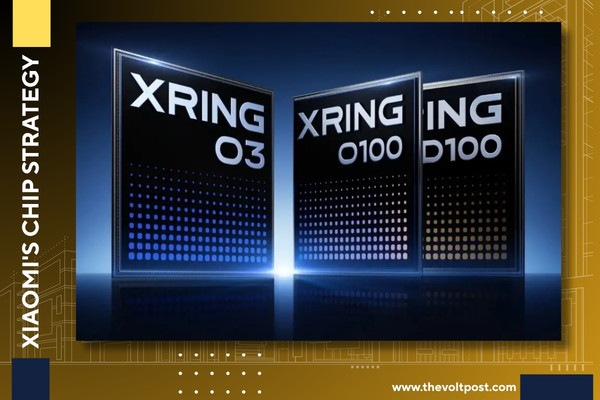
The company introduced the Xuanjie O3 flagship smartphone SoC, Xuanjie O100 AI accelerator and Xuanjie D100 autonomous driving processor at a technology communication event in Beijing on August 24.
The launch marks a broader shift in Xiaomi’s chip strategy from developing a smartphone processor to building an in house computing platform across its wider ecosystem.
The most immediate focus is the Xuanjie O3, which is scheduled to debut in September in the Xiaomi 18 Fold. Xiaomi has also positioned the chip for use in the Xiaomi Pad 9 Pro Max.
Xiaomi expands its semiconductor strategy
Xiaomi’s latest move comes after years of investment in proprietary chip development.
Founder and CEO Lei Jun said the company has invested more than RMB 21 billion in large scale chip research and development over more than five years. The semiconductor organisation has grown to nearly 3,000 specialists.
The scale of that investment highlights the strategic importance of silicon to Xiaomi. Rather than relying exclusively on third party processors, the company is developing its own computing platforms that can be tuned to its smartphones, AI models, connected devices and vehicles.
Reuters reported that the strategy is also intended to give Xiaomi greater control over product features and reduce its dependence on external chip suppliers.
The company continues to work with suppliers such as Qualcomm and MediaTek, meaning the new chips are currently an additional platform rather than a complete replacement for external silicon.
Xuanjie O3 brings 3nm processing and LPDDR6
The Xuanjie O3 is the flagship of the three new chips.
Built using a 3nm process, the processor integrates 24 billion transistors in a 133 square millimetre die. Its CPU uses a 10 core all performance core configuration consisting of six larger cores and four large cores, with a maximum clock speed of 4.35GHz. Xiaomi says multi core performance has improved by around 60 percent compared with the previous generation.
The chip also introduces a 16 core G2 Ultra NX GPU with ray tracing capabilities. Xiaomi claims an 85 percent improvement in graphics performance compared with the previous generation, while power consumption at equivalent performance levels can be reduced by as much as 64 percent.
Memory is another major part of the O3’s design. Xiaomi says it is the first mobile processor to support LPDDR6, with memory speeds reaching 10,667Mbps and bandwidth of 113.8GB/s.
That memory upgrade is particularly important as smartphones increasingly handle generative AI workloads locally. Faster memory can help feed processors and accelerators with data more efficiently, making memory bandwidth an increasingly important part of overall AI performance.
AI moves closer to the device
Xiaomi has designed the O3 with on device AI as a central capability rather than treating it as an additional feature.
The company says the redesigned NPU can deliver up to 200 TOPS of tensor computing and 3.13 TFLOPS of vector computing. The architecture also distributes AI acceleration across several parts of the processor, including the CPU, GPU, image signal processor and display processing unit.
This approach is aligned with the industry’s broader move towards local AI processing. Running more workloads directly on smartphones can reduce reliance on cloud connectivity while improving response times for applications such as image processing, translation, personal assistants and generative AI.
The O3 is also being developed around Xiaomi’s MiMo AI model, reinforcing the company’s attempt to align its software and silicon roadmaps.
Xiaomi says the processor achieved an AnTuTu score of 5.22 million, becoming the first mobile platform to cross the five million mark in the company’s cited testing. The figure remains a vendor reported benchmark and will need to be assessed against independent testing once commercial devices become widely available.
O100 targets high bandwidth AI workloads
The second chip, Xuanjie O100, takes Xiaomi’s silicon strategy beyond the smartphone application processor.
The O100 is designed as a high bandwidth AI accelerator for on device large language model workloads. Xiaomi says it uses 6nm wafer on wafer three dimensional stacking combined with hybrid bonding, with a bonding pitch of 1.4 micrometres.
The architecture delivers claimed bandwidth of up to 1.22TB/s. Xiaomi says the accelerator can reach local inference speeds of up to 330 tokens per second when used with the O3.
The significance of the O100 goes beyond raw bandwidth. AI processors are increasingly constrained by the movement of data between memory and compute resources. Advanced packaging and vertically stacked memory are emerging as important approaches to address that challenge.
D100 extends Xiaomi’s chip ambitions into autonomous driving
The third processor, Xuanjie D100, targets autonomous driving and high compute automotive AI workloads.
Xiaomi describes the D100 as a 3nm high performance AI chip for intelligent driving. It combines a 20 core CPU with a 16 core NPU and supports up to 160GB of unified memory. The company says the platform can locally deploy models with as many as 200 billion parameters.
The D100 represents an important extension of Xiaomi’s semiconductor programme because the company’s automotive business has become an increasingly significant part of its broader technology strategy.
By developing dedicated silicon for vehicles, Xiaomi can potentially optimise computing architecture around its own intelligent driving software and vehicle platforms.
Three chips point to one larger strategy
The three processors have different target applications, but together they reveal the direction of Xiaomi’s semiconductor roadmap.
The O3 addresses flagship smartphones and tablets. The O100 focuses on high bandwidth AI acceleration. The D100 targets autonomous driving.
This gives Xiaomi a silicon portfolio that stretches across consumer devices, AI computing and vehicles. Industry reporting has described the development as an expansion of the company’s previously more narrowly focused smartphone chip programme.
The timing is also significant. Xiaomi is attempting to build greater control over its computing architecture at a time when AI is increasing demand for processing power, memory bandwidth and specialised accelerators across almost every technology segment.
Qualcomm and MediaTek remain important
Despite the scale of Xiaomi’s semiconductor investment, the new chips are not expected to eliminate the company’s dependence on Qualcomm and MediaTek in the near term.
The Xuanjie O3 is initially expected to ship in relatively limited volumes, with market reports putting the first Xiaomi 18 Fold shipment target at roughly 200,000 to 300,000 units. That is small compared with Xiaomi’s overall smartphone volumes.
This means the immediate significance of the O3 is less about replacing external suppliers and more about giving Xiaomi an additional platform for product differentiation.
A proprietary SoC allows a device maker to coordinate processor architecture, operating system, AI models, imaging, power management and other hardware functions more closely. It can also provide greater flexibility when negotiating with external silicon suppliers.
Xiaomi’s position is therefore different from companies that have been pushed towards proprietary chips by supply restrictions. The company can continue sourcing processors externally while gradually increasing the role of its own silicon. Reuters noted that this flexibility is an important distinction in Xiaomi’s strategy.
September will provide the first real market test
The Xuanjie O3 is scheduled to enter the market with the Xiaomi 18 Fold in September. The processor is also expected to feature in the Xiaomi Pad 9 Pro Max.
That launch will provide the first opportunity to evaluate whether Xiaomi’s performance claims translate into sustained real world performance, battery efficiency and user experience.
The O100 and D100 face a longer road. Both have completed development and are expected to enter commercial deployment in 2027.
For Xiaomi, the bigger question is not whether it can design a competitive chip. The company has now demonstrated that capability. The more difficult challenge will be scaling production, improving yields, supporting software ecosystems and deploying its silicon across enough products to justify the enormous investment behind the programme.
The three chip launch therefore represents more than another smartphone processor announcement. It signals Xiaomi’s attempt to make semiconductors a core part of its technology stack, from mobile devices and AI computing to intelligent vehicles.
If the Xuanjie O3 performs as promised once it reaches consumers, Xiaomi could gain a stronger position in the increasingly competitive market for proprietary mobile silicon.
The commercial rollout of the O100 and D100 in 2027 will show whether that strategy can extend beyond smartphones and become a broader computing platform for Xiaomi’s ecosystem.
Sources and references
- BigGo Finance, reporting on Xiaomi’s August 24 Xuanjie chip announcement. BigGo Finance report
- Reuters, reporting on Xiaomi’s Xring O3 launch, TSMC manufacturing and the company’s semiconductor investment. Reuters report
- 21st Century Business Herald, reporting on Xiaomi’s three chip strategy and commercial roadmap. 21st Century Business Herald report
- Interface News, analysis of Xiaomi’s expansion from smartphone SoCs into AI computing and intelligent driving. Interface News report