



Critical infrastructure operators are living with a dangerous illusion of security. While nearly 9 out of 10 industrial executives believe their cyber defenses are top-notch, a stark new report shows that most don’t even know what equipment is connected to their networks, a blind spot currently costing companies up to $500,000 for every hour a cyberattack knocks them offline.
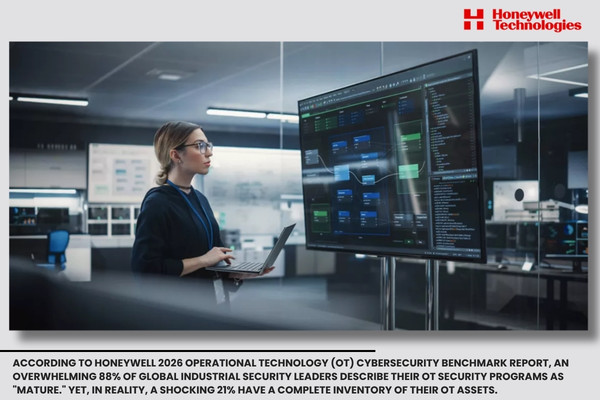
According to Honeywell 2026 Operational Technology (OT) Cybersecurity Benchmark Report, an overwhelming 88% of global industrial security leaders describe their OT security programs as “mature.” Yet, in reality, a shocking 21% have a complete inventory of their OT assets.
That disconnect is taking a massive toll on real-world operations. The survey reveals that major cyber incidents now force an average of 16.2 hours of downtime, causing financial bleeding that extends far beyond the IT department.
Executives increasingly view these attacks not as mere tech glitches, but as core operational disruptions that directly threaten employee safety, production schedules, and customer trust.
The threat is particularly severe in critical sectors:
- Energy & Utilities: A staggering 91% of respondents reported suffering a significant OT cybersecurity incident over the past 12 months.
- Maritime: 87% experienced a major operational cyber incident in the last year.
- Oil & Gas: More than half (54%) were hit by a significant OT incident in the same period.
- Healthcare: Facilities remain deeply exposed, with only 19% of healthcare respondents reporting that their building and facility systems are fully integrated into cyber monitoring and protection networks.
Across all sectors, basic operational visibility remains surprisingly thin. Only a third (33%) of surveyed organizations have fully integrated their operational technology into a centralized security operations center (SOC). Even worse, just 20% continuously monitor connected IoT devices like security cameras and environmental sensors, leaving massive backdoors open to attackers.
The report also highlights a massive gap in how companies plan to use artificial intelligence. While 99% of leaders expect AI to dramatically reshape OT security within the next two to three years, only 23% are currently using autonomous or agentic AI systems for real-time threat detection.
 The takeaway for industrial operators is simple: visibility is everything. Organizations with comprehensive asset tracking and monitoring are four times better positioned to spot incoming threats, halt breaches, and restore normal operations quickly when an attack hits.
Honeywell’s findings are based on a global survey of more than 600 cybersecurity risk, compliance, and operations executives across the Americas, EMEA, and APAC regions, covering key sectors including energy, oil and gas, healthcare, maritime, and manufacturing.
Leadership Comment
“As cyber threats increasingly impact physical operations, resilience depends on extending cybersecurity across every connected system that supports uptime and business continuity,” said Jim Masso, President and CEO of Honeywell Technologies Process Automation. “Organizations can no longer afford to have this visibility gap.”
To read the full report, CLICK HERE.