



Intel has announced two major leadership appointments aimed at strengthening its core product business and accelerating its innovation roadmap.
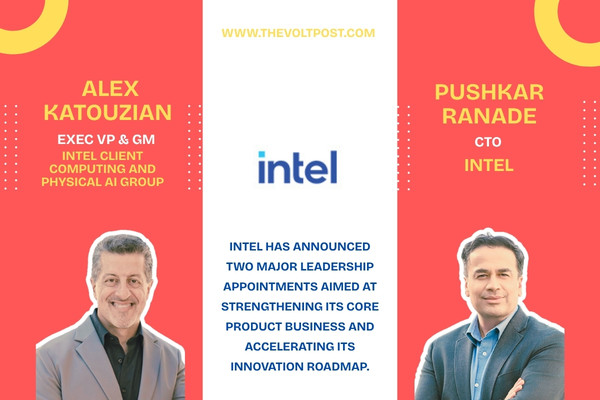
Alex Katouzian has been named executive vice president and general manager of Intel’s Client Computing and Physical AI Group.
In this role, he will lead efforts to align Intel’s client computing portfolio with the fast-evolving world of physical AI, spanning robotics, autonomous systems, and next-generation AI-driven devices.
Katouzian joins Intel from Qualcomm Technologies, where he most recently served as executive vice president and general manager of mobile, compute, and extended reality (XR). He is known for his strong technical vision and a proven ability to execute at scale. He is set to join Intel in May.
In addition, Intel has officially appointed Pushkar Ranade as chief technology officer, moving him out of the interim role. As CTO, Ranade will be responsible for shaping Intel’s overall technology strategy, leading special initiatives, and advancing key areas such as quantum computing, neuromorphic systems, photonics, and advanced materials.
Ranade will also continue in his role as chief of staff to the CEO, helping ensure close alignment between Intel’s technology direction and business priorities.
Both Katouzian and Ranade will report directly to CEO Lip-Bu Tan.
 Leadership Comments
“AI is creating unprecedented opportunities at the edge, driving a sea change in client computing and physical AI systems,” said Lip-Bu Tan, Intel CEO. “Alex brings deep technical expertise, strong operational discipline, and decades of experience building and scaling global compute platforms. He is the right leader to help us reimagine client computing beyond the traditional PC and align this future with the next wave of growth in physical AI.”
“Intel is creating the foundation for AI-driven transformation, from leading in AI PCs, to scaling AI inference at the edge, and accelerating the future of physical AI systems,” said Katouzian. “I’m excited to join Lip-Bu and the Intel team at this critical moment to help scale innovation and deliver the next generation of computing experiences.”
To Know More: CLICK HERE