



A new separator design from researchers at Hanbat National University is helping lithium-metal batteries keep up with the demands of fast charging and discharging without sacrificing stability or safety.
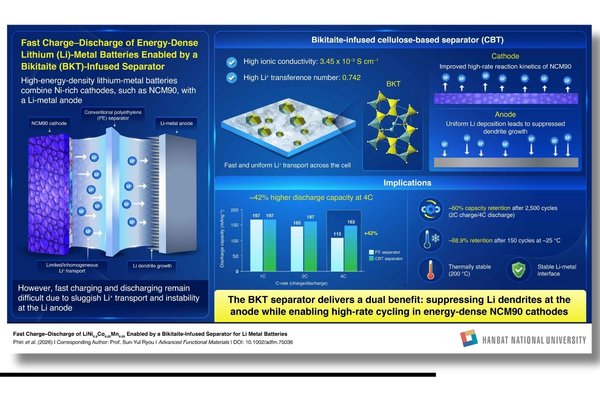
Image credit: Professor Sun-Yul Ryou from Hanbat National University
License type: Original Content
Usage restrictions: Cannot be reused without permission
The bottleneck in high-energy batteries
Lithium-metal batteries paired with ultra–high-nickel cathodes like NCM90 (LiNi?.?Co?.??Mn?.??O?) promise much higher energy density than today’s lithium-ion cells.
But push them hard, say at 4C discharge rates and performance often collapses.
On the anode side, uneven ion flow triggers dendrite growth, which eats up active lithium, degrades the solid electrolyte interphase (SEI), and can even short the cell.
A Mineral-Infused Separator That Guides Ions
To tackle this, Professor Sun-Yul Ryou’s team engineered a cellulose-based separator infused with bikitaite, a zeolite mineral, dubbed CBT.
The porous cellulose scaffold provides mechanical strength, while bikitaite’s ion-conducting channels create interconnected pathways that shepherd lithium ions more uniformly across the cell.
The result is stated as an ionic conductivity of 3.45 × 10?³ S cm?¹ and a lithium-ion transference number of 0.742, numbers that translate into lower polarization and steadier electrochemistry under high-rate stress.
High-Rate Cathode Performance
At modest 1C discharge, both CBT and conventional polyethylene separators delivered about 197 mAh g?¹ from the NCM90 cathode.
But as rates climbed, the gap widened. At 2C, CBT held 187 mAh g?¹ versus 165 mAh g?¹ for the standard separator. At 4C, CBT reached 163 mAh g?¹, a 42% jump over the 115 mAh g?¹ seen with polyethylene.
That’s notable because separator tweaks are usually expected to help the anode; here, the cathode’s high-rate capability improved substantially too.
Dendrites Held In Check, Cycle Life Extended
On the lithium-metal batteries side, real-time imaging showed smooth, compact lithium plating with no visible dendrites in CBT-equipped cells. During stripping, lithium came off more uniformly, reducing dead lithium formation and SEI damage.
Those gains carried through in long-term testing. Li||NCM90 cells cycled at 2C charge/4C discharge retained roughly 60% capacity after about 2,500 cycles with CBT.
Cold performance also improved: around 68.9% capacity remained after 150 cycles at ?25 °C. And the separator stayed intact at 200 °C, a useful safety margin.
Importance of This Scaling
Swapping in a functional separator is far less disruptive than reinventing cathodes or anodes.
Ceramic-coated separators are already common in commercial cells, so adding ion-guiding chemistry like bikitaite could slot into existing manufacturing lines with relatively modest changes.
The study doesn’t yet cover pouch or cylindrical formats, and scale-up validation remains a next step. Still, the findings point to a practical lever, separator engineering to unlock faster, more stable high-energy batteries.
Key Comments
“Our results show that battery performance can be improved not only through new cathode and anode materials, but also through separator engineering. What was particularly interesting was that the effect of the modified separator extended beyond the lithium-metal anode and significantly improved the high-rate performance of the NCM90 cathode,” explains Prof. Ryou.
“Functional separators should not be viewed only as barriers that separate the two electrodes or as a means of protecting the lithium-metal anode. By controlling ion transport across the cell, they could become an important design element for simultaneously achieving high energy density and high-rate operation in next-generation batteries,” concludes Prof. Ryou.
Reference Title of original paper: Fast Charge-Discharge of LiNi0.9Co0.05Mn0.05 Enabled by a Bikitaite-Infused Separator for Li Metal Batteries Journal: Advanced Functional Materials DOI: 10.1002/adfm.75036