



South Korea’s INFAC Corporation has developed a new 800V battery pack design for electric vehicles that integrates a high-power, isolated and regulated 800V-to-48V DC-DC converter directly inside the battery pack.
The approach is designed to simplify EV power distribution while reducing the weight, space and cost associated with high-voltage cables, connectors and external DC-DC converter systems. By stepping down high-voltage power at the source, INFAC can distribute 48V SELV power across the vehicle through a more modular zonal architecture.
At the heart of the design are Vicor’s high-density BCM6135 DC-DC converters and PRM3735 regulators. The combination provides the high-voltage-to-48V conversion and regulation needed to support INFAC’s compact battery-integrated power architecture, while meeting the tight space requirements of modern EV battery packs.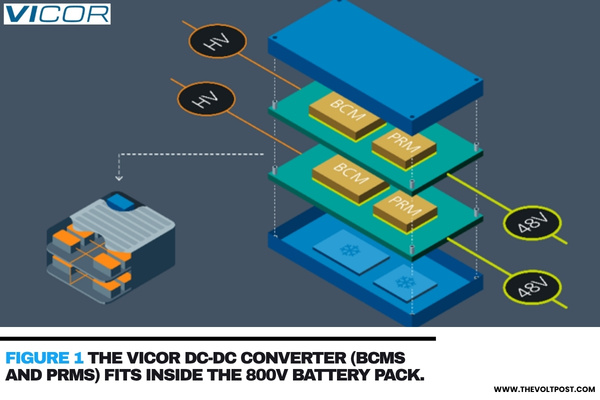
Bringing DC-DC conversion into the battery pack
Traditionally, high-voltage DC-DC converters are installed outside the battery assembly system, whether the vehicle uses an 800V or 400V architecture. That arrangement adds to the complexity of the vehicle because the external converter requires its own thermal management, safety provisions, wiring, brackets and enclosure.
INFAC took a different approach by moving the DC-DC conversion stage into the battery itself.
The company recognized that the battery pack already has a liquid cooling system capable of managing significant thermal loads. Using that existing infrastructure for the integrated power module eliminates the need for a separate cooling system for an externally mounted DC-DC converter.
This also changes the role of the battery pack within the vehicle. Instead of functioning primarily as an energy source, the battery becomes a central power hub capable of supplying both high-voltage power to the drivetrain and regulated 48V power to other vehicle systems.
The EV motor and inverter can require hundreds of kilowatts and continue to rely on high-voltage distribution. At the same time, many powertrain, body and chassis electronics operate in the 3.5kW to 12kW range and can be supplied through a 48V SELV zonal network.
By integrating the DC-DC conversion stage at the battery, INFAC reduces the need to maintain separate high-voltage and low-voltage power distribution paths.
Cutting weight, space and system complexity
The battery-integrated design addresses several of the challenges associated with conventional EV power architectures.
Because the DC-DC converter is located inside the battery pack, high-voltage cable runs can be shortened and the associated harnesses can be simplified. The design also reduces the number of external brackets, enclosures and cooling components required around the vehicle.
Using the battery’s existing liquid cooling network further reduces the number of coolant loops and thermal interfaces. Fewer connections and cooling paths can also mean fewer potential leak points and electrical failure risks.
INFAC says the compact DC-DC package can be integrated into the battery without taking space away from battery cells, helping preserve the vehicle’s available energy capacity and range.
The approach also reduces the need for a dedicated cooling system for a remote converter, saving both weight and cost.
Enabling 48V zonal architectures
The move toward 48V zonal architectures is being driven by the need to simplify vehicle wiring as the number of electronic functions in EVs continues to grow. Instead of running long wiring harnesses throughout the vehicle, power can be distributed locally to different zones.
INFAC’s architecture supports this transition by converting 800V battery power to 48V at the source. This allows lower-voltage distribution to be used for a wide range of vehicle electronics while keeping high-voltage distribution focused on systems that actually require it.
The result is a more compact and flexible approach that can be adapted to different EV platforms without changing the battery cell configuration or compromising available range.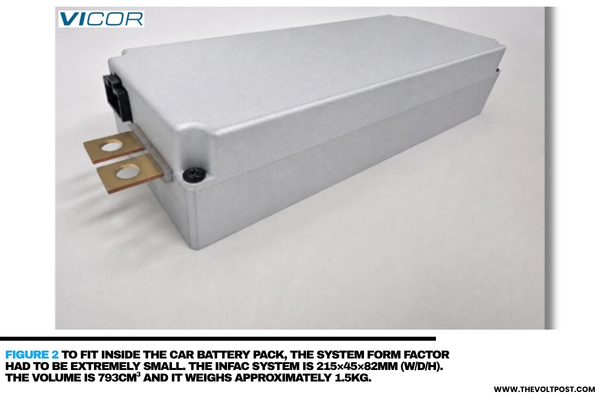
Vicor modules address the packaging challenge
Integrating a high-voltage DC-DC converter inside a battery pack has historically been difficult. Designers have had to balance limited space with power density, electrical isolation, thermal management, safety and the mechanical demands of the battery environment.
Vicor’s high-density BCM6135 and PRM3735 combination helped the company overcome those packaging constraints. The modules provide the compact form factor and power architecture required to place the conversion and regulation functions within the battery pack.
For INFAC, the result is a battery architecture that combines energy storage with power conversion and distribution in a single system.
By using the battery’s existing cooling infrastructure and reducing external high-voltage connections, the design offers a path toward lighter, more compact and simpler EV platforms. It also gives manufacturers greater flexibility in adopting 48V zonal power architectures as vehicle electrical systems become increasingly complex.