



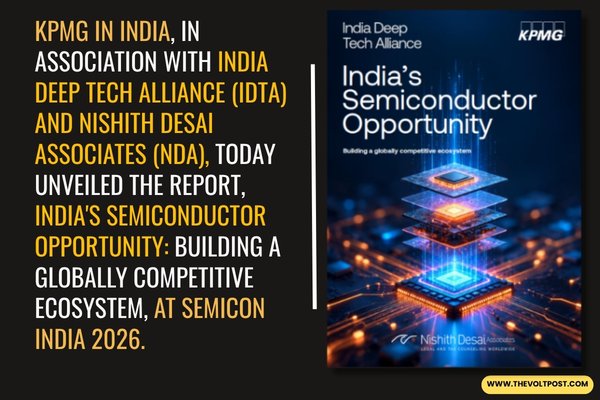
KPMG in India, in association with India Deep Tech Alliance (IDTA) and Nishith Desai Associates (NDA), today unveiled the report, India’s Semiconductor Opportunity: Building a Globally Competitive Ecosystem, at SEMICON India 2026. The report examines how India can leverage policy support, growing domestic demand, engineering talent and emerging manufacturing capabilities to build a globally competitive semiconductor ecosystem.
The report comes approximately one year after IDTA was launched at SEMICON India 2025 as an industry-led initiative to mobilise long-term private capital, technical expertise and ecosystem support for Indian deep-tech companies.
It takes an ecosystem-wide view of the semiconductor opportunity and the capabilities India must build across the value chain.
Demand Projected to Roughly Double by 2029-30
According to the report’s segment-wise demand assessment, India’s semiconductor demand is projected to rise from approximately USD 44 billion in 2025-26 to around USD 90 billion by 2029-30.
Mobile and wearables are projected to constitute the largest segment, with estimated demand of approximately USD 42.13 billion by 2029-30.
An Ecosystem-Wide Opportunity
India’s semiconductor ambitions extend beyond fabrication and pursued through a focused strategy aligned with its demand profile and existing strengths.
Building a globally competitive industry will require capabilities across semiconductor design, manufacturing, advanced packaging, equipment and materials, research and development, talent, supply chains and the commercialisation of new technologies.
In this context, the report identifies indigenous intellectual-property creation and commercialisation as an important element of India’s semiconductor strategy.
Patent Landscape Highlights Strengths and Gaps
The report maps India’s semiconductor patent landscape over the decade to June 2026. It records approximately 78,000 published patent applications and approximately 28,000 grants during the period.
Within the technology categories tracked by the report, semiconductor accelerators account for roughly 92 per cent of filings.
Filing activity is led by the research centres of global firms, with only one academic institution, IIT Madras, in the tracked top ten.
Patents in advanced packaging, high-bandwidth memory and chiplets, all supply-constrained globally, remain comparatively thin in India’s portfolio.
Packaging filings are spread across bonding, interconnect, interposer and thermal and power technologies, an area where India can build capability without the capital intensity of leading-edge wafer fabrication.
The report expects the assembly, testing and packaging push under Semicon 2.0 to broaden India’s patent footprint into process technology, thermal management and interconnects.
Trade Secrets Identified as a Legal Priority
The report also makes the case for closing a gap in India’s legal framework. Much of what semiconductor companies most need to protect is confidential technical know-how rather than patentable inventions.
In the absence of a dedicated trade secrets statute, disputes are litigated case by case without a statutory definition, a dedicated forum or a predictable remedy.
The report identifies trade secrets legislation as a priority for a country seeking to attract design and manufacturing investment.
A Phased Pathway to Global Competitiveness
Against this evidence base, the report sets out a phased pathway: scale India’s strengths in semiconductor design and advanced packaging while developing mature-node and compound-semiconductor fabrication; build capabilities in materials, equipment, testing, commercialisation and R&D; and position India over the longer term for advanced-node technologies, AI accelerators and high-performance computing chips.
The report also examines the importance of coordinated action across government, industry, investors, research institutions and startups.
As global semiconductor value chains become increasingly strategic and geographically diversified, India has an opportunity not merely to participate in those value chains, but to establish globally relevant capabilities across multiple layers of the ecosystem.
Key Comments
Arun Kumar, Executive Committee’s Chair, India Deep Tech Alliance, said:
“India’s semiconductor opportunity is no longer simply about whether the country can participate in the global semiconductor industry; it is about how rapidly and how deeply we can build capabilities that are globally competitive. That requires looking beyond individual projects to the entire ecosystem. This report seeks to identify the building blocks needed to convert India’s current momentum into enduring competitive advantage.”
Akhilesh Tuteja, Partner & National Leader – Clients and Markets, KPMG in India, said:
“Semiconductors are no longer just an enabler of digital transformation; they have become a cornerstone of technological sovereignty, economic resilience and national competitiveness. As nations recalibrate supply chains and secure critical technology capabilities, India has a unique opportunity to translate its strengths in talent, innovation and manufacturing into lasting strategic advantage. Building trusted and resilient semiconductor capabilities across the value chain will be essential not only for reducing external dependencies, but also for strengthening India’s position in the global technology landscape and advancing its Viksit Bharat @2047 vision.”
Nishith Desai, Founder, Nishith Desai Associates, said:
“Semiconductors sit at the heart of the digital economy and increasingly shape national competitiveness, technological resilience and strategic autonomy. India has built formidable strength in chip design and engineering talent; the next step is to translate that strength into globally valuable, India-owned intellectual property. By combining capital and manufacturing capacity with stronger IP creation, commercialisation and protection, India can emerge not only as a semiconductor manufacturing destination, but also as a globally significant centre of semiconductor innovation.”
With semiconductor demand projected to nearly double by 2029-30, India has a significant opportunity to strengthen its position across the semiconductor value chain.
The report highlights a phased pathway for building globally competitive capabilities in design, manufacturing, advanced packaging, innovation and intellectual property, helping translate this opportunity into long-term economic and strategic advantage.
The report is available for download on IDTA’s website here.