


Thermal cameras such as the Flir T540 are emerging as useful tools for predictive maintenance at large-scale power generation sites. One example is an 80 GW integrated hydro-wind-solar base in southwest China, which used the T540 with a dual field-of-view lens to help solve major O&M issues.
China’s rapid buildout of photovoltaic capacity has made it a central market, with the country now accounting for more than 40% of global capacity. But despite the momentum, the PV sector still faces persistent challenges, including intermittency, output swings, accuracy issues, operational risks and the inefficiencies of traditional operations and maintenance (O&M) models.
To tackle those problems, more companies are turning to infrared imaging. Thermal cameras such as the Flir T540 are emerging as useful tools for predictive maintenance at large-scale power generation sites. One example is an 80 GW integrated hydro-wind-solar base in southwest China, which used the T540 with a dual field-of-view lens to help solve major O&M issues.
A key advantage of the Flir T540 professional infrared thermal camera is its pairing with the FlexView dual field-of-view lens. The setup allows users to switch instantly between a 24° standard FOV and a 14° telephoto FOV without changing lenses manually, helping teams localize faults more quickly and accurately.
Using thermal imaging data and on-site conditions, the O&M team adopted a more proactive maintenance strategy that improved inspection efficiency, boosted accuracy and reduced both cost and downtime.
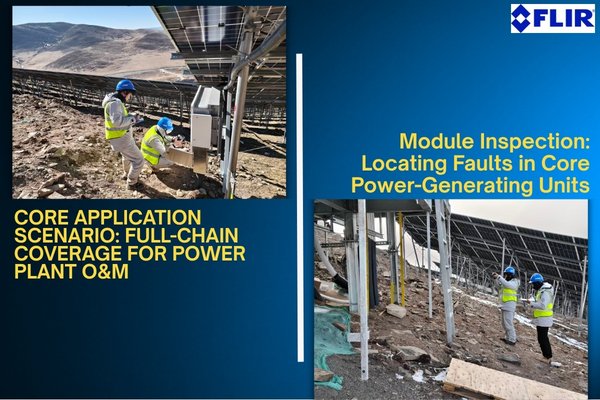
At the module level, the camera helps identify several common defects. Hot-spot problems caused by shading, damage or diode failure can show up as temperature differences above 5°C, allowing repairs within 24 hours and helping avoid 20% to 50% power loss.
Micro-cracks and cold-solder joints appear as linear or mesh-like low-temperature patterns of about 1°C, making it possible to repair them within 72 hours and extend module life. PID degradation, meanwhile, shows up as stripe-shaped high-temperature zones along module edges, which the T540 can detect early enough to support resolution within seven days before the damage spreads.
The camera is also being used to inspect critical equipment, including inverters and transformer boxes, where overheating on heat sinks and terminals can be caught before burnout occurs. In battery banks, it helps identify localized overheating. On insulated busbars, it can reveal poor contact or insulation aging before short circuits develop. It can also detect abnormal temperature rises in SVG units, incoming cables, support structures and transmission lines, helping reduce downtime and safety risks.
The dual FOV lens also improves inspection safety by letting operators spot short-circuit risks from a safer distance.
 Taken together, the case shows how the