



Vivek Raghunathan, CEO and Co-Founder of Xscape Photonics, speaks with Niloy Banerjee, Group Editor of The Volt Post, about how the company’s FalconX and ChromX platforms aim to transform data-center architecture turning racks of discrete accelerators into a cohesive, ultra-low-latency compute fabric.
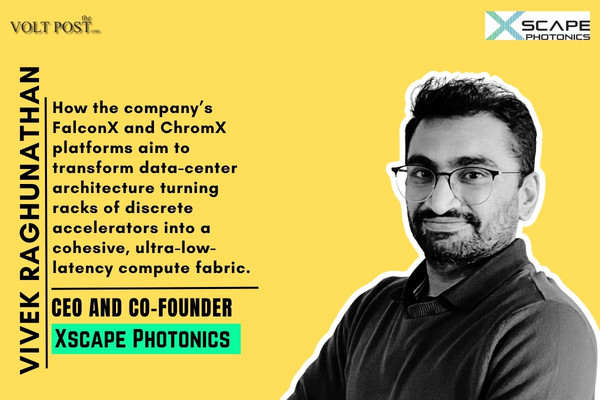
In this Volt-Full interview they discuss FalconX’s multi-wavelength CombX laser and ELSFP form factor, the tangible performance and cost benefits hyperscalers can expect, early integration and validation hurdles, go-to-market plans with major cloud players, and the roadmap from FalconX to a 128+-color ChromX platform.
Vivek also cover reliability and TCO advantages, investor and partner roles in ecosystem adoption, India’s strategic importance for silicon-photonics deployment, and the company’s near-term milestones as it scales from evaluation kits to volume production. Edited Excerpts Below.
How does FalconX fit into Xscape’s bigger vision of turning the entire data center into something that feels like “one giant GPU,” and what specific performance or cost benefits do you expect hyperscalers to see?
FalconX is a foundational step towards realizing that vision. Today’s data centers are constrained by the limits of electrical and copper-based interconnects, which force GPUs to be tightly grouped, workloads to be carefully partitioned, and data flow to be severely bottlenecked out of individual components/accelerators.
As such, operations are segmented and rely on careful arrangement to optimize performance around just how fast data can be moved around – hardly a single consolidated unit.
Multi-wavelength, high-bandwidth optical channels like FalconX can produce significantly more data that can flow freely between accelerators, making distributed data center systems behave more like a unified compute resource.
At a hyperscale level, it allows for more efficient GPU use (less idling and more uptime), better energy efficiency through electrical use and cooling demands, faster model training times, more predictable and reliable performance with lower latency, and more.
Ultimately, wavelength optical technology like FalconX will unlock better performance at a lower cost per workload.
From a systems-level standpoint, what makes FalconX’s eight-wavelength redundant CombX laser fundamentally different from conventional ELSFP or multi-laser approaches, and how does that difference translate into better reliability and total cost of ownership for AI clusters?
CombX is Xscape Photonics’ proprietary comb-based laser technology. For those unfamiliar with the term, it is a laser emitter capable of producing multiple wavelengths (or colors) of light, currently between 8-16, from a single on-chip component that’s pumped with one discrete laser.
FalconX is unique, and an industry-first, in its fully redundant combination of the comb-based laser and the ELSFP form for generating and scaling optical bandwidth.
Though there are other multi-wavelength solutions out there, most generate each wavelength separately via multiple distinct laser sources.
As such, other ELSFP solutions require buying 8 discrete laser sources to generate 8 colors, and if a redundancy is needed for every color, this jumps to 16 additional components.
FalconX’s multi-wavelength capability means redundancy can be incorporated from the beginning, either by providing additional colors on the same chip and or buying an additional pump laser. This brings down total components significantly, thereby bringing down cost and improving reliability.
Hyperscalers are increasingly building their own photonics-in-the-rack solutions. How do you position FalconX as a complementary building block or a competitive alternative and what is your go-to-market strategy with these large customers?
Hyperscalers are building their own racks but still looking to buy pluggable lasers from multiple vendors.
OCI-MSA between Broadcom, AMD, Meta, OpenAI, Nvidia and Microsoft was introduced as a standard to encourage multi-vendor laser sourcing.
Xscape’s FalconX is the industry’s first OCI MSA compliant laser that can be sold to hyperscalers and accelerator vendors alike.
FalconX is the first step toward ChromX and your roadmap to 128+ colors. How are you balancing the need to bring FalconX to market quickly with the longer-term R&D required to scale up channel counts and build programmable fabrics?
That comes down to building FalconX on a scalable ChromX platform from day one. The core work on laser design and integration that has enabled us to ship FalconX in a pluggable laser module form factor is already structured in a way that can grow over time.
Our parallel R&D, such as increasing channel counts (currently up to 16, and eventually up to 128+), will continue at pace, and FalconX will remain adaptable and easy to slot in at any stage of the platform’s development.
This way, our customers can reap near-term benefits by implementing a pluggable component of the forthcoming platform now, and we can continue advancing that same platform towards expanded and more advanced capabilities.
Each step in our roadmap builds directly on the last, so our individual product development moves forward in step with our long-term research.
Since optical interconnects sit right at the heart of AI cluster performance, what are the biggest adoption hurdles technical, operational, or commercial that Xscape is actively working to de-risk with FalconX and early ChromX deployments?
From an integration standpoint, any new laser vendors need to prove reliability at scale for the hyperscalers to buy in.
So, one of our biggest considerations is to avoid introducing new risk or complexity into existing systems, while still delivering the clear performance and efficiency gains we set out to achieve.
Consequently, we have prioritized making our early offerings as easy as possible to seamlessly fit into how data center architectures are currently designed – showing that optical interconnects can be integrated gradually, practically, and in a bespoke manner as needed.
In the near term, we want to balance this ease of integration with demonstrable system-level value (ex. predictable performance and reduced bandwidth bottlenecks). This should be simultaneous with shipping and qualifying our lasers in existing systems to prove our manufacturing and reliability at scale .
FalconX is intentionally designed as an ELSFP for this reason, and the CombX laser design inherently allows for scalability without any physical redesigns to add more optical channels.
Last summer, we also released the EagleX laser evaluation kit, a “sandbox” device that allows customers to test how the ChromX platform would perform alongside their existing systems.
Since we are building on a platform that can and will evolve over time, customers don’t have to weigh the risks of adopting technology that can’t scale with their future needs.
With backing from Addition, NVIDIA, and IAG Capital, how are you leveraging those investor relationships beyond just funding for ecosystem validation, reference designs, and integration into broader AI infrastructure stacks?
Having a partner and investor network this deeply-embedded in AI infrastructure gives us early visibility into how system requirements change and grow as clusters scale.
As our R&D towards the ChromX platform continues, this has proven a key advantage for anticipating where bandwidth and architectural constraints become most critical at a hyperscale level.
Since Xscape’s multi-wavelength solutions like FalconX are built to be fundamentally scalable, this positions us well to design a platform that can grow proactively as demand increases.
The addition of Addition, our latest investors, bolsters that feedback loop within our network to give us even broader visibility on where the market is heading.
That way, we can give our customers the confidence that what they deploy with us today will continue to meet their needs as AI infrastructure scales around us.
Several players are going after AI-driven optical interconnects with different architectures. How would you define Xscape’s competitive moat technology, IP, partnerships, or deployment agility and where do you see the biggest opportunity for disruption?
Our competitive moat is really a combination of unique core technology, and how effectively our team is able to apply it to real-world systems.
On the tech side, our comb-based multi-wavelength architecture unlocks much higher bandwidth density without the need to scale hardware linearly, which sets us far apart from traditional interconnects and other optical approaches to escape bandwidth.
Today, Xscape Photonics is building the only platform that can scale to 100X in Perf/W over the next decade. We are developing these offerings on a clear but dynamic roadmap closely aligned with the AI ecosystem, informed by our rich and experienced partner network.
And importantly, our technology is designed to allow for incremental deployment, as the shift to silicon photonics for AI data centers will not happen overnight.
FalconX and our future products have an intentionally low barrier to adoption, and are able to still enable meaningful performance gains in the short term while leaving the door open for future growth.
At a human level, Xscape Photonics is differentiated by its peerless foundation in academic research. We are fortunate to have many of the world’s foremost experts on silicon photonics bringing their expertise to bear for our mission to redefine next-generation data center architectures.
With nearly $95 million in total funding to date, how do you see your capital strategy evolving as you ramp FalconX into volume production and move ChromX closer to production, and what are your key milestones over the next two to three years?
Our current capital is mainly geared towards scaling production of our FalconX product, selecting our go-to-market channel and vendor partners, and committing to their expansion.
 Significance of the Indian market for the company?
India represents an increasingly important market for Xscape Photonics, and for optical infrastructure at large, as AI adoption accelerates globally.
There is strong momentum in the country towards data center buildouts and an increased digital infrastructure footprint, especially as hyperscalers expand cloud regions at a more global scale.
This in itself drives a need for higher-bandwidth, energy-efficient connectivity for these new clusters, where silicon photonics can become a crucial enabler.
This interview has been edited for brevity and clarity.
*All views expressed in this interview belong exclusively to Vivek Raghunathan, CEO and Co-Founder of Xscape Photonics and do not reflect the views of The Volt Post. The Volt Post is not responsible for the opinions, figures, or statistics presented here.