



As India accelerates its push toward self-reliance in critical healthcare technologies, the spotlight is increasingly shifting to design-led innovation in medical devices. In this conversation with The Volt Post, Venkatesh Narasimhan, APAC R&D Training and Ecosystem Relations Head at Silicon Labs, discusses the company’s strategic partnership with IIT Hyderabad’s Centre for Healthcare Entrepreneurship (CfHE) and its broader vision to enable India’s medtech startups.
Speaking with Niloy Banerjee, Group Editor & Head – External Communications, the exclusive interview explores how early-stage enablement, edge intelligence, and real-world pilot deployments with MedTech Startups can help move India from being a technology consumer to a global hub for connected, secure, and scalable healthcare hardware. Edited Volt-Full Excerpts Below.
Q1. India’s medical device market is still heavily import-dependent. How do you see this partnership with CfHE at IIT Hyderabad helping shift the country from technology consumption to design-led innovation?
Today, most medical devices used in India are imported. This partnership is a step toward changing that. By giving CfHE startups direct access to Silicon Labs’ chips and engineering support, we are helping them design devices in India, not just assemble or sell them here.
Our joint workshops will provide the founders with proper training on advanced chipsets and microprocessor boards, so design decisions are made locally from day one.
Over time, this builds the skills and confidence needed for India to create its own medical devices, rather than depending on imported technology. Thus, this partnership is aligned with ‘Atmanirbhar Bharat’ agenda.
Q2. What made medical devices, and especially early-stage startup enablement, the right strategic entry point for Silicon Labs’ CSR-led engagement in India?
Medical devices need devices that are reliable, energy-efficient, and secure, which is exactly what our wireless and edge-ML chips are built for. Working with early-stage startups lets us shape the technology choices at the design stage itself, when it matters most.
Getting the design right is rarely a linear, unidirectional process – it actually involves iteration with real world experiences and feedback through pilot deployments. Entrepreneurs often hit a roadblock at the pilot stage – experiencing high difficulty in on-boarding customers.
This is where Silicon Labs pitches in with CSR support targeted to healthcare, taking care of the cost of pilot deployment and easing barriers for the healthcare institution to participate in the pilot.
Q3. How can low-power wireless MCUs and edge-ML-capable platforms change what Indian startups can build at the prototype stage, particularly in connected healthcare?
Low-power wireless MCUs let startups build devices that run longer on a single charge, which matters a lot for wearables and remote monitoring tools.
Edge-ML capability means that some intelligence, such as detecting an irregular heartbeat, can run directly on the device instead of requiring constant cloud access.
Together, these let startups build smaller, smarter, and more reliable prototypes for connected healthcare, faster and at lower cost.
Q4. For startups developing wearable monitoring or edge diagnostics, what are the biggest trade-offs they must balance between power efficiency, connectivity, security, and cost?
The expected user experience of wearable healthcare devices can be stringent. The devices must be small, affordable, functionally rich, last long on every battery charge, seamlessly connect to smartphones or the Wi-Fi network, and keep user data secure and private.
These are difficult problems putting contrasting requirements on the design. Fortunately, these are solved with the right chip at the core of the device.
Silicon Labs’ devices are engineered from the ground up for energy efficiency, with low power multiprotocol connectivity optimized for battery operated devices. Advanced security processing implemented in hardware makes for smaller silicon area, translating to lower cost as well as lower power consumption.
Similarly, advanced analysis at the edge using ML algorithms to handle critical and real-time situations requires energy efficient hardware acceleration. Getting to the sweet spot in the right combination of all these features with optimized design is critical and is addressed in the Silicon Labs devices.
Q5. Silicon Labs is funding pilot deployments of startup devices in real hospitals and healthcare centres. What do you hope to learn from testing these solutions across both urban and rural settings?
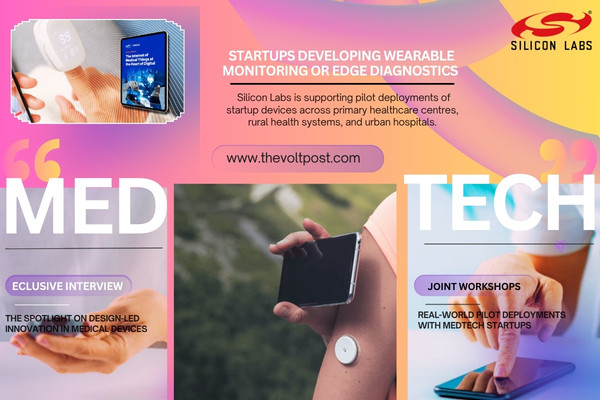
Through this CSR initiative, Silicon Labs is supporting pilot deployments of startup devices across primary healthcare centres, rural health systems, and urban hospitals.
Startups offer their innovative and unique solutions for a diverse range of healthcare needs. For rural scenarios that are characterized by issues of scarcity of facilities and personnel, they offer digital tools for diagnostics, monitoring and enforcement, often with remote operation capability and AI assistance.
Pilots here would need to focus on user friendliness of the solution, depth of AI assistance that negates the lack of super specialists, ease of remote monitoring and intervention, and low-cost focus in business models.
In urban scenarios, startups need to look at how globally competitive their solutions are, how they can scale their business to beyond active patients, and addressing emerging demand for technology assisted independent living.
Pilots here would need to focus on functionality, how solutions compare with globally available products, how they augment and coexist with specialized healthcare options, and radical improvements over existing methods.
 Q6. Medical devices need to be reliable, secure, and compliant from day one. What should Indian founders understand early when building for regulatory-grade healthcare applications?
Founders should design for reliability, security, and global regulatory compliance from the very first prototype, rather than adding them later.
The solutions emerging from this partnership are designed to be secure, compliant with global standards, and reliable even in resource-constrained settings.
Building with this mindset early makes it much easier to scale later. Founders need to look at multiple regulatory procedures and requirements based on the target markets to be addressed – and consider compliance at early stages of their product development, for example when selecting all the hardware and software components of their solution.
Q7. How important is it for global semiconductor companies to see India not just as a market, but as a design and innovation hub for medical and IoT hardware?
This is central to how we see India. Our work with CfHE is intentionally focused on enabling Indian teams to design devices, not just use imported ones.
This aligns with the national push for indigenous innovation, deep-tech entrepreneurship, and self-reliance in critical healthcare technologies. India has a rich history of engineering expertise in a broad spectrum of areas.
Often, though, the engineering innovation and development is isolated to a piece of the whole product that is developed and marketed globally and owned by a company with an overseas headquarters.
There are a couple of problems with this – first, the product may not be tailored specifically for the fast-growing India market, and second, there would remain a considerable import component to procuring the product for local use.
This can all change with startups here defining, optimizing, developing, owning, and delivering the product locally. The local ecosystem today supports this much more than earlier. Technology in healthcare is more pervasive, and medical professionals are more open to trials of innovative products.
Q8. In resource-constrained healthcare settings, what kind of embedded architecture gives startups the best chance of building affordable, scalable, and clinically useful products?
An architecture that is low-power, secure, and built for reliability in tough conditions gives startups the best chance here. The goal is to create solutions that are affordable, accessible to underserved populations, and reliable even in areas with limited infrastructure, while remaining scalable for Indian and international markets.
Cost reduction is critical; it requires effort and the right approach. Iterations are often required for converging on the sweet spot of cost, size, performance, and battery life. Hardware product firms face a particular challenge today in an unprecedented rise in memory prices making memory footprint a key architectural constraint.
Startups are looking at alternative revenue models like subscription-based pricing, device lease options through participating clinics, and pay-per-use kiosk enabled offerings.
Enabling these models effectively requires the right architecture – with security and licensing methods built into the device, configuration options for subscription-based feature enablement, over the air updates, and innovative split of functionality between the device, the smartphone app and the cloud.
Wearable devices may need to be reused by other patients and should therefore be engineered to allow deep sanitization, with IP68 compliant design and a choice of materials to handle chemical cleansing.
This is in contrast to other markets where the cost distribution is different, making it more attractive to specify devices as one-time-use.
Q9. Silicon Labs has emphasized edge intelligence across its wireless portfolio. Where do you see the strongest near-term healthcare use cases for on-device ML in India?
Strong near-term use cases include elderly care – privacy protected emergency monitoring for fall detection, cardiac and respiratory anomalies, etc.; infant and neo-natal monitoring; sleep apnea detection; in-hospital monitoring; cardiac health monitoring and early warning; and smart diagnostics for early detection, among others.
Q10. What are the biggest challenges in scaling local medical device hardware in India, and where do startups most often struggle?
The biggest challenge for startups with innovative medical device hardware products is funding. The hardware development cycle is long and iterative, pushing revenue start to two or more years down the line. The investment community is also loath to provide funding for hardware – this is common to India and the rest of the world.
The second challenge is lack of the right experience in building robust, high-quality hardware that can provide many years of trouble-free operation.
Going beyond functional performance is critical to establish credibility in the market – long-term device reliability and uniform manufacturing quality are critical for continued success.
Q11. Looking ahead, what would success look like for this initiative over the next few years, both for the startups involved and for India’s broader medtech ecosystem?
 Success would mean CfHE startups building globally competitive, made-in-India medical devices that are affordable, secure, and ready for both Indian and international markets.
For India’s broader medtech ecosystem, it would mean a stronger pipeline of homegrown innovation, with research moving faster into real healthcare impact, and India being seen as a hub for smart, secure, and scalable medical devices.
At ground level, we look forward to seeing a few startups from those onboarded into CfHE’s annual fellowship programme making a start and finding success through this partnership.