

Researchers in Australia (RMIT University) have built a neuromorphic vision chip that can see, process, and store visual data all in one device. It works like the human eye and brain do together, capturing images and interpreting them without needing separate hardware.
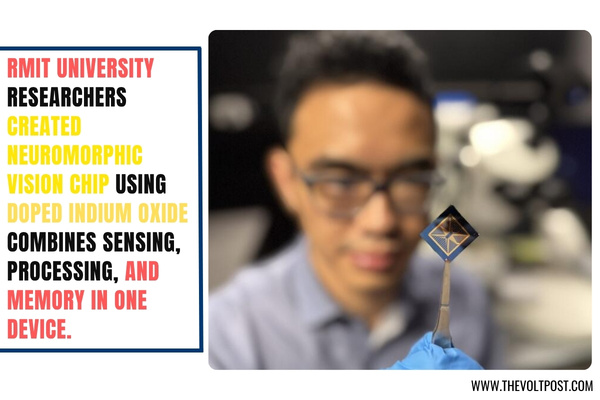
The breakthrough came from engineers at RMIT University, with help from Deakin University and the University of Melbourne.
By combining sensing, processing, and memory into one platform, the team eliminated the separate components that usually slow down machine vision systems.
How It Works
Traditional cameras capture data and send it to external processors. This new chip does the calculation right where the light hits it.
The sensing layer is thousands of times thinner than a human hair and responds to light while keeping that information over time, just like a biological vision system.
The neuromorphic vision chip uses doped indium oxide as its active material. This layer is less than 3 nanometers thick and runs at just 50 millivolts, which is a tiny fraction of the voltage standard electronics need.
When light hits the material, it creates what researchers call a persistent photocurrent an electrical signal that stays after the light disappears.
Since this “memory” of light fades slowly and naturally, the chip holds visual information longer without needing frequent electrical refresh signals.
This biological trait lets the device learn from patterns and recognize them later with far fewer repeated exposures than conventional systems need.
Real-Time Decision-Making
Professor Sumeet Walia, who led the team, said the goal was to eliminate delays and energy costs from moving data between separate systems.
“Our invention enables real-time decision-making by avoiding the need to process vast amounts of irrelevant information and not being hindered by data transfers to external processors,” he explained.
The chip also holds visual information for extended periods without frequent electrical refresh signals, which saves energy and improves efficiency.
Aishani Mazumder, a PhD researcher at RMIT University and the paper’s first author, said the system takes inspiration from how the brain processes information. “Neuromorphic vision systems are designed to use similar analog processing techniques as the human brain, significantly reducing the energy needed for complex visual tasks compared to current technologies.”
What the Chip Can Do
The device mimics the retina’s ability to capture full images and the brain’s capacity to interpret and store them, giving machine vision a more compact and efficient solution.
It handles multiple functions in one component:
- Detecting incoming light
- Processing signals
- Storing visual data for later use
The researchers arranged these atomically thin sheets into a focal plane array a grid of pixels that acts as a proof-of-concept camera sensitive to ultraviolet light.
When UV light patterns hit the array, the chip detects them, memorizes them, and recognizes them in real time, doing what researchers call “in-sensor neuromorphic computation.”
Where It Could Be Used
For autonomous machines, researchers see this technology powering applications in:
- Self-driving vehicles for object recognition and hazard detection
- Autonomous robots for real-time environmental adaptation
- Surveillance systems in dangerous or remote locations
- Forensic and industrial inspections for advanced imaging
- Bionic vision systems
- Dynamic gesture recognition
- Food shelf-life assessments
By combining multiple functions into one component, the chip could enable longer autonomous operation without heavy computational infrastructure, perfect for systems that need to adapt quickly to changing environments.
Expanding To Cover Visible And Infrared Light
Initial tests happened in ultraviolet light, and the team is now expanding to cover visible and infrared light for broader applications.
The researchers are optimistic this could eventually lead to vision systems that improve with experience, like biological systems do.
They’re scaling up from single-pixel prototypes to full sensor arrays for more complex, higher-resolution neuromorphic vision systems.
 The Science Behind It
The research used nanofabrication facilities at RMIT University, supported by the Australian Research Council and the National Computational Infrastructure. The findings were published in Advanced Functional Materials.
This technology bridges the gap between current digital systems and real-time decision-making by working like a brain, not a computer.