



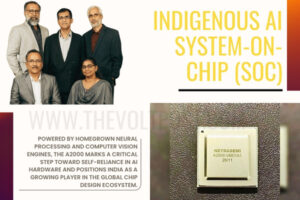
In a landmark moment for India’s semiconductor ambitions, Kerala-based fabless startup Netrasemi has unveiled the A2000, India’s first fully indigenous AI system-on-chip (SoC) designed for edge devices. Powered by homegrown neural processing and computer vision engines, the A2000 marks a critical step toward self-reliance in AI hardware and positions India as a growing player in the global chip design ecosystem.

What Makes This Breakthrough Chip Important
The A2000 AI system-on-chip (SoC) is reported as not just another chip, it’s built from the ground up in India for compact, power-efficient edge AI devices like smart cameras, edge AI boxes, and intelligent video gateways.
Unlike cloud-dependent AI systems, edge devices process data locally, reducing latency and improving real-time decision-making for surveillance, automotive, and industrial automation applications.
Key Technical Highlights
The Team Behind the Breakthrough
Netrasemi was founded in 2020 by Jyothis Indirabhai (CEO), Sreejith Varma, and Deepa Geetha, a trio determined to build India’s first fully India-designed AI/ML chip. The company operates as a fabless semiconductor firm, meaning it designs chips but outsources manufacturing to global foundries like TSMC.
“We are currently working with several OEMs on early sample evaluations and co-development,” said CEO Jyothis Indirabhai.
Early trials are already underway with three customers in the surveillance and automotive sectors.
Funding & Government Support
Netrasemi has raised ?125 crore in total funding, backed by Zoho Corporation and Unicorn India Ventures. The startup was also one of four companies selected in 2023 for ?15 crore under the Ministry of Electronics and Information Technology’s (MeitY) Design Linked Incentive (DLI) scheme, a key government push to boost domestic chip design.
Additional Chip Projects
What This Means for India’s Semiconductor Ecosystem
The AI system-on-chip (SoC) A2000 launch is a major milestone in India’s journey toward semiconductor self-reliance under the Make in India and Digital India initiatives. While fabrication still happens at TSMC in Taiwan, the design, architecture, and IP are entirely Indian, a critical distinction in the global chip value chain.
 This development aligns with India’s broader goal to become a global hub for semiconductor design and innovation, reducing dependence on foreign AI hardware and enabling homegrown solutions for smart cities, industrial automation, and defense applications.
Roadmap to 2027
- 2026 (May): Silicon bring-up completed; A2000 declared production-ready
- 2027 (early): Mass production begins at TSMC Taiwan
- 2027 (mid): Commercial launch of A2000
- 2027 (Q2): A4000 edge AI server chip expected fabrication-ready