



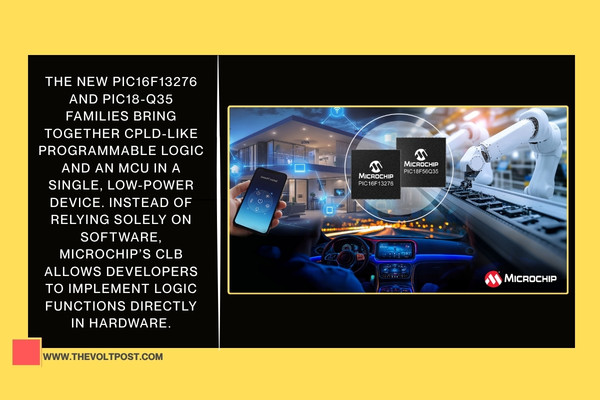
The new PIC16F13276 and PIC18-Q35 families bring together CPLD-like programmable logic and an MCU in a single, low-power device. Instead of relying solely on software, Microchip’s CLB allows developers to implement logic functions directly in hardware.
Engineers working on timing-critical applications like motor control, industrial automation, and automotive safety often run into issues with latency and unpredictable software execution. To tackle these challenges without adding the cost and complexity of multi-chip designs, Microchip Technology is expanding its Configurable Logic Block (CLB)-based microcontroller portfolio.
The new PIC16F13276 and PIC18-Q35 families bring together CPLD-like programmable logic and an MCU in a single, low-power device. Instead of relying solely on software, Microchip’s CLB allows developers to implement logic functions directly in hardware.
This approach helps reduce power consumption, improves system predictability, and boosts throughput compared to traditional MCU-only solutions or separate CPLD-plus-MCU setups.
One standout feature is the ability to automatically load the CLB at power-up or reset. This means logic can initialize independently of the CPU, ensuring predictable startup behavior something that’s especially important in safety-critical industrial and automotive systems.
In terms of capability, the PIC16F13276 family includes 32 logic elements, while the PIC18-Q35 family offers up to 128. This gives engineers the flexibility to run parallel, deterministic logic alongside embedded control, all within a single chip.
The result is a more streamlined design that can replace discrete CPLD and MCU combinations, cutting down on bill of materials, board space, and overall system complexity.
These devices are also drop-in compatible with existing PIC16 and PIC18 designs, making it easier to adopt hardware-based logic without a full redesign. For added security, Programming and Debugging Interface Disable (PDID) provides anti-tamper protection against unauthorized access or modifications.
To further support design accuracy, Microchip includes a CLB timing analysis tool that helps engineers identify signal delays, critical paths, and potential timing risks early in development. Catching these issues upfront can significantly reduce debugging time and speed up deployment.
To learn more about Microchip’s portfolio of CLB-enabled MCUs, CLICK HERE
Leadership Comment
“Our new product development isn’t based on keeping pace with competitors, it’s based on efficiently solving real-world design challenges,” said Greg Robinson, corporate VP of Microchip’s MCU business unit. “By enabling CPLD-like functionality on a low-power, cost-effective microcontroller, these two families give engineers an easy way to add programmable logic to their designs.”
Development Tools
Microchip’s enhanced CLB Configuration tool, now available in Microsoft® Visual Studio® Code (VS Code®), helps accelerate logic development through an intuitive, drag-and-drop graphical interface.
The integrated CLB synthesizer combines logic design with upfront timing analysis, simulation and hardware debug capability, enabling developers to verify functionality, observe real-time operation and validate precise timing without writing HDL code or manually configuring registers.
The PIC16F13276 and PIC18?Q35 MCUs are also supported by Microchip’s comprehensive development ecosystem, including MPLAB® X Integrated Development Environment (IDE) and MPLAB Code Configurator (MCC).
The PIC18F56Q35 Curiosity Nano (EV55P36A) and PIC16F13276 Curiosity Nano (EV18Z11A) evaluation kits provide cost-effective, ready-to-use hardware platforms with full programming and debugging support for rapid prototyping and evaluation.
Pricing and Availability
PIC16F13276 MCUs are available starting at $0.32 at volume and the PIC18-Q35 devices are available starting at $0.62 at volume.
You can purchase directly from Microchip or contact a Microchip sales representative or authorized worldwide distributor.