


Jungheinrich, a Hamburg-based major in intralogistics, has built its reputation on helping businesses move, store, and manage goods more efficiently. With decades of experience in material handling and warehouse automation, the company is now focused on solving a more pressing challenge: how to keep up with rising e-commerce demand while making better use of limited warehouse space.
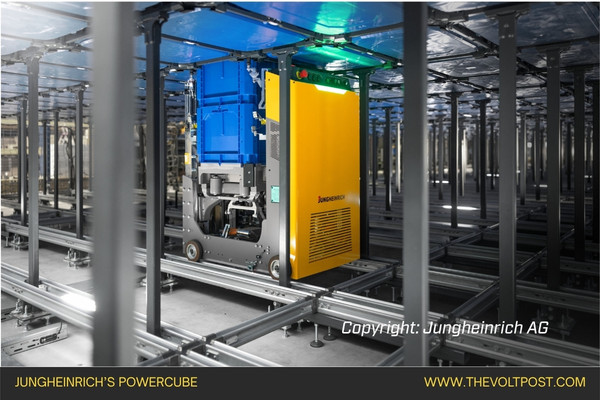
That challenge led to the development of the PowerCube an automated compact container storage system designed to rethink how warehouses operate.
As customer expectations shift toward faster deliveries and higher throughput, traditional storage models are starting to show their limits. PowerCube is Jungheinrich’s answer to that shift.
“Our customers need to maximize space while keeping up with growing order volumes,” says Carlos de Almeida. “That’s exactly what PowerCube is built to do.”
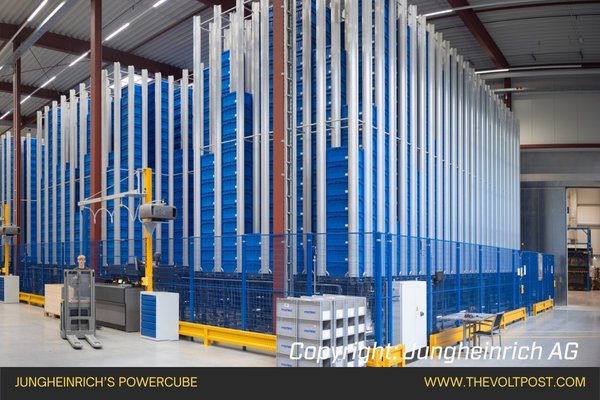
At its core, PowerCube is about efficiency. The system dramatically increases storage density while speeding up order processing, allowing warehouses to handle more inventory in less space.
It runs on Jungheinrich’s in-house Warehouse Control System (WCS), which manages a fleet of automated shuttles over Ethernet, ensuring fast and reliable movement across a high-density grid.
These shuttles operate across the entire base layer in two dimensions, while the system fully utilizes vertical space up to 12 meters to store containers above. The result is a compact, high-throughput storage solution designed for modern warehouse demands.
PowerCube brings several clear advantages:
- Up to four times higher storage density compared to conventional shelving
- Vertical storage capability reaching 12 meters
- Scalable architecture that adapts to throughput and capacity needs
- High-performance shuttles capable of carrying two containers at once, up to 50 kg each
- Fast deployment with minimal infrastructure changes—no floor milling required
“We wanted a system that combines speed, safety, and scalability,” Carlos adds. “PowerCube delivers on all three.”
One of the key technical challenges behind the system is connectivity. Coordinating multiple shuttles moving freely across the grid requires highly reliable, real-time wireless communication. Even a brief disruption can stop a shuttle, block access to stored goods, and impact the entire operation.
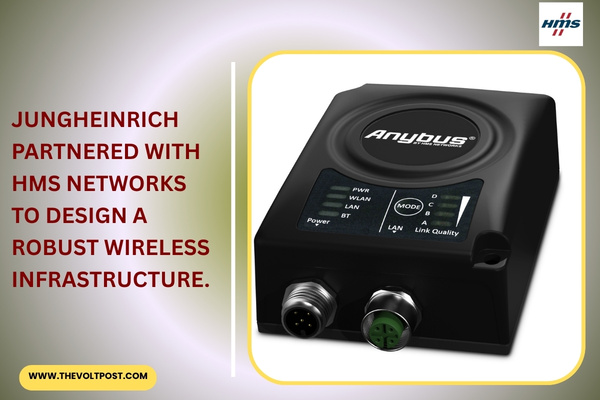
Hardwiring wasn’t an option the shuttles need complete freedom of movement. To solve this, Jungheinrich partnered with HMS Networks to design a robust wireless infrastructure.
“We’re experts in logistics, not networking,” Carlos explains. “So we brought in HMS to make sure the system performs reliably.”
The solution combines several elements:
- Anybus wireless access points distributed across the system for full coverage
- Dual-band setup, using 5 GHz for service devices and 2.4 GHz for shuttle control and safety-critical communication
- Compact, IP67-rated Anybus Wireless Bridge II units installed on each shuttle
- A point-to-multipoint architecture that allows seamless roaming and continuous connectivity
This setup ensures stable performance even in demanding environments, including cold storage facilities where condensation can be an issue.
PowerCube is already proving itself in real-world deployments. Early users are seeing tangible benefits in both space utilization and order processing speed. One example is Fastbolt, which adopted the system to address growing demand and limited storage capacity.
“It’s rewarding to see PowerCube solving real problems in the field,” says Carlos. “That’s when you know the concept works.”
Looking ahead, Jungheinrich plans to scale the system further expanding storage capacity, increasing shuttle density, and supporting larger installations. This next phase will bring new challenges, particularly around wireless network design, real-time monitoring, and cybersecurity.
At the same time, the company is preparing for evolving regulatory requirements, including RED, CRA, NIS2, and the upcoming EU Machinery Regulation set for 2027. Ensuring compliance while maintaining performance and safety will be a key focus.
 With PowerCube, Jungheinrich is not just improving warehouse storage it’s setting a new direction for automated intralogistics. And with a reliable wireless backbone in place, the system is well positioned to support the next generation of smart, high-efficiency warehouses.
Leadership Comment
“We really appreciated HMS’ support and guidance. The Bridges and Access Points are working well, but it wasn’t just about the products. Their Wireless & Infrastructure Implementation Assistance service made a big difference, helping us overcome the challenges of deploying wireless connectivity in a dense, metallic structure. Using their expertise and analysis tools, HMS designed the best layout for access points to ensure reliable performance in every installation. In some cases, we even asked HMS to join us at our customer’s warehouse to perform a site survey and validate signal coverage,” adds Carlos.
“We’re really pleased with the collaboration with HMS. It’s helped us achieve the required robust connectivity, and as we expand and meet cybersecurity and safety requirements, our partnership with HMS will become even more valuable. This is only the start!” concludes Carlos.
To Know More: CLICK HERE