



GlobalFoundries(GF) is pushing deeper into advanced packaging with the production readiness of its SLATE wafer-to-wafer bonding technology, unveiled on June 23. Built on the company’s 9SW radio-frequency silicon-on-insulator (RF SOI) platform, the solution is being manufactured at its 300mm fab in Singapore and is slated for volume production in the second half of 2027.
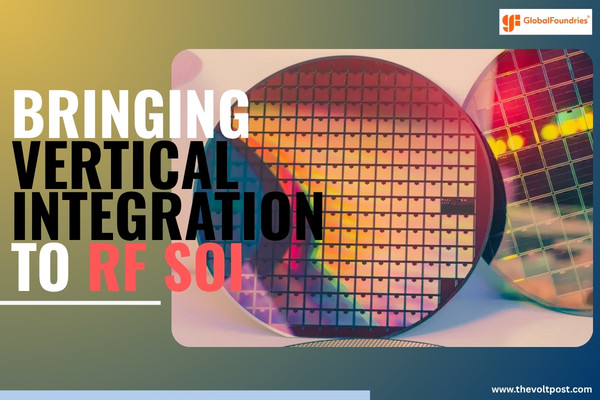
At its core, SLATE introduces a 3D integration approach that allows designers to stack large field-effect transistors vertically instead of spreading them across a single die. The result is a significant reduction in footprint up to 45% for key RF components such as switches, low-noise amplifiers, and antenna tuners.
For device makers working within compact space and power constraints, especially in 5G smartphones, that kind of efficiency can make a meaningful difference.
GlobalShuttle multi-project wafer program later in 2026
GF is positioning SLATE as more than a lab-scale innovation. The company says customers will be able to start prototyping through its GlobalShuttle multi-project wafer program later in 2026, putting the technology firmly in the design-win phase ahead of its planned production ramp.
Whether SLATE translates into meaningful commercial gains will depend on how quickly customers commit to deploying it in real products over the coming quarters.
Bringing Vertical Integration to RF SOI
The launch also reflects a broader industry shift. As traditional transistor scaling delivers diminishing system-level gains, chipmakers are increasingly turning to advanced packaging and heterogeneous integration to improve performance, power efficiency, and density.
SLATE fits squarely into this trend, bringing vertical integration to RF SOI, a segment where both layout efficiency and electrical performance are critical.
The underlying 9SW platform already supports sub-8GHz and emerging FR3 applications, with GF claiming more than 20% efficiency gains driven by improved Ron-Coff performance and lower standby current. By layering 3D integration on top, SLATE aims to further optimize RF front-end modules, which must pack multiple analog and mixed-signal functions into increasingly compact designs.
Strategically, the move aligns with GF’s long-standing focus on specialty technologies. Having exited the leading-edge logic race, the company has concentrated on differentiated platforms where factors like power handling, signal integrity, and long qualification cycles matter more than transistor scaling alone.
SLATE appears to extend that strategy by adding a packaging-driven advantage that enhances density without requiring customers to shift to an entirely new ecosystem.
From a competitive standpoint, SLATE could strengthen the company’s position in RF markets tied to premium smartphones, satellite communications, and other connectivity-heavy applications. If its die-size reduction claims hold up in production designs, the technology may help customers deliver more compact and efficient modules, an increasingly important requirement as board space shrinks.
GF’s first-quarter 2026 revenue
Financially, however, the impact will not be immediate. The company reported first-quarter 2026 revenue of $1.634 billion, up 3% year-on-year, with a non-IFRS gross margin of 29%.
It also guided second-quarter revenue to around $1.760 billion at the midpoint, indicating stable near-term demand even before SLATE contributes to the top line.
With prototyping only beginning later this year and volume production still more than a year away, the technology is unlikely to influence earnings in the short term.
The longer-term question is adoption
If major RF module vendors integrate SLATE into high-volume programs, it could reinforce GlobalFoundries’ relevance in a competitive segment where supplier relationships tend to be sticky. If uptake remains limited, the announcement may carry  more strategic than financial weight.
Beyond immediate revenue prospects, SLATE also plays into GF’s broader focus. The company has often been defined by its decision to step away from cutting-edge logic nodes.