



Inertial Labs, a VIAVI company, has launched the INS-NV, a programmable development platform that merges a tactical-grade inertial navigation system (INS), an attitude and heading reference system (AHRS), and the edge-computing power of an NVIDIA Jetson Orin NX module.
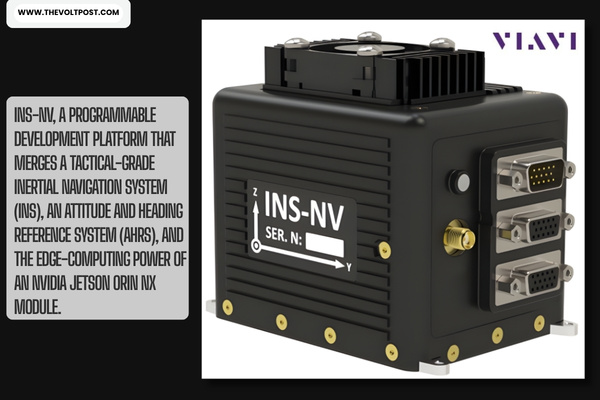
The system is purpose-built to accelerate the development of Alternative Position, Navigation, and Timing (Alt-PNT) systems.
By integrating a high-performance AI processor directly with the navigation hardware, the INS-NV eliminates the massive time sink traditionally required to bridge INS hardware with complex machine vision software.
Engineered to maintain precision in highly dynamic, GNSS-denied or compromised environments, the INS-NV platform relies on Inertial Labs’ established ecosystem of sensor fusion filters, calibration software, and navigation algorithms to deliver real-time time, position, velocity, and attitude data.
Core hardware and integration features include:
- Tactical-Grade Sensors: Fully calibrated MEMS accelerometers and gyroscopes, backed by magnetometers and a barometric altimeter.
- Full-Constellation GNSS: Native receiver support across GPS, QZSS, GLONASS, Galileo, BeiDou, and NavIC.
- Plug-and-Play Expandability: Designed to easily integrate commercial off-the-shelf (COTS) vision cameras alongside additional Inertial Labs sensor modules.
The INS-NV is available immediately. For defense and specialized industrial applications, Inertial Labs provides MAVLink-, ASPN-, pntOS-, and MOSA-compliant variants upon request.
Leadership Comment
 “Visual navigation needs continuous information about vehicle position, orientation and time. Because these systems have traditionally lacked a high-end processor, developers have to spend considerable R&D time and budget to integrate their software with the INS, and that’s before they build a platform,” said Jamie Marraccini, Vice President, Inertial Labs Products, VIAVI. “The advanced sensor fusion addresses this challenge, enabling developers to run their own visual navigation stacks alongside our INS and AHRS technologies, and more quickly create advanced alternative navigation and PNT systems.”
To Know More: CLICK HERE