



The telecommunications landscape is shifting at breakneck speed. As India rapidly scales its 5G infrastructure and lays the groundwork for AI-driven data centers, 6G, and quantum-safe networks, the complexity of validating and securing these digital lifelines has never been higher.
During the recent India Mobile Congress (IMC) 2026, The Volt Post sat down with Monojit Samaddar, Country Director at VIAVI, to discuss how the company is anchoring this evolution. From realistic real-world 6G channel emulation to transforming distributed fiber sensing into intelligent infrastructure protection, Monojit Samaddar details what it takes to build, test, and secure the next generation of global connectivity. The Volt-Age Edited Excerpts Below:
The telecommunications industry is undergoing a significant transformation. What key changes are shaping the landscape in India, and what role is VIAVI playing in enabling this evolution?
India is at the forefront of the global telecommunications transformation, with the rapid rollout of 5G, adoption of cloud-native networks, emergence of AI-RAN, growth of AI-driven data centers, and ambitious digital initiatives reshaping how networks are designed, deployed, operated, and secured.
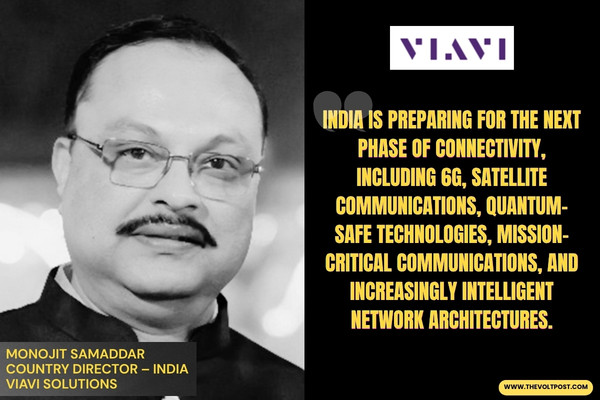
At the same time, India is preparing for the next phase of connectivity, including 6G, satellite communications, quantum-safe technologies, mission-critical communications, and increasingly intelligent network architectures.
These technologies will extend connectivity across terrestrial, non-terrestrial, enterprise, industrial, and critical infrastructure environments, creating new levels of network complexity and performance requirements.
At VIAVI, we see these shifts as a significant opportunity. As networks become more intelligent and complex, trusted test, measurement, assurance, and security solutions are foundational to successful deployment.
We help operators, hyperscalers, network equipment manufacturers, enterprises, and ecosystem partners validate, optimize, and secure next-generation networks, AI infrastructure, and mission-critical communications with confidence.
India is not only one of the fastest-growing telecom markets—it is emerging as a global innovation hub for future connectivity.
VIAVI is proud to collaborate with the ecosystem to accelerate innovation and enable resilient, future-ready digital infrastructure that will support India’s AI-driven economy.
As connectivity architectures become more open, intelligent, and distributed, how is VIAVI helping validate emerging technologies such as 6G, Open RAN, and non-terrestrial networks (NTN)?
The future of connectivity will be shaped by advanced wireless technologies, intelligent automation, and increasingly distributed network architectures. As technologies such as 6G, Open RAN, AI-native networks, and non-terrestrial networks (NTN) evolve, they introduce new opportunities while also increasing the complexity of interoperability, performance, security, and lifecycle management.
To address these challenges, the industry requires advanced validation and assurance solutions capable of testing multi-vendor environments, software-driven architectures, and highly dynamic networks.
VIAVI supports this evolution with a comprehensive portfolio of test, measurement, and assurance solutions that help network operators, equipment manufacturers, and ecosystem partners develop, validate, and deploy next-generation communications networks.
Solutions such as VIAVI TM500 enable comprehensive validation of 5G, NTN, Open RAN, and emerging wireless architectures, helping customers verify interoperability, performance, and compliance across complex network environments.
TeraVM provides application emulation and security performance capabilities, while OneAdvisor 800 Wireless supports field deployment, optimization, and maintenance of wireless networks. VIAVI solutions also support advanced network assurance through automation, analytics, and real-time visibility.
The VIAVI 6G Forward program covers research, innovation, integration and standardization work. The VIAVI GPU-Powered Real-Time 6G Testbed is an advanced platform designed to validate theoretical 6G concepts in real-world conditions before full-scale deployment.
This cutting-edge system enables researchers and engineers to experiment with next-generation wireless technologies while significantly reducing development time and costs.
Through simulation, emulation, automation, and intelligent analytics, VIAVI helps organizations evaluate network behavior, optimize performance, and accelerate innovation across emerging technologies including AI-RAN, Open RAN, NTN, and future 6G networks.
By enabling comprehensive validation from development through deployment and operation, VIAVI helps the industry build more intelligent, flexible, interoperable, and resilient communications networks.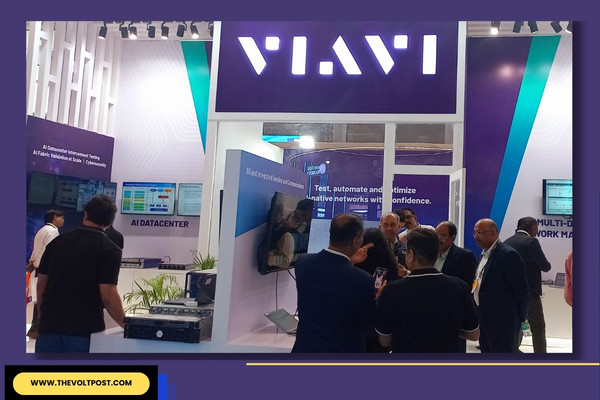
How does VIAVI’s channel emulation platform help telecom and device companies accelerate real-world testing and validation of next-generation wireless technologies such as 6G and Wi-Fi 7/8?
As wireless technologies evolve toward 6G and Wi-Fi 7/8, testing is becoming significantly more complex. Engineers need to validate performance not only under ideal lab conditions, but across the diverse and unpredictable RF environments that devices and networks will encounter in the real world. This makes realistic, repeatable channel emulation increasingly important for identifying issues early and accelerating development.
This is where VIAVI’s Vertex 6.0 comes in. Vertex 6.0 extends VIAVI’s wireless portfolio by bringing real-world RF propagation into the lab, complementing the TM500 network emulation platform and TeraVM application and security validation solutions. It is the industry’s first channel emulator designed for next-generation 6G and Wi-Fi 7/8 testing, supporting newly defined 6G waveform requirements and exceeding Wi-Fi 7/8 bandwidth requirements.
The platform extends testing across complex cellular, Wi-Fi, military and aerospace RF technologies. Its modular, field-replaceable RF architecture enables customers to scale capabilities within the existing 6U Vertex chassis.
For Wi-Fi 7/8, the platform supports 320 MHz bandwidth, 4096 QAM and 2×2 through 8×8 configurations, along with a broad range of propagation scenarios—including land-to-land, land-to-air and air-to-air, anechoic and reverberation chambers, and NTN environments such as LEO, MEO and GEO, mesh, drone and ISAC networks.
Combined with the VIAVI FR3 MIMO converter and raytracing with ISAC, Vertex 6.0 can act as a digital twin for RF propagation, supporting emerging use cases such as FR3, Wi-Fi 7/8, AI-RAN and ISAC.
Ultimately, Vertex 6.0 helps chipset, device and network equipment manufacturers replicate real-world conditions in a controlled environment, identify performance issues earlier, reduce late-stage testing risks, and accelerate the development and validation of next-generation wireless technologies.
With rising concerns around quantum threats, how is VIAVI contributing to the industry’s readiness for quantum-safe network security?
Quantum-safe communications are moving rapidly from research initiatives toward real-world deployment. The emergence of quantum computing, advances in Quantum Key Distribution (QKD), Post-Quantum Cryptography (PQC), hybrid security models, and satellite-based secure communications are driving organizations to rethink long-term cybersecurity strategies.
The challenge is not only developing stronger cryptographic algorithms, it is also ensuring that quantum-safe architectures deliver real-world performance, interoperability, scalability, and resilience under operational conditions.
VIAVI addresses this challenge through an integrated portfolio spanning physical infrastructure validation, network-scale security testing, and operational assurance.
At the center of this portfolio is the QST1000 Quantum-Safe Test Solution, which provides AI-powered orchestration to support end-to-end testing of hybrid PQC, QKD, and Key Management System (KMS) environments. This enables automated and intelligent validation of quantum-safe security architectures.
QST1000 includes the capabilities of TeraVM Security and CyberFlood, enabling organizations to validate network security, resilience, and quantum-safe readiness through realistic application traffic, cyberattack, and protocol emulation.
With MITRE ATT&CK framework support, including advanced Post-Quantum Cryptography (PQC) performance validation, QST1000 helps organizations assess quantum-safe implementations under realistic conditions.
At the physical layer, QST1000 provides MAP-300 capabilities for validating emerging quantum communications and QKD systems through realistic optical environment emulation and controlled impairment testing, including 400G and 800G networks.
By combining AI-powered orchestration with optical, network, and security validation capabilities, VIAVI helps organizations accelerate the transition from quantum-safe innovation to real-world deployment.
Fiber sensing is a key aspect of infrastructure protection. How is Distributed Acoustic Sensing (DAS) transforming real-time monitoring, security, and protection of large-scale infrastructure assets?
Distributed Acoustic Sensing (DAS) is evolving from a traditional event detection technology into an intelligent infrastructure monitoring platform.
While early DAS deployments focused primarily on applications such as pipeline monitoring and perimeter security, advances in sensing technology, signal processing, and AI-based analytics are expanding its use across critical infrastructure environments.
Today, DAS is being applied in areas including telecom and data center protection, border and perimeter security, pipeline  monitoring, subsea power cable integrity, and structural monitoring.
VIAVI’s DAS solutions combine advanced True-Phase DAS technology with AI and machine learning capabilities to improve sensing accuracy, event classification, and real-time decision-making.
By transforming distributed sensing data into actionable intelligence, VIAVI enables operators to detect events faster, reduce false alarms, improve situational awareness, and protect critical infrastructure assets more effectively.