



Navitas Semiconductor is expanding its ultra-high-voltage (UHV) SiC portfolio with a new line of power modules built specifically to handle the heavy demands of advanced energy and grid infrastructure.
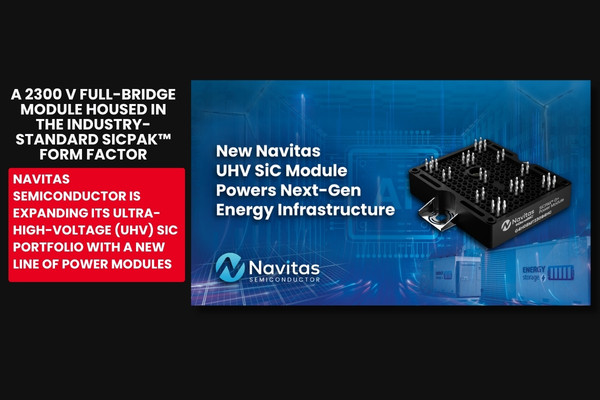
The standout of the release is the G4H08MT23GB4, a 2300 V full-bridge module housed in the industry-standard SiCPAK™ form factor. What makes it notable is its class-leading 8 m? RDS(ON), which is driven by Navitas’ fourth-generation GeneSiC™ Trench-Assisted Planar™ (TAP) architecture.
Because as grid-tied power setups become the backbone for next-generation AI data centers, the hardware has to keep up. These new modules act as the core medium-voltage building blocks for solid-state transformers, taking grid power and converting it directly into the high-voltage DC rails that AI server racks demand.
Beyond AI, they’re designed to drive serious efficiency and power density upgrades in grid-scale battery storage, solar inverters, and megawatt-level EV charging stations.
Built for High-Power Environments
Navitas made a few smart construction choices here to address the realities of high-reliability applications:
- Thermal & Isolation Performance: They’re using an aluminum nitride (AlN) active-metal-braze (AMB) substrate, which handles heat exceptionally well while supporting over 5 kV of isolation.
- Epoxy-Resin Potting: Instead of standard silicone gel, they’ve opted for an epoxy-resin potting technology. It’s a practical upgrade that cuts down internal stress, blocks moisture and contaminants, and delivers a 10x improvement in thermal conductivity.
- Upgraded Connections: The module features high-current, press-fit pins capable of handling twice the current of standard connections.
- Simplified Assembly: System designers can opt for a pre-applied thermal interface material (TIM) to streamline heatsink assembly.
Taking Reliability Testing Further
Navitas isn’t just stopping at standard AEC-Q101 and JEDEC requirements. They are qualifying this module family against their own AEC-Plus benchmark, which is significantly more punishing.
By testing dynamic reverse bias (DRB) and dynamic gate switching (DGS), and essentially tripling the duration of standard high-temperature and high-voltage static tests, they’re ensuring these modules survive the grueling, long-term mission profiles common in grid infrastructure.
Leadership Comments
As Paul Wheeler, VP & GM of Navitas’ SiC Business Unit, noted: “Our fourth-generation GeneSiC Trench-Assisted Planar architecture continues to push the limits of what’s possible in ultra-high voltage SiC. This new 2300 V module delivers a leading  RDS(ON) of any device using the SiCPAK form factor, giving system designers a proven, reliability-tested building block for the solid-state transformers and energy storage systems that are reshaping grid and AI data center infrastructure.”
“Our fourth-generation GeneSiC Trench-Assisted Planar architecture continues to push the limits of what’s possible in ultra-high voltage SiC,” said Paul Wheeler, VP & GM of Navitas’ SiC Business Unit. “This new 2300 V module delivers a leading RDS(ON) of any device using the SiCPAK form factor, giving system designers a proven, reliability-tested building block for the solid-state transformers and energy storage systems that are reshaping grid and AI data center infrastructure.”
Samples of the G4H08MT23GB4(HC) family are available immediately, with options for pre-applied TIM and high-current variants:
| Part Number | Configuration | Pre-Applied TIM | Pins |
| G4H08MT23GB4 | Full-Bridge | No | Standard |
| G4H08MT23GB4-T | Full-Bridge | Yes | Standard |
| G4H08MT23GB4HC | Full-Bridge | No | High-Current |
| G4H08MT23GB4HC-T | Full-Bridge | Yes | High-Current |
A double-pulse test (DPT) system, EVB-UHVSIC-GB-E-DPT-1, is also available on request. This has been created to help engineers evaluate the device’s switching performance. A white paper on Trench-Assisted Planar Technology is also available for download from the Navitas website.