


Efficient Power Conversion (EPC) is teaming up with Analog Devices (ADI) to push high-current power conversion into the multi-kilowatt range, pairing its 100 V eGaN FETs with ADI’s advanced control architecture.
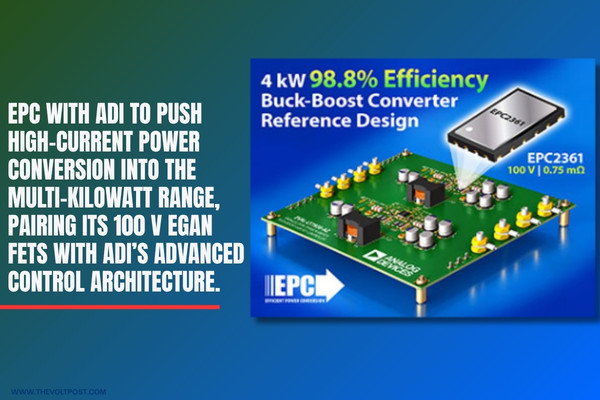
The new EVAL-LT7930-AZ reference design combines ADI’s LT7930 controller with EPC2361 GaN FETs in a dual-phase, interleaved buck-boost converter. Operating from a 36 V to 65 V input to deliver a steady 48 V output, the platform supports up to 4 kW of output power.
It also showcases the sheer efficiency GaN makes possible, the design hits 98.8% efficiency at 65 V, and holds a strong 98.5% at both 36 V and 48 V inputs.
Doing the heavy lifting is the EPC2361, a 100 V, 133 A enhancement-mode GaN transistor squeezed into a compact 3 mm × 5 mm footprint. With a typical on-resistance of just 0.75 m?, ultra-low conduction losses, low gate charge, and absolutely zero reverse recovery, it is engineered specifically for high-frequency, high-current environments.
What makes this reference design particularly effective is how it optimizes switching behavior specifically for GaN. The power-stage controller features gate drivers tailored for GaN FETs alongside programmable dead-time control. Dialed into a tight 10 ns to match the EPC2361’s parameters, this precise dead-time setting minimizes reverse-conduction losses while keeping switching operations entirely safe.
 The resulting architecture targets demanding, high-density applications, including data center power systems, high-frequency DC-DC conversion, AC-DC power supplies, motor drives, robotics, drones, and solar MPPT.
The EPC2361 is currently available through EPC’s global distribution network, including Digi-Key, and Mouser, with full access to device models, design documentation, and evaluation hardware to streamline integration.
Leadership Comment
As EPC CEO and co-founder Alex Lidow points out, modern high-power conversion requires pairing low-loss power devices with highly efficient control architectures. “This type of collaboration helps power designers move GaN from individual devices into complete high-performance power systems,” Lidow said.
To Know More: CLICK HERE