



How Thermal and Acoustic Imaging Redefine Condition Awareness in Semiconductor Manufacturing.
Semiconductor manufacturing leaves absolutely zero room for error. A modern fab is a massive, highly synchronized ecosystem of vacuum lines, precise gas delivery, electrical infrastructure, and hyper-controlled cleanrooms.
When production tolerances are measured in nanometers, a minor temperature drift or a subtle gas leak isn’t just a blip on a screen, it’s a direct threat to yield, stability, and the bottom line.
The challenge isn’t just keeping the machines running; it’s spotting the invisible warning signs before they trigger a catastrophic failure.
A developing fault in a pump, an overloaded electrical cabinet, or a degrading cooling system always starts small.
But how do you catch it early without shutting down a multi-million-dollar process just to take a look?
This is where advanced visibility becomes your strongest operational asset.
Seeing the Heat: The Thermal Advantage
Thermal imaging removes the guesswork from condition monitoring by turning invisible temperature variations into immediate, actionable visual evidence.
Instead of relying on a single-point measurement, engineers get the entire thermal picture.
This broad view instantly reveals what the naked eye cannot: abnormal friction in mechanical components, overloaded circuits, failing insulation, or dangerous thermal drift. For R&D and process teams, this insight is invaluable.
It allows them to analyze thermal uniformity and behavior in real-time, ensuring that temperature—a critical process parameter—remains exactly where it needs to be.
Hearing the Invisible: Acoustic Imaging
Fabs are incredibly loud, making it notoriously difficult to locate vacuum, compressed air, or specialty gas leaks using traditional methods.
Acoustic imaging cuts straight through that industrial noise. By visualizing the exact source of a sound frequency, these cameras allow technicians to pinpoint leaks from a distance.
It turns an hours-long, frustrating search into a fast, targeted fix, keeping maintenance teams focused on repairs rather than endless troubleshooting.
Safe, Non-Contact Inspection
Crucially, both thermal and acoustic imaging are entirely non-contact.
Fabs are filled with energized high-voltage systems, hot surfaces, moving parts, and incredibly sensitive processes.
Being able to inspect these assets from a safe, practical distance means teams can gather critical data without introducing physical risk or forcing a process interruption.
Scalable Visibility Across the Fab
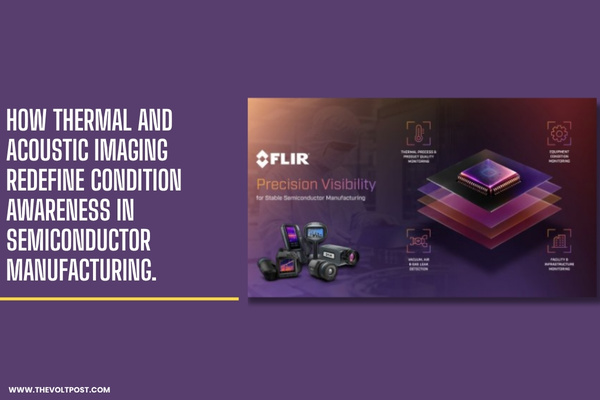
No two problems require the exact same approach, which is why FLIR has built a portfolio that scales from the fab floor to the R&D lab:
-
Routine Inspection & Troubleshooting: Handheld thermal cameras (like the iXX, Exx, and T-Series) and the Si2-Series acoustic imagers allow technicians to actively sweep critical assets, document anomalies, and catch leaks during their daily rounds.
-
24/7 Continuous Monitoring: For mission-critical equipment that never sleeps, fixed-mount smart sensors (AX8, A50/A70, and Axxx-Series) and the new Si2a-Series acoustic cameras serve as relentless watchdogs. They provide continuous, automated monitoring for wear or partial discharge, triggering alarms the second a baseline shifts.
-
Advanced R&D: When absolute precision is required for scientific analysis or product testing, FLIR’s R&D Science Kits (including the A6780 and A8580) deliver deep, high-resolution thermal data.
-
Data Integration: Hardware is only as good as the analysis behind it. Software platforms like Assetlink, Thermal Studio, and Research Studio tie these workflows together, allowing teams to track degradation over time, generate reports, and base their decisions on historical data.
Buying the Luxury of Time
 Ultimately, the greatest benefit of thermal and acoustic imaging is time. When you capture and document baseline data, you can spot degradation weeks or months before a component fails.
For maintenance teams, this means repairs become scheduled, controlled events rather than 3 AM emergencies.
Process teams can confidently verify that thermal behaviors match their exact expectations. Facility teams can prioritize which utility systems need immediate attention.
By integrating these complementary technologies, semiconductor manufacturers are able to:
- Detect issues long before they impact production.
- Investigate the root cause of problems instantly.
- Improve the speed and safety of routine inspections.
- Support rigorous process and product quality analysis.
- Maintain complete awareness, from the cleanroom floor down to the foundational facility infrastructure.
In an industry where the cost of disruption is astronomical, more data isn’t enough. The real value is turning that data into decisive action, protecting uptime, safeguarding yield, and ensuring the fab runs exactly as designed.
Learn more about Flir solutions for semiconductor manufacturing at flir.com/semiconductor