



SGS has partnered with DOBOT to verify its CR 30H Series meets the cybersecurity requirements of ISO 10218-1:2025, the latest international standard for industrial robot safety. This verification confirms the DOBOT CR 30H Series is designed with security in mind, strengthening its suitability for high-end manufacturing and improving access to global markets.
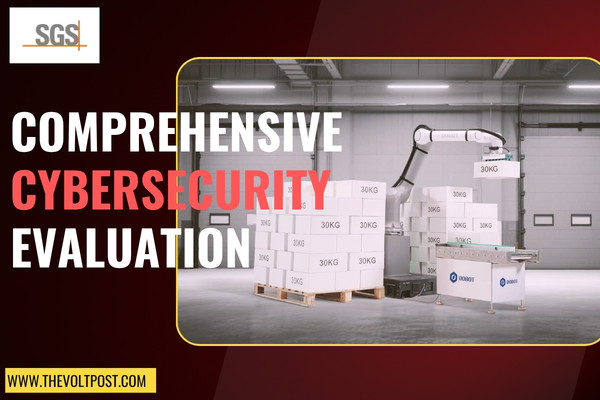
In February 2026 SGS issued a Verification of Conformity (VoC) to DOBOT, confirming the robot meets all cybersecurity elements of ISO 10218-1:2025.
For SGS, the project is a milestone said its official press release. The company states that recent development demonstrates the company’s capability to assess and test robotics against the revised standard and reinforces its leadership in both functional safety and cybersecurity for robotic systems.
Comprehensive cybersecurity evaluation
The assessment took place at SGS’s cyber lab in Guangzhou, China, and covered the full range of cybersecurity requirements, including threat modeling and risk assessment, access control and identity authentication, secure communication protocols, configuration protection, port and interface management, and secure software updates.
Throughout the process, SGS’s cyber team collaborated closely with DOBOT to identify vulnerabilities, refine the product, and streamline the path to certification.
Robots built for high-performance collaboration
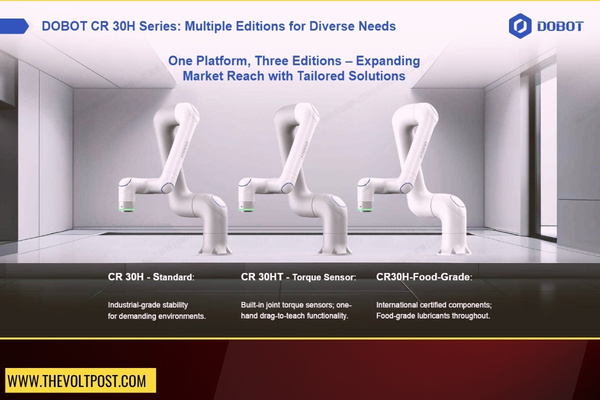
DOBOT CR Series collaborative robots are designed for safe, flexible and efficient human?robot collaboration across industries such as automotive, consumer electronics, semiconductors, healthcare, chemicals and retail.
Key features include payload options from 3 kg to 16 kg, high repeatability of ±0.02 mm, 22 built-in safety features, certifications to ISO 13849 and ISO/TS 15066, five adjustable collision-detection levels, and optional SafeSkin proximity sensing up to 15 cm.
These capabilities help manufacturers boost productivity and flexibility while cutting labour costs.
Supporting cyber-resilient robotics
As robots connect more closely with production networks, control systems and enterprise platforms, cybersecurity risks from unauthorized access to insecure updates, threaten both operations and safety.
Compliance with ISO 10218-1:2025 helps mitigate those risks by embedding robust cybersecurity controls into robot design.
SGS’s robotics and cybersecurity services span industrial and collaborative robots, robot controllers, intelligent production equipment and other automation products.
With a global lab network and multidisciplinary expertise, the company helps robotics companies meet complex international safety and cybersecurity requirements with confidence.
SGS Digital Trust
This collaboration aligns with the company’s broader DIGITAL TRUST framework, which helps customers build, demonstrate and sustain trust across the digital ecosystem.
Extending that framework to robotics strengthens resilience, transparency and confidence in increasingly connected and intelligent systems.
 Leadership Comment
Xie Junjie, Product Director, DOBOT said: “Meeting cybersecurity requirements is a fundamental prerequisite for robotics entering advanced industrial applications and global markets.
“We selected SGS for its proven expertise across industrial control systems, IoT, functional safety and cybersecurity. Their end-to-end support, from standards interpretation to technical assessment and implementation, has enabled us to reduce risk, achieve efficient certification and accelerate global deployment.”
Ross Wang, Senior Manager of Business Development, Cybersecurity, Connectivity & Products, SGS: “As a leader in cybersecurity standardization and regulatory compliance, we are proud to support DOBOT in achieving this important certification. This milestone highlights our expertise in industrial robot safety and cybersecurity, and reflects our commitment to helping customers meet increasingly stringent requirements for intelligent manufacturing systems.
“With robotics adoption accelerating across industrial sectors, ensuring safe and secure operation is critical. DOBOT can now move forward with confidence, knowing its products are designed to minimize risks to both operators and working environments.”
To Know More: CLICK HERE