



Modern applications increasingly depend on smooth communication between distributed CAN networks and Ethernet-based systems. But engineers often have to make trade-offs between performance, latency, and cost.
Many existing solutions are either overbuilt with features they don’t really need or too limited to handle real-world CAN FD demands.
CAN@net Basic takes a more practical approach by focusing on the essentials, efficient data exchange, low latency, and affordability.
Solving the latency challenge
In many CAN-to-Ethernet setups, sending an Ethernet frame for every CAN message can create too many interrupts, which adds jitter and makes performance less stable.
On the other hand, batching data can reduce jitter but introduces more delay. CAN@net Basic uses UDP/IP communication to cut protocol overhead and keep interrupt load low.
The result is a balanced solution with low latency and controlled jitter, making it a good fit for time-sensitive applications.
Solving the scaling challenge
In systems where many devices need to exchange CAN FD data, such as test environments or distributed machines, the physical limits of the CAN bus can quickly become a bottleneck.
Bus length and node count can restrict how far and how widely the system can grow.
CAN@net Basic helps solve that problem by extending communication over Ethernet, giving engineers more flexibility to connect distributed systems without being tied to traditional CAN topology limits.
Solving the cost challenge
Not every application needs a full-featured gateway, yet many users still end up paying for one.
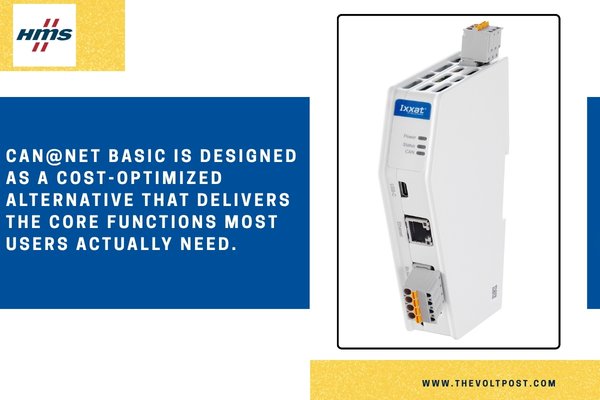
CAN@net Basic is designed as a cost-optimized alternative that delivers the core functions most users actually need.
With a market-aligned list price of 270 Euros, it offers industrial-grade performance and quality without unnecessary extras.
 Key technical features
- One CAN CC/CAN FD channel.
- CAN data rates up to 8 Mbit/s.
- One Ethernet channel with RJ45.
- ASCII interface mode.
- UDP/IP over Ethernet.
- USB Type-C interface, USB 2.0 high-speed at 480 Mbit/s.
- Removable push-in connectors.
- Galvanic isolation: CAN 2.5 kV for 1 minute, Ethernet 1.5 kV for 1 minute.
- Operating temperature from -25 °C to +85 °C.
- IP20 ingress protection.
- DIN rail housing, 108 x 149 x 27 mm.
To Know More: CLICK HERE