



Earlier Ensemble generations were aimed primarily at classic edge AI workloads such as vision, audio and sensor analytics. By contrast, the new GenAI family explicitly targets generative AI at the endpoint.
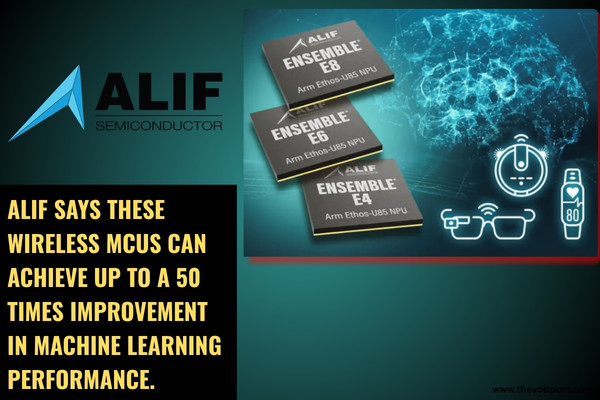
Alif Semiconductor revving-up its edge AI ambitions with a new wave of AI ready microcontrollers designed to run transformer models and generative workloads on tiny, battery powered devices.
Alif has been carving out a niche as a specialist in ultra low power, AI enabled 32 bit microcontrollers and fusion processors since it first brought NPU equipped MCUs to market in 2021.
At the center of that strategy is the Ensemble family of Arm based MCUs and fusion processors. These devices scale from simple single core parts to more complex multi core designs that combine Cortex M and Cortex A CPUs with Arm Ethos NPUs for on chip AI acceleration.
The idea is to give developers a flexible platform where they can dial in performance, power and cost to suit everything from basic sensor nodes to multimodal edge systems.
The latest additions the Ensemble E4, E6 and E8 series mark a clear step up in what an MCU can deliver for AI at the edge.
Built around the Arm Ethos U85 NPU, these devices have enough headroom to run transformer based machine learning models and generative AI workloads directly on the endpoint.
Alif’s own benchmarks highlight more than 450 GigaOPS of AI performance and hardware tuned specifically for transformer style networks, putting capabilities once reserved for larger SoCs into microcontroller class silicon.
One of the more eye catching claims is support for small language models running locally at around 36 mW on an E4 device. That opens the door to text generation and natural language interaction on small, battery powered products where cloud connectivity is expensive, unreliable or undesirable.
Earlier Ensemble generations were aimed primarily at classic edge AI workloads such as vision, audio and sensor analytics. By contrast, the new GenAI family explicitly targets generative AI at the endpoint. Alif points to use cases such as smart glasses, human machine interfaces, diagnostics, robotics, transportation and smart city equipment all running richer on device models without relying on the cloud.
To make that practical for developers, the company has added support for the ExecuTorch Runtime, a quantization focused extension of the PyTorch framework. With ExecuTorch, teams can train and optimize models in familiar tools and then deploy them on Ensemble E4, E6 and E8 MCUs via Alif’s software stack, reducing the friction of moving from lab prototypes to production grade embedded generative AI.
Under the hood, Alif has reworked its system architecture to keep up with data hungry AI workloads. The GenAI devices support up to two MIPI CSI cameras and integrate a fully hardware accelerated image signal processor capable of handling up to 60 frames per second at 2 megapixel resolution.
A widened memory subsystem is designed to move data quickly between on chip and external memory, enabling sub millisecond inferencing when models are run from internal MRAM, which combines speed with low power operation.
When you add in integrated security functions and the connectivity options available across the Ensemble and Balletto lines, the result is a dense single chip platform aimed squarely at imaging heavy and vision driven edge AI designs.
Alif is also keeping the rest of its edge AI portfolio in play. Beyond the GenAI focused MCUs, the company continues to promote its E1, E3, E5 and E7 devices as flagships for battery powered edge AI. These parts offer on the order of 250 GigaOPS of AI performance, up to 19 MB of integrated memory and low power NPU wake features, targeting always on sensing, voice, health monitoring and predictive maintenance.
For designs that need both wireless and AI, the Balletto B1 series brings neural processing together with Bluetooth LE 5.3 and 802.15.4 connectivity in a single chip.
Alif says these wireless MCUs can achieve up to a 50 times improvement in machine learning performance compared with traditional, non NPU microcontrollers, which gives IoT platforms more headroom to move beyond basic thresholding into genuine on device intelligence.
 Industry partners such as Arm position Alif as one of the companies pushing power efficient, secure AI into constrained edge environments. By tightly coupling Arm Cortex A and Cortex M cores with the Ethos U85 NPU and a layered security architecture, Alif is aiming to make real time AI and even generative models viable in form factors and power envelopes that historically only handled simple control logic.