


Modern designs increasingly employ intelligent display modules that integrate a display, microcontroller, memory and communication interfaces, and, in many variants, a touch panel as well. As a result, they can handle a significant portion of the tasks associated with graphics rendering and user interface operation. One example of this approach is the range of 4D Systems solutions available from TME.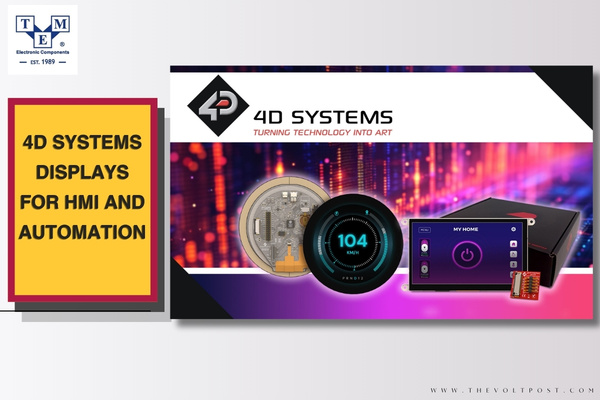
In modern electronic equipment, the display serves one of the most important functions. It provides users with information about system status, measurement results, operating parameters, as well as any faults or issues that may occur. If the display is additionally equipped with a touch panel, it also becomes a convenient means of control.
In practice, it can replace an array of buttons, switches and indicators, simplifying the overall design. It is also worth noting that a properly integrated display can improve ergonomics, operating speed and ease of configuration. This is important not only in consumer equipment, but also in building automation, measuring instruments, industrial systems, laboratory equipment and IoT solutions.
Modern designs increasingly employ intelligent display modules that integrate a display, microcontroller, memory and communication interfaces, and, in many variants, a touch panel as well. As a result, they can handle a significant portion of the tasks associated with graphics rendering and user interface operation. One example of this approach is the range of 4D Systems solutions available from TME.
Displays with ESP32-P4 Processor
One of the latest additions to the 4D Systems portfolio is a series of displays based on the ESP32-P4 processor from Espressif, a well-established name in the industry.
The range includes unconventional round displays with 3.4-inch and 4-inch diagonals, as well as large-format 7-inch, 8-inch, 9-inch and 10.1-inch widescreen modules.
Depending on the specific model, display resolutions are 800×800, 720×720 or 1280×800 pixels. IPS panels provide wide viewing angles, while high brightness levels of up to 1000cd/m2 ensure good readability in brightly lit environments.
Displays with ESP32-P4 microcontroller
The ESP32-P4 features 32MB of Flash memory and 32MB of PSRAM, providing sufficient capacity for extensive application code and graphical assets without requiring external memory.
If additional storage is needed, data can also be stored on a microSD card. The module additionally provides numerous GPIO lines, UART, SPI and I2C interfaces, as well as analog inputs and PWM outputs.
The design also supports the implementation of a MIPI-CSI camera interface, an additional real-time clock, a USB-C port and an I2S audio path with an amplifier, allowing a speaker to be connected directly. Wi-Fi and Bluetooth connectivity requires an additional ESP32-C6 expansion module. This dedicated add-on board is designed to connect directly to the rear of ESP32-P4 series display modules.
The ESP32-P4 series is particularly well suited to applications requiring high resolution, smooth graphics rendering and sophisticated user interfaces. Typical applications include machine control panels, laboratory equipment, building automation systems and multimedia device interfaces.
The round variants additionally enable the development of modern controllers, indicators and control panels inspired by conventional analog instruments.
GEN4-ULCD DISPLAYS
The gen4-uLCD range is one of the core display series offered by 4D Systems. It includes modules with screen sizes ranging from 2.4 inches to 7 inches and resolutions from 240×320 to 800×480 pixels.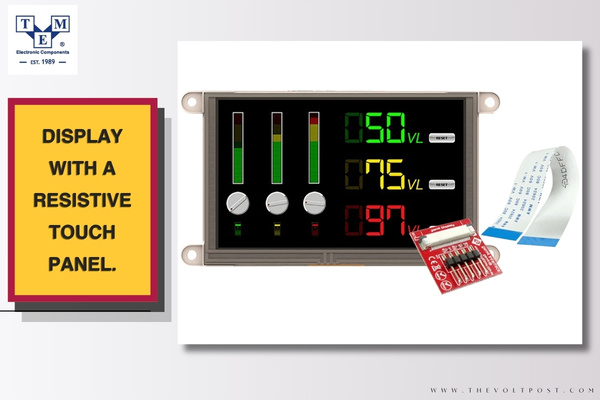
Depending on the model, variants are available without touch functionality, with resistive or capacitive touch panels, as well as versions featuring an integrated bezel. Resistive touch panels are particularly suitable where devices need to be operated using a stylus or while wearing gloves, whereas capacitive touch panels provide an operating experience familiar from modern mobile devices.
At the heart of a significant portion of the series is the DIABLO16 graphics processor from 4D Labs. It handles direct display control, text and graphics rendering, animation playback and touch-panel operation.
In addition, built-in GPIO and communication interfaces, analog inputs, PWM support and a microSD card slot allow the display to interface with sensors, actuators and other electronic components within the device. Depending on the model, the display may alternatively be powered by the PICASO processor.
The broad selection of sizes and configurations makes this the most versatile family in the 4D Systems portfolio. These modules can be used in controllers, measuring instruments, access control systems and automation equipment, as well as in prototypes where rapid development of a functional device is required.
4Discovery Displays
The 4Discovery series takes a somewhat different approach to display design. These displays are housed in an aesthetically designed enclosure suitable for wall mounting or integration into an equipment housing.
The range includes models with 3.5-inch and 5-inch screens. The smaller 4Discovery-35 features a 480×320-pixel display and a resistive touch panel.
Among other applications, it has been designed for installation in standard electrical wall boxes commonly used for wiring accessories. This makes it suitable for use as a controller for lighting, temperature, access control and other building automation functions.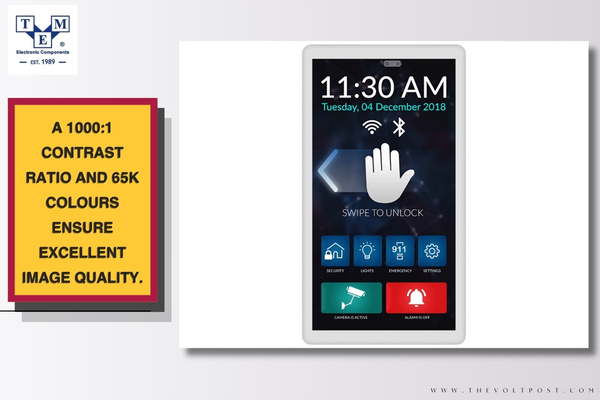
The 5-inch models feature a portrait-oriented IPS display with a resolution of 480×854 pixels and a capacitive touch panel. They can also be equipped with a proximity sensor, which can be used to wake the display when a user approaches the device.
Versions with light-coloured or black enclosures are available, while selected variants designated with the letter W also support Wi-Fi and Bluetooth connectivity.
RS485 is the primary wired interface used in this series. Two RJ45 connectors on the 5-inch versions make it easy to daisy-chain the bus between multiple devices.
RS485 is well suited to building and industrial automation applications because it supports communication over relatively long distances and allows multiple devices to share a single bus. Depending on the system architecture, the panel can operate as either a master or slave device.
The DIABLO16 processor handles the user application, while data and multimedia content can be stored on an external microSD card.
The combination of a touch display, enclosure, RS485 interface and wireless connectivity makes 4Discovery a suitable choice for applications where functionality, appearance and ease of installation are all important.
Typical applications include lighting, air-conditioning and heating control, access control systems, smart building installations and distributed energy monitoring systems.
GEN4-RP2350 DISPLAYS
The gen4-RP2350 series combines an intelligent display architecture with the RP2350 microcontroller developed by Raspberry Pi.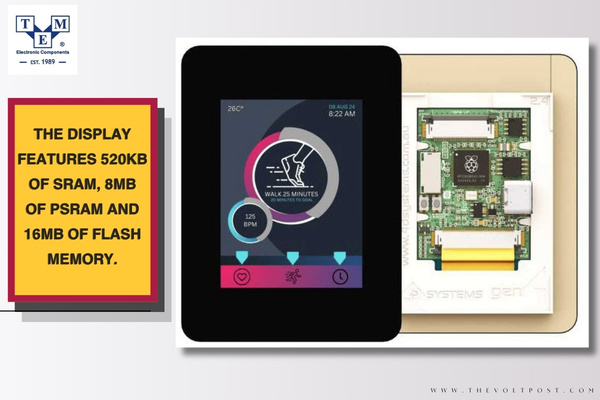
The family includes displays ranging from 2.4 inches to 9 inches, with resolutions from 240×320 to 800×480 pixels.
Depending on the model, users can choose between non-touch versions, resistive or capacitive touch panels, and capacitive variants with an integrated display bezel.
The Raspberry Pi RP2350 microcontroller offers the unusual ability to select the processor architecture at the development stage.
The device incorporates two Arm Cortex-M33 cores and two Hazard3 RISC-V cores, with the system operating using either one of these core pairs. The device also features a range of security capabilities, including Arm TrustZone, hardware-based random number generation and hardware acceleration for selected cryptographic operations.
These capabilities can be particularly relevant in panels used for access control, network device configuration and other applications requiring protection of code and data.
The display modules are equipped with 520kB of internal SRAM, 16MB of Flash memory and 8MB of PSRAM. They also provide UART, SPI and I2C interfaces, PWM outputs, analog inputs, general-purpose GPIO, a USB-C connector and a microSD card reader.
A major advantage of this family is its compatibility with development tools and programming workflows familiar from the Raspberry Pi Pico platform, including the Raspberry Pi Pico SDK used with Visual Studio Code. Furthermore, this type of microcontroller can also be programmed using the Arduino IDE, which simplifies the prototyping process.
The gen4-RP2350 can be regarded as a middle ground between the conventional gen4-uLCD modules and the highest-performance ESP32-P4 family.
It offers considerable flexibility, a broad selection of display sizes and an accessible development environment, making it a suitable platform for measuring instruments, control panels, educational systems, prototypes and low-volume production of functional devices.

Transfer Multisort Elektronik (TME) is one of the world’s largest global distributors of electronic components, electrotechnical parts, workshop equipment, and industrial automation. The catalog includes over 1,500,000 products from 1,300 leading manufacturers. TME’s modern logistics centers in ?ód? and Rzgów (Poland), with a combined area of over 40,000m², ship nearly 6,000 packages daily to customers in more than 150 countries.
Source: TME