



For broadband operators, the transition to DOCSIS 4.0 has long felt like a financial trap delivering next-generation, multi-gigabit speeds usually means ripping out and replacing customer hardware en masse. Now, MaxLinear says it has a workaround. The company has unveiled Puma 9, an 8nm SoC designed to support DOCSIS 3.1, 3.1+, and 4.0 standards on a single platform.
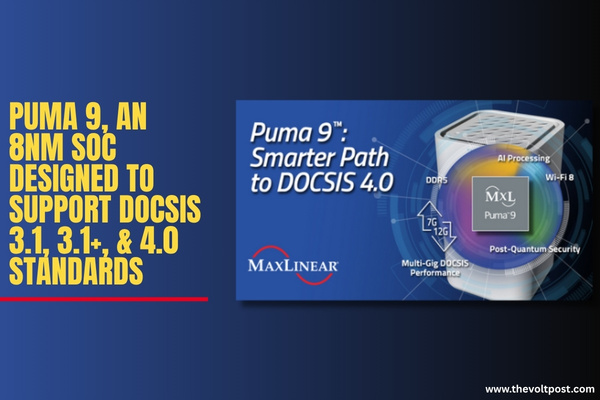
MaxLinear says it achieves this at cost parity with existing DOCSIS 3.1 equipment.
By turning the DOCSIS 4.0 migration into a software-driven, in-field upgrade, the platform essentially eliminates the need for expensive “truck rolls” and hardware swaps when operators are finally ready to flip the switch.
Solving the Upgrade Dilemma
Until now, operators have been caught in a bind. Rolling out DOCSIS 4.0 customer premises equipment (CPE) is notoriously expensive and requires grueling qualification cycles. As a result, many providers hold off on upgrading hardware until massive network overhauls are fully underway, stripping them of the agility to launch faster speeds in specific, highly competitive markets.
Puma 9 decouples the hardware lifecycle from the network upgrade cycle. Providers can deploy DOCSIS 4.0-ready gateways today at standard prices, preserving their capital while waiting to remotely unlock D3.1+ or D4.0 capabilities exactly when and where the business demands it.
Even without a full DOCSIS 4.0 network, operators can immediately squeeze more life out of their current infrastructure. In a DOCSIS 3.1+ configuration, Puma 9 leverages five OFDM channels to push downstream speeds past 10 Gbps delivering a 12 Gbps, DOCSIS 4.0-like experience over existing 3.1 networks.
Future-Proofing: AI, Wi-Fi 8, and Quantum Security
Raw bandwidth is only half the battle. As home networks prepare for the heavy processing demands of Edge AI, personal AI services, and the upcoming Wi-Fi 8 standard, Puma 9 integrates a dedicated MaxAI™ Neural Processing Unit (NPU). This onboard intelligence helps manage quality of service (QoS) and optimizes network traffic on the fly, keeping latency low.
MaxLinear is also using the new platform to aggressively insulate operators from looming supply chain crunches and next-gen cyber threats.
Notably, Puma 9 is the industry’s first DOCSIS platform compatible with DDR5 memory. With major memory vendors rapidly phasing out DDR4, relying on older memory types introduces severe longevity risks for broadband equipment that is expected to stay in homes for years. The jump to DDR5 secures a much longer, more stable supply chain lifecycle.
On the security front, the chip is armed with Post-Quantum Cryptography (PQC) readiness. Built with a secure-by-design architecture, it ensures operators will stay compliant with strict upcoming cybersecurity frameworks across the globe, including the U.S. NIST IR 8425A and the EU’s Cyber Resilience Act.
Ultimately, MaxLinear is pitching Puma 9 as a way for broadband providers to stop constantly chasing hardware refresh cycles, allowing them to finally deliver the multi-gigabit, AI-driven home networks of the future without breaking the bank today.
Leadership Comment
“When planning their next-gen network and CPE upgrades, operators require flexibility above all else,” said Jeff Heynen, Vice President, Broadband Access and Home Networking, Dell’Oro Group. “Operators are looking to proactively manage their spending on next-gen upgrades, which is now becoming more of a focus because of the DDR supply situation. Having the flexibility to separate the timing of network and CPE spends, eliminating long SW qualification cycles with a single CPE platform that is backward and forward compatible, enabling CPE upgrade while meeting legacy CPE HW costs – all  these items materially lower operators’ deployment risk and capital expenses, and allow them to spend exactly where they need to be competitive.”
Operators are looking for a smarter path to DOCSIS 4.0—one that minimizes cost and risk while maximizing the value of today’s investments,” said Puneet Sethi, SVP & GM of MaxLinear’s Network Infrastructure and Carrier Business Unit. “Puma 9 significantly changes those economics to benefit operators and consumers. Operators can now deploy DOCSIS 4.0-ready equipment today without expanding their CPE budget allocation, enabling them to offer higher speeds to consumers who need it. Puma 9 also offers 12 Gbps in D3.1+ mode, which enables D4.0 experience over a D3.1 network, enabling operators to phase their network upgrade spend without compromising consumer experience.”
Availability
Puma 9 is currently available to broadband operators and OEM partners developing next-generation DOCSIS gateways and eMTA solutions. Additional product and partner announcements are expected throughout 2026.
To Know More: CLICK HERE