




By Abhishek Jadhav
Industrial electromechanical systems are becoming more compact and software defined. The functions that were previously handled by mechanical contacts, optical isolation, thermal fuses, and discrete power stages, are increasingly being implemented using semiconductor-based control, switching, coreless transformer isolation, and protection devices.
This is changing how engineers design these subsystems. Motor control timing, power path switching, isolation, and wire protection cannot be addressed as separate design issues. A motor board may need synchronized current sensing and PWM generation, while the same system may also require bidirectional power switching, isolated relay outputs, and electronic I2t protection with diagnostic feedback.
Infineon Technologies’ PSOC™ Control C3 microcontrollers, CoolGaN™ BDS 40 V G3 power devices, iSSI solid-state isolators, and BTG70008A-1ESW PROFET™ Wire Guard address different layers of the same design transition. Together, they show how electromechanical systems are moving from passive components and isolated protection blocks towards active, software-visible semiconductor control of motion, power, isolation, and wiring protection.
Advanced real-time processing with PSOC™ Control C3
At the center of any modern integrated system is the control unit. It must manage high-speed peripherals with deterministic, low-latency execution. The Infineon PSOC™ Control C3 microcontrollers (Figure 1) are designed for motor control and power conversion applications.
They are based on a 32-bit Arm® Cortex®-M33 core operating up to 180 MHz. The architecture supports the high performance required to manage WBG power stages and complex control algorithms like Field-Oriented Control (FOC).
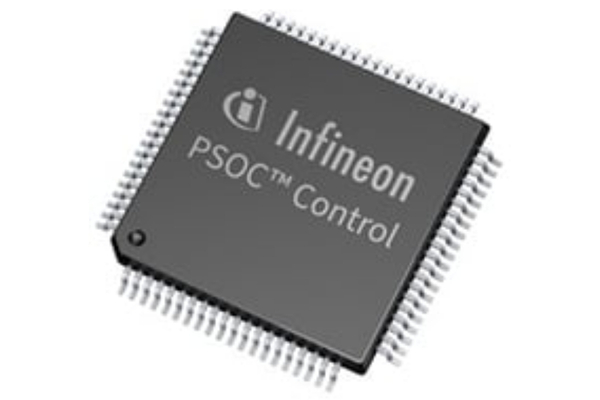
The highlight of the product is its integrated Coordinate Rotation Digital Computer (CORDIC) accelerator, a dedicated math engine that offloads rotation and trigonometric calculations, such as the Park and inverse Park transforms. By executing these rotations in hardware, the CORDIC unit frees the main CPU to manage other tasks, such as state-machine logic, communication protocols, or diagnostics.
This is complemented by an integrated floating-point unit (FPU) and digital signal processor (DSP) instructions within the Cortex-M33 core. For example, a dual-motor FOC algorithm combined with an active power factor correction (PFC) stage can operate with a total CPU load of less than 50 percent in certain applications.
The bridge between the digital control algorithm and the gate drivers of the power stage is the Timer/Counter Pulse-Width Modulator (TCPWM) peripheral. In the PSOC™ Control C3 family, the TCPWM resource has sixteen 16-bit and four 32-bit timers capable of generating complementary PWM outputs with programmable dead-time insertion. For advanced high-frequency topologies and systems using WBG (SiC and GaN) power devices, standard PWM resolution may be insufficient.
High-frequency switch-mode power converters and motor drives operating in the hundreds of kilohertz or megahertz range require control over the duty cycle to maintain voltage and current regulation. Standard PWM peripherals have a timing resolution limited by the clock period. At a switching frequency of 500 kHz, a 5.56 ns step size represents a relatively large percentage of the total switching period.
This leads to a limit cycle oscillation where the controller jumps between discrete duty cycles and generates low-frequency voltage ripple and output noise. The PSOC™ Control C3 Main Line addresses this limitation by incorporating a high-resolution PWM (HRPWM) peripheral capable of sub-80 ps timing resolution.
Infineon also provides the ModusToolbox™ Motor Suite with motor control code examples, configuration tools, and parameter-tuning support. It allows engineers to configure the synchronous ADC sampling, CORDIC math engine, and TCPWM peripherals through a GUI.
The Infineon PSOC™ Control C3 is PSA Certified Level 2, meaning the MCU contains a hardware-isolated Root of Trust and can defend against software-based attacks. The device incorporates a cryptographic accelerator that supports NIST P-256 elliptic-curve cryptography and a true random number generator (TRNG).
High-frequency power switching with CoolGaN™
In low-voltage electromechanical and embedded power paths where board area, switching loss, and reverse-current control matter, wide-bandgap devices can help reduce losses and increase power density.
The Infineon CoolGaN™ bidirectional switch (BDS) 40 V G3 family leverages these properties to address the common design challenge of creating a compact, efficient bidirectional switch.
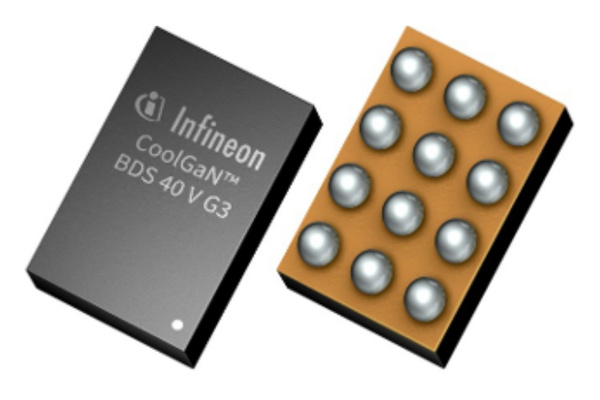
A CoolGaN™ BDS (Figure 2) is a monolithic device that integrates two GaN switches in a common drain, dual-gate architecture to provide four-quadrant operation in a single component. The integration has a significant reduction in solution size, with Infineon reporting a footprint decrease up to 82 percent and a halving of the component count compared to equivalent back-to-back Si MOSFET solutions.
However, the adoption of GaN technology introduces design tradeoffs that engineers must manage. The extremely high switching speeds make these devices highly sensitive to PCB layout. Parasitic inductance in the power loop and gate-drive loop can cause voltage overshoot, ringing, and instability in a GaN circuit.
Minimizing this inductance requires careful layout practices, such as keeping the gate drive loop as short and wide as possible, minimizing common source inductance through optimized via placement, and using compact packages like the WLCSP in which the CoolGaN™ BDS devices are offered.
In addition, the gate of an e-mode GaN HEMT has a lower threshold voltage and tighter maximum voltage tolerance compared to Si MOSFETs. This requires a precise and clean gate drive signal to prevent damage or spurious turn-on.
To ease this transition, the CoolGaN™ BDS family is designed to be compatible with standard 5V gate drivers to allow designers to leverage existing layouts and reduce redesign efforts.
Robust galvanic isolation with iSSI coreless transformer
In electromechanical systems where high-voltage power electronics coexist with low-voltage digital control, robust galvanic isolation is required for operational integrity.
For years, optocouplers have been the default solution, comprising an LED and a photodetector to transmit signals across an insulation barrier. However, this technology has drawbacks in modern high-performance systems. The underlying GaAs technology suffers from aging effects where the current transfer ratio (CTR) degrades over time.
The Infineon iSSI (integrated solid-state isolator) family (Figure 3) addresses these challenges by replacing the optical methods with proprietary coreless transformer technology. The architecture allows Infineon to create an isolation barrier with ratings up to 5.7 kV RMS and a maximum transient isolation voltage of 8000 V.
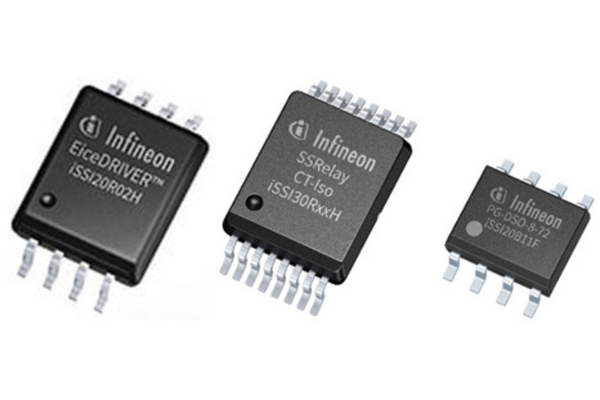
The iSSI family combines isolation, gate-drive energy transfer, and the features needed to build protected solid-state relay circuits. Its overcurrent protection (OCP) uses a current-sense input that compares a sensed voltage to a typical internal threshold of about 200 mV. When the threshold is exceeded, the device triggers a latched fault response with fast turn-off.
The iSSI20R0xH and iSSI20BxxF series are offered in compact 8-pin packages, while the iSSI30RxxH devices use a 16-pin package to support additional functions such as separate current-sense and temperature-sense inputs and dynamic Miller clamp pins.
Intelligent protection and distribution with the PROFET™ eFuse
Traditional power systems with centralized fuse boxes and electromechanical relays are poorly suited for modern systems. Mechanical fuses are slow, imprecise, one-time-use devices that are incapable of providing the required diagnostic feedback. Relays are bulky, suffer from mechanical wear, and generate acoustic noise and EMI.
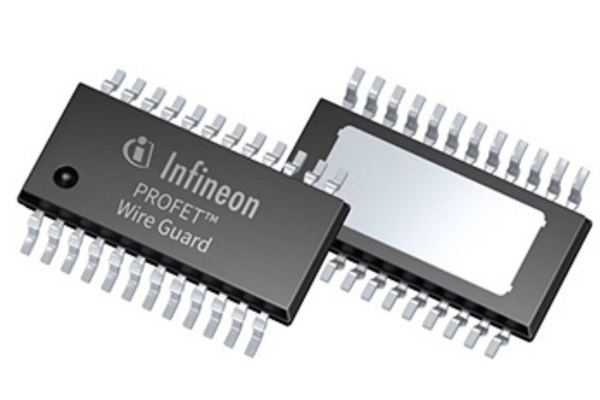
The BTG70008A-1ESW (Figure 4) from Infineon’s PROFET™ (Protected High-Side Power Switch) Wire Guard series is designed to replace these legacy components with a highly integrated, intelligent electronic fuse (eFuse). This device can be integrated as a smart high-side power switch that combines control, diagnostics, and advanced protection in a single AEC-Q100 qualified package.
The most critical feature of the BTG70008A-1ESW is its hardware-based I2t wire protection. The PROFET™ Wire Guard emulates the thermal characteristics of a connected wire harness, offering six selectable curves that can be chosen to match its gauge and thermal tolerance.
This protection remains active even if the main microcontroller is in a reset or standby state, providing a fail-safe mechanism. It allows for optimized wire harness design and potentially reduces copper weight, while ensuring that the wire is protected across a wide range of fault conditions, including transient inrush currents and sustained overloads.
The BTG70008A-1ESW provides an adjustable overcurrent threshold through an external resistor. When a hard short-circuit occurs, it can isolate the fault in microseconds. This rapid response prevents the fault from causing a voltage drop on the main power bus, which could otherwise lead to an undervoltage reset of critical ECUs.
It is documented as an ISO 26262 safety element out of context for safety requirements up to Automotive Safety Integrity Level (ASIL) D. The PROFET™’s predictable failure modes, integrated protection mechanisms, and diagnostic feedback capabilities are essential for creating a safety-critical system.
Conclusion
Electromechanical design now requires a more integrated approach. The motor, relay, fuse, isolator, power switch, and controller are part of a coordinated control and protection architecture.
As systems continue to become smaller and more power-dense, engineers need semiconductor devices that can improve timing accuracy, switching efficiency, isolation reliability, and fault response.
Infineon solves these challenges at different design layers through PSOC™ Control C3, CoolGaN™ BDS 40 V G3, iSSI solid-state isolators, and PROFET™ Wire Guard.
Source: DigiKey