





Deploying AI inference into power constrained, mission critical environments like aerospace and defense systems demands a careful balance of performance, efficiency, reliability and development simplicity. Microchip Technology is targeting that intersection with the release of its VectorBlox 3.0 Accelerator Software Development Kit (SDK), designed to make FPGA based AI implementation more straightforward and faster to bring to market.
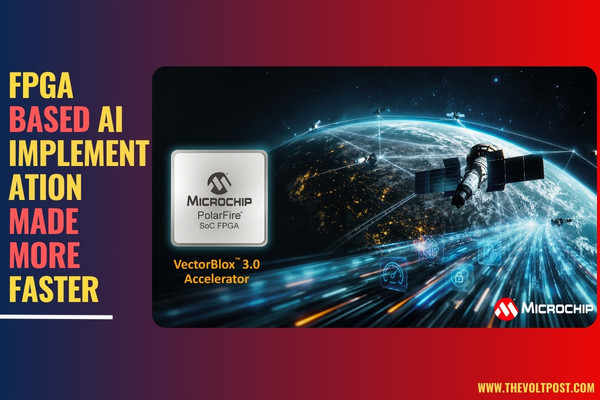
Offered free of charge, the updated VectorBlox 3.0 SDK and the associated CoreVectorBlox IP are packaged as an integrated toolchain for PolarFire® FPGA and SoC platforms.
Instead of combining multiple tools, developers can use VectorBlox to handle optimization, compilation and deployment of convolutional neural network (CNN) models end to end. Because the accelerator scales efficiently across model sizes and can handle multiple AI workloads on a single device, customers can consolidate several vision or sensor driven AI functions onto one low power FPGA, saving both board space and power budget.
One of the headline capabilities in VectorBlox 3.0 is support for sparse neural networks. By skipping zero valued operations, the SDK helps CNN based vision models execute more efficiently, boosting inference performance while reducing power consumption.
That is particularly important for always on edge AI use cases that have to stay responsive without blowing through tight energy constraints. Sparsity driven model compression is intended to cut compute and memory requirements while maintaining model accuracy, giving designers more headroom on mid range FPGA devices.
Microchip is also highlighting domain specific capabilities through Spacecraft Pose Network v2 (SPNv2), a neural network designed to estimate position and orientation using vision data.
SPNv2 underpins autonomous navigation and proximity operations in space, supporting scenarios such as autonomous rendezvous and docking, space debris removal, satellite inspection and formation flying.
Built on mid range, power efficient, single event upset (SEU) immune PolarFire FPGAs and SoCs, the solution combines AI acceleration with secure boot, anti tamper protection and high reliability for harsh operating conditions.
That security and robustness story is central for mission critical defense, aerospace and industrial deployments where long operational lifetimes, data protection and system resilience are non negotiable.
By integrating VectorBlox 3.0’s AI acceleration and sparsity support to PolarFire’s low power, radiation tolerant and security focused architecture, Microchip is positioning its FPGA platforms as a compelling fit for next generation edge AI systems that cannot afford to fail.
Leadership Comment
“As AI models continue to grow in complexity, compression is becoming essential for deploying intelligence at the edge,” said Shakeel Peera, corporate vice president and GM of Microchip’s FPGA business unit. “With VectorBlox 3.0, we’re leveraging sparsity-based model compression from our Neuronix acquisition to reduce compute demands while preserving accuracy.”
 Testimonials
“Leveraging VectorBlox acceleration on Microchip’s PolarFire SoC enabled us to efficiently deploy advanced onboard AI pipelines for low-latency payload operations in orbit,” said Vito Fortunato, SPACEDGE™ services line manager at Planetek Italia. “The platform allowed us to validate real-time Earth Observation processing capabilities including object detection, semantic scene analysis and edge-generated actionable information products on top of the AI-eXpress-1 satellite, deployed in 2025, while providing the radiation resilience and operational reliability required for continuous Low Earth Orbit operations.”
“The combination of PolarFire SoC and VectorBlox creates a powerful synergy for deploying AI-powered autonomy solutions directly in orbit,” said Federico Fontana, Head of Hardware Engineering at AIKO. “We validated this through the deployment of our clear_CHARLES suite, which provides onboard cloud and ship detection for adaptive and autonomous payload operations on power-efficient platforms, making a further step toward increasingly autonomous, responsive and software-defined space systems.”
VectorBlox SDK v3.0 is supported by Microchip’s Libero® SoC Design Suite and integrates with CoreVectorBlox IP. Visit the website to learn more about the company’s full portfolio of FPGAs and design resources.
Pricing and Availability
VectorBlox SDK v3.0 and CoreVectorBlox IP are available to customers at no charge. To learn more, contact a Microchip sales representative or authorized worldwide distributor.